
(To see other currencies, click on price)
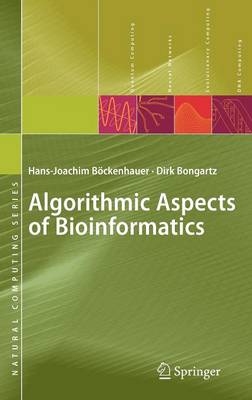
MORE ABOUT THIS BOOK
Main description:
Advances in bioinformatics and systems biology require improved computational methods for analyzing data, while progress in molecular biology is in turn influencing the development of computer science methods. This book introduces some key problems in bioinformatics, discusses the models used to formally describe these problems, and analyzes the algorithmic approaches used to solve them.
After introducing the basics of molecular biology and algorithmics, Part I explains string algorithms and alignments; Part II details the field of physical mapping and DNA sequencing; and Part III examines the application of algorithmics to the analysis of biological data. Exciting application examples include predicting the spatial structure of proteins, and computing haplotypes from genotype data.
This book describes topics in detail and presents formal models in a mathematically precise, yet intuitive manner, with many figures and chapter summaries, detailed derivations, and examples. It is well suited as an introduction into the field of bioinformatics, and will benefit students and lecturers in bioinformatics and algorithmics, while also offering practitioners an update on current research topics.
Feature:
Introduces some key problems in bioinformatics
Discusses the models used to formally describe these problems
Analyzes the algorithmic approaches used to solve these key problems
Features exciting application examples
Presents formal models in a mathematically precise, yet intuitive manner
Back cover:
Advances in bioinformatics and systems biology require improved computational methods for analyzing data, while progress in molecular biology is in turn influencing the development of computer science methods. This book introduces some key problems in bioinformatics, discusses the models used to formally describe these problems, and analyzes the algorithmic approaches used to solve them.
After introducing the basics of molecular biology and algorithmics, Part I explains string algorithms and alignments; Part II details the field of physical mapping and DNA sequencing; and Part III examines the application of algorithmics to the analysis of biological data. Exciting application examples include predicting the spatial structure of proteins, and computing haplotypes from genotype data.
This book describes topics in detail and presents formal models in a mathematically precise, yet intuitive manner, with many figures and chapter summaries, detailed derivations, and examples. It is well suited as an introduction into the field of bioinformatics, and will benefit students and lecturers in bioinformatics and algorithmics, while also offering practitioners an update on current research topics.
Contents:
and Basic Algorithms.- Basics of Molecular Biology.- Basic Concepts: Strings, Graphs, and Algorithms.- String Algorithms.- Alignment Methods.- DNA Sequencing.- and Overview.- Physical Mapping.- DNA Sequencing.- Analyzing Biological Data.- Finding Signals in DNA Sequences.- Genome Rearrangements.- Phylogenetic Trees.- Haplotyping.- Higher-Dimensional Structures of Biomolecules.
PRODUCT DETAILS
Publisher: Springer (Springer Berlin Heidelberg)
Publication date: April, 2007
Pages: 396
Weight: 771g
Availability: Not available (reason unspecified)
Subcategories: Biochemistry
Publisher recommends
From the same series

CUSTOMER REVIEWS
From the reviews:
"This book is a worthy leader in what will surely be a torrent of high-level texts inspired by the success of DNA containing genetic instructions. … this book is a highly recommended compendium of applications for geneticists and computer scientists. … The computer science theory is developed in this text with … numerous simple illustrations from DNA." (Harvey Cohn, ACM Computing Reviews, Vol. 49 (12), December, 2008)