
(To see other currencies, click on price)
MORE ABOUT THIS BOOK
Main description:
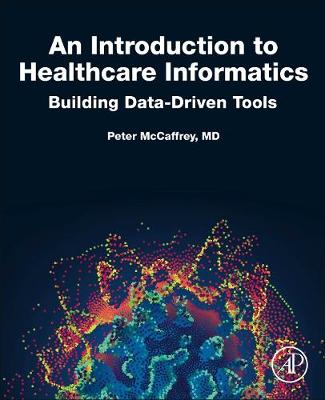
An Introduction to Healthcare Informatics: Building Data-Driven Tools bridges the gap between the current healthcare IT landscape and cutting edge technologies in data science, cloud infrastructure, application development and even artificial intelligence. Information technology encompasses several rapidly evolving areas, however healthcare as a field suffers from a relatively archaic technology landscape and a lack of curriculum to effectively train its millions of practitioners in the skills they need to utilize data and related tools.
The book discusses topics such as data access, data analysis, big data current landscape and application architecture. Additionally, it encompasses a discussion on the future developments in the field. This book provides physicians, nurses and health scientists with the concepts and skills necessary to work with analysts and IT professionals and even perform analysis and application architecture themselves.
Contents:
Section 1: Storing and Accessing Data 1. The Healthcare IT Landscape 2. Relational Databases 3. SQL
4. Example Project 1: Querying Data with SQL 5. Non-Relational Databases 6. M/MUMPS
Section 2: Understanding Healthcare Data 7. How to Approach Healthcare Data Questions 8. Clinical and Administrative Workflows: Encounters, Laboratory Testing, Clinical Notes, and Billing 9. HL-7 and FHIR, and Clinical Document Architecture 10. Ontologies, Terminology Mappings and Code Sets
Section 3: Analyzing Data 11. A Selective Introduction to Python and Key Concepts 12. Packages, Interactive Computing, and Analytical Documents 13. Assessing Data Quality, Attributes, and Structure 14. Introduction to Machine Learning: Regression, Classification, and Important Concepts 15. Introduction to Machine Learning: Support Vector Machines, Tree-Based Models, Clustering, and Explainability 16. Computational Phenotyping, and Clinical Natural Language Processing 17. Example Project 2: Assessing and Modeling Data
18. Introduction to Deep Learning and Artificial Intelligence
Section 4: Designing Data Applications 19. Analysis Best Practices 20. Overview of Big Data Tools: Hadoop, Spark and Kafka 21. Cloud Technologies
PRODUCT DETAILS
Publisher: Elsevier (Academic Press Inc)
Publication date: July, 2020
Pages: 350
Weight: 680g
Availability: Available
Subcategories: Public Health