
(To see other currencies, click on price)
MORE ABOUT THIS BOOK
Main description:
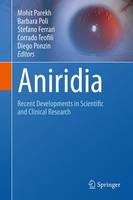
The aim of this book is to highlight the latest findings in Aniridia research. Aniridia, meaning "without iris", is a rare genetic disorder affecting vision, characterized by the incomplete formation of the iris (the coloured part of the eye that surrounds the black pupil). It may also cause other segments of the eye to be under-developed such as the optic nerve and the macula (the central part of the retina). Aniridia and associated conditions affect individuals differently. So while some affected people are partially sighted or blind, others may have near normal sight. Aniridia is congenital (present at birth) and is caused by a dysfunction of the PAX6 gene, situated on the 11th chromosome that causes the premature cessation of eye development. Aniridia affects between 1:40,000 to 1:100,000 people, and affects males and females equally. People with Aniridia may also experience secondary conditions such as Photophobia, Nystagmus, Glaucoma, Cataracts and Keratopathy.
Contents:
Preface
What is Aniridia: Epidemiology, clinical features and genetic implications
Giuseppe Damante and Angela Valentina D'Elia Introduction
Optical Coherence Tomography imaging in patients with PAX6 mutations
Mervyn G Thomas and Irene Gottlob
Aniridic Glaucoma: Diagnosis and Treatment
Marchini G, Toscani M, Vizzari G
Management of Glaucoma in Congenital Aniridia
Peter A. Netland
Clinical and surgical management of cataract in congenital aniridia
Dominique Bremond-Gignac
The ocular surface in aniridia
Paolo Rama, Maurizia Vigano, and Karl Anders Knutsson
Aniridic Keratopathy: Conservative approaches
Dr. Santiago Lopez Garcia-Dra Isabel Garcia Lozano
Lamellar and penetrating keratoplasty in congenital aniridia
Sandra Planella, Maria Fideliz de la Paz, Juan Alvarez de Toledo
Boston KPRoType I as a viable alternative to visual rehabilitation in aniridia patients: advances and limitations
Samantha Williamson, Kimberly Hsu, Jose de la Cruz
Cell therapy for regeneration of the corneal epithelium aniridic patients
JT Daniels, SJ Tuft and AJ Shortt
Strategies for success in limbal allograft transplantation for aniridia
Omar Hassan and Ali R Djalilian
The paediatric patient: identifying congenital aniridia as soon as possibleElena Piozzi and Davide Allegrini
Early diagnosis: the key roles of neonatologists, paediatricians and paediatric ophthalmologists
Kristina Tornqvist
Aniridia guides and aniridia-syndrome (Pax6-Syndrome)
Barbara Kasmann-Kellner, Arne Viestenz, Berthold Seitz
Assessing the visual function in congenital aniridia and following the child during daily life
Luisa Pinello
Children with aniridia and healthcare systems: from needs assessment to a comprehensive programme of care and assistance
Mazzucato M, Manea S, Minichiello C, Bua M, De Lorenzi M, Facchin P
European/international guidelines on Aniridia: the patients' point of view
Barbara Poli, Rosa Sanchez de Vega, Corrado Teofili
What to do when diagnosed with Aniridia: the role of patients associations
Jill A Nerby
Conclusions and future perspectives
Tor Paaske Utheim
Index
PRODUCT DETAILS
Publisher: Springer (Springer International Publishing AG)
Publication date: September, 2015
Pages: 200
Weight: 4624g
Availability: Available
Subcategories: General Issues, Ophthalmology and Optometry