
(To see other currencies, click on price)
MORE ABOUT THIS BOOK
Main description:
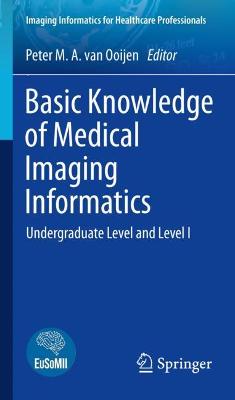
This book provides a unique introduction to the vast field of Medical Imaging Informatics for students and physicians by depicting the basics of the different areas in Radiology Informatics. It features short chapters on the different main areas in Medical Imaging Informatics, such as Picture Archiving and Communication Systems (PACS), radiology reporting, data sharing, and de-identification and anonymization, as well as standards like Digital Imaging and Communications in Medicine (DICOM), Integrating the Health Enterprise (IHE) and Health Level 7 (HL7,.
Written by experts in the respective fields and endorsed by the European Society of Medical Imaging Informatics (EuSoMII) the scope of the book is based on the Medical Imaging Informatics sub-sections of the European Society of Radiology (ESR) European Training Curriculum Undergraduate Level and Level I.
This volume will be an invaluable resource for residents and radiologists and is also specifically suited for undergraduate training.
Contents:
1. From Physical Film to PACS
Peter van Ooijen
How the transition went from the use of physical film to the PACS environment. What are the basic components of a PACS.
2. The essence of HL7, DICOM, and IHE
Peter Mildenberger
What is the essence of the most important standards in the imaging domain, HL7, DICOM and IHE. What are they used for and what are the basic and most important building blocks
3. Development of Radiology Reporting
Daniel Pinto dos Santos
How did radiology reporting develop from dictation and typists to full-blown voice recognition. What are the components involved, what problems can you run into with such systems? What is the role of structured reporting.
4. Basic Imaging Workflow
Elmar Kotter
What does the imaging workflow look like both within radiology and beyond. What kind of communication is involved. Where are the previously described standards used. How does PACS and RIS/EPD driven workflow differ?
5. Diagnostic displays
Erik Ranschaert
What are requirements for diagnostic displays? How are they checked? What is the role of the DICOM standard in this? What about the use of mobile device screens?
6. Advanced Visualization Basics
Angel Alberich-Bayarri
The basics of advanced visualization including examples and discussion about the different technical implementations (server and client based rendering, web based, CPU/GPU etc)
7. Sharing imaging data
Erik Ranschaert
How are data shared within the enterprise and outside. What are the caveats. What is the role of mobile devices.
8. De-identification and anonymization
Peter van Ooijen
How can imaging data be prepared for use in (clinical) research by de-identification and anonymization. What is the role of the standards? What kind of tools can be used?
9. New and upcoming technologies
All authors contribute
New technologies such as AR/VR, 3D Printing and Artificial Intelligence are changing the role of radiology. What is going on and how are they going to change the field.
PRODUCT DETAILS
Publisher: Springer (Springer Nature Switzerland AG)
Publication date: May, 2021
Pages: None
Weight: 454g
Availability: Available
Subcategories: General Issues, Radiology