
(To see other currencies, click on price)
MORE ABOUT THIS BOOK
Main description:
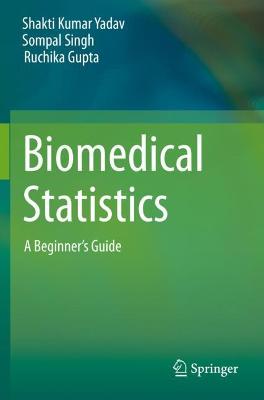
This book is written in a very easy-to-follow format, and explains the key concepts of biomedical statistics in a lucid yet straightforward manner. It explains how mathematical and statistical tools can be used to find answers to common research questions. In addition, the main text is supplemented by a wealth of solved exercises and illustrative examples to aid in comprehension.
Given its content, the book offers an invaluable quick reference guide for graduating students and can be very helpful in their examination process. At the same time, it represents a handy guide for medical and paramedical teachers, post-graduate medical students, research personnel, biomedical scientists and epidemiologists.
Contents:
Section I Introduction
Chapter 1. Applications of Statistics
Chapter 2. Statistical Terms
Descriptive Statistics
Inferential Statistics
Chapter 3. Data Types
Categorical Data
Numerical Data
Chapter 4. Data Classification
Classification of numerical data
Classification of categorical data
Chapter 5. Data Presentation
Pictogram
Pie Diagram
Bar diagram
Line diagram
Histogram
Frequency polygon
Ogive curves
Scatter Diagram
Regression line
Box and whiskers plot:
Chapter 6. Measures of Central Tendency
Mean
Median
Mode
Chapter 7. Measures of Location
Percentile
Decile
Quartile
Chapter 8. Measures of Dispersion
Range
Interquartile Range
Coefficient of quartile deviation
Mean Deviation
Mean square deviation
Variance and standard deviation
Coefficient of variance
Skewness
Kurtosis
Chapter 9. Sampling Methods
Sampling Process
Without replacement (WOR) vs with replacement (WR)
Probability Sampling
Non-probability sampling
Section II Tests for Inference
Chapter 10. Statistical Distribution- Continuous
Normal distribution
Standard normal distribution:
Student t-distribution:
Chi-square distribution:
F-distribution:
Chapter 11. Sampling Distribution and Hypothesis testing
Confidence interval:
Difference in means
Concept of Z-statistics
Hypothesis Testing:
Chapter 12. Test of Inference- One Sample or two sample mean
One sample:
Two sample:
Test for homogeneity of variance
Two small sized sample- Test for inference:
Test for inference of paired samples:
Chapter 13. Test for Inference- Multiple sample comparisons
Concept of sum of squares:
ANOVA one way
ANOVA two way
Chapter 14. Test for Inference- Categorical Data I
Tabulation of categorical data
Testing for significance of individual proportion
Testing for significance of difference between two proportions
Chapter 15. Test for Inference- Categorical Data II
1xC tables
RxC Table
2x2 table
Chapter 16. Test for Inference- Correlation and Regression
Pearson's correlation coefficient
Test for the significance of r:
Regression analysis
Chapter 17. Sample Size Estimation
Sample size for assessing significance of single mean:
Sample size for assessing significance of single proportion:
Sample size for assessing significance of two means:
Sample size for assessing significance of two proportion:
Sample size for correlation coefficient:
Sample size for sensitivity and specificity:
Sample size for univariate logistic regression:
Relative risk
Sample size to assess significance to two incidences in a cohort study
Sample size for case control and cohort studies:
Sample size for finite population:
Chapter 18. Epidemiological Studies
Cohort Study:
Case Control Study:
Sources of errors in epidemiological studies:
Designing study and writing a study report:
Chapter 19. Analysis of Diagnostic Test
Sensitivity (Sn):
Specificity (Sp):
Positive predictive value (PPV):
Negative predictive value (NPV):
Accuracy:
Section III Demography and Life Tables
Chapter 20. Demography
Utility of demographic data:
Demographic publications in India are available from:
Sources of demographic data:
Stages of life:
Chapter 21. Measures of Demography
Measures of Population:
Measures of fertility and reproduction:
Measures of Morbidity:
Measures of Mortality:
Measures related to population control:
Measures of health:
Chapter 22. Infectious Disease Epidemiology
Primary attack Rate:
Secondary attack rate (SAR):
Case fatality rate (CFR):
Cause specific mortality rate (CSMR):
Infection rate (IR):
Chapter 23. Life Tables
Simplified example:
Section IV Concept of Probability
Chapter 24. Introduction to Probability
Axiomatic Approach using set function
Definitions:
Theorems of Probability
Chapter 25. Random Variable and Mathematical Expectation
Chapter 26. Statistical Distribution- Discrete
Binominal Distribution:
Appendix
Index
PRODUCT DETAILS
Publisher: Springer (Springer Verlag, Singapore)
Publication date: December, 2020
Pages: 287
Weight: 480g
Availability: Available
Subcategories: General Issues, Public Health