
(To see other currencies, click on price)
MORE ABOUT THIS BOOK
Main description:
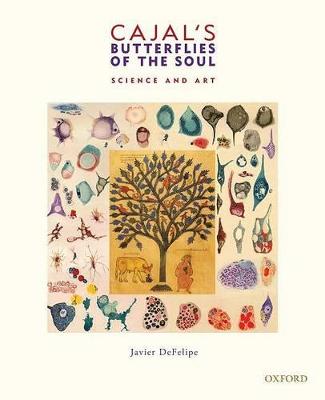
This book contains a large collection of beautiful figures produced throughout the nineteenth century and the beginning of the twentieth century and that represent some characteristic examples of the early days of research in neuroscience. The main aim of this work is to demonstrate to the general public that the study of the nervous system is not only important for the many obvious reasons related to brain function in both health and disease, but also for the
unexpected natural beauty that it beholds. This beauty has been discovered thanks to the techniques used to visualize the microscopic structure of the brain, a true forest of colourful and florid neural cells. As illustrated by his marvellous drawings, the studies of Santiago Ramon y Cajal (1852-1934) no
doubt contributed more than those of any other researcher at the time to the growth of modern neuroscience. Thus, we have honored his name in the title of this book, even though the figures contained in the main body of the book are from 91 authors. Looking at the illustrations in this book the readers will not only marvel at Cajal's drawings but they will also find that many of the other early researchers that studied the nervous system were also true artists, of considerable talent and
aesthetic sensibility. Thus, the present book contains numerous drawings of some of the most important pioneers in neuroscience, including Deiters, Koelliker, Meynert, Ranvier, Golgi, Retzius, Nissl, Dogiel, Alzheimer, del Rio-Hortega and de Castro.
The book has been divided into two Parts, Part I and II, the latter containing the main body of the work. Part I contains introductory information that will give readers unfamiliar with the nervous system a better understanding of the importance of the scientific illustrations produced in those days. The second part of the book, Part II, contains the collection of 282 figures with the intention of transforming the reader into an observer. These illustrations have been divided in three main
categories: Section I, The Benedictine period: The early days; Section II, The black period: Neurons, glia and organization of the nervous system; Section III, The colourful period: internal structure and chemistry of the cells.
This book will be of general interest, not only due to the captivating aesthetic appeal of the illustrations but also because they represent the bases of our current understanding of the nervous system. The reader will find that many of the illustrations can be considered to belong to different artistic movements, such as modernism, surrealism, cubism, abstract art or impressionism. Indeed, these illustrations may also provide artists with a source of inspiration since they reveal a fantastic
and virtually unknown world of forms, a microuniverse with an aura of mystery.
Contents:
PART I: INTRODUCTION
INTRODUCTORY REMARKS
The beauties of the nervous system: neurons and glial cells
A note on the illustration.
A SKETCH HISTORY OF THE MICROSCOPIC ANATOMY OF THE NERVOUS SYSTEMBEFORE THE DISCOVERY OF THE "REAZIONE NERA"
SECTION 1 : THE BENEDICTINE PERIOD: THE EARLY DAYS
Globules, granules, corpuscles (nerve cells): key elements of the nervous system
Relationship between nerve cells and nerve fibers: development of microanatomical methods
The reticular theory
SECTION 2: THE BLACK PERIOD: NEURONS, GLIA AND ORGANIZATION OF THE NERVOUS SYSTEM
The discovery of the reazione nera
The Golgi method, Cajal, Maestre de San Juan and Simarro
Cajal's first study with the Golgi method: dendrites and axons end freely
The neuron doctrine and the law of dynamic polarization of nerve cells
Arrows in the illustrations: the direction of the nervous currents
SECTION 3: THE COLORFUL PERIOD: INTERNAL STRUCTURE AND CHEMISTRY OF THE CELLS
On the early use of selective colorants to study the nervous system
The first explosion of colors: normal and altered cytology of neural cells
The second explosion of colors: Fluorescence microscopy and confocal laser scanning microscopy
The third explosion of colors: the green fluorescent protein and the Brainbow
CLOSING COMMENTS ON BRAIN AND ART
BIBLIOGRAPHY
PART II: GALLERY OF DRAWINGS
SECTION 1. THE BENEDICTINE PERIOD: THE EARLY DAYS
FIGURE LEGENDS AND BIBLIOGRAPHY
SECTION 2. THE BLACK PERIOD: NEURONS, GLIA AND ORGANIZATION OF THE NERVOUS SYSTEM
FIGURE LEGENDS AND BIBLIOGRAPHY
SECTION 3. THE COLORFUL PERIOD: INTERNAL STRUCTURE AND CHEMISTRY OF THE CELLS
FIGURE LEGENDS AND BIBLIOGRAPHY
INDEX
PRODUCT DETAILS
Publisher: Oxford University Press (Oxford University Press Inc)
Publication date: November, 2009
Pages: 384
Dimensions: 235.00 x 288.00 x 21.00
Weight: 1538g
Availability: Available
Subcategories: Neurology, Neuroscience, Psychiatry