
(To see other currencies, click on price)
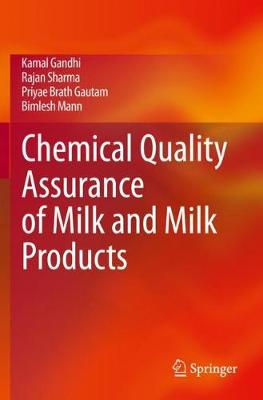
MORE ABOUT THIS BOOK
Main description:
This book discusses quality-related aspects of milk and milk products, covering the various analytical procedures for testing the quality and composition. It also describes the adulteration of milk and milk products and the common as well as advanced techniques used to detect such adulteration. Further, the book examines food laws, guidelines and regulations laid down by FSSAI, CODEX, ISO, IDF and USFDA, and addresses the functioning of a number of international and national organizations, including the WTO, Codex Alimentarius Commission, and BIS. Familiarizing readers with the concepts of QC, TQM, PDCA cycle and related concepts of quality assurance, the book also provides information on other topics that indirectly contribute to the quality of milk and milk products, like the calibration of milk testing equipment, quality of water used in milk processing and the standardization of various chemicals used for testing.
This book is a valuable resource for researchers and industry professionals dealing with dairy products.
Contents:
Introduction
1.1 Status of production of milk and milk products in India and Abroad
1.2 Status of consumption of milk and milk products in India and Abroad
1.3 Common difficulties faced by dairy industry in Quality Assessment of raw milk
Sampling Plan for Milk and milk products
2.1 Sampling Plan for Raw Milk
2.2 Sampling Plan for Processed Milk
2.3 Sampling procedure for Cheese
2.4 Sampling procedure for Paneer
2.5 Sampling procedure for Khoa
2.6 Sampling procedure for Channa
2.7 Sampling procedure for Sweetened Flavored Milk
2.8 Sampling procedure for Dahi and Yoghurt
2.9 Sampling procedure for Srikhand
2.10 Sampling procedure for Ice-Cream
2.11 Sampling procedure for Evaporated and Sweetened Condensed Milk
2.12 Sampling procedure for Ghee, Butter Oil and Anhydrous Butter Oil
2.13 Sampling procedure for Butter
2.14 Sampling procedure for Milk Powders
Quality Assessment of Raw milk
3.1 Visual and organoleptic tests
3.2 Sediment test
3.3 Clot-on-boiling test
3.4 Alcohol test
3.5 Alcohol-Alizarin test
3.6 Heat Stability for high heat treated milk
3.7 Detection of preservatives in milk
3.7.1 Neutralizers
3.7.2 Boric acid and borates
3.7.3 Formalin
3.7.4 Hydrogen peroxide
3.7.5 Benzoic acid
3.7.6 Salicylic acid
3.7.7 Hypochlorites
3.8 Detection of adulterants
3.8.1 Sucrose or cane sugar
3.8.2 Starch or other cereal flours
3.8.3 Urea
3.8.4 Glucose
3.8.5 Maltodextrin
3.8.6 Pond water
3.8.7 Vegetable fat
3.8.8 Vanaspati
3.8.9 Mineral oil
3.8.10 Animal body fat
3.8.11 Buffalo milk in cow milk
3.8.12 Mastitic/ abnormal milk
3.8.13 Addition of Skim milk powder
3.8.14 Detection of adulteration in milk using biosensor and immunological techniques
3.9 Compositional analysis of raw milk
3.9.1 Fat test
3.9.2 Solids-not-fat test
3.9.3 Titratable acidity
3.9.4 Protein content
3.9.5 Lactose content
3.9.6 Ash content
Quality Assessment of Processed milk
4.1 Chemical Tests for Processed Milk
4.1.1 Fat test
4.1.2 Solids-not-fat test
4.1.3 Titratable acidity
4.1.4 Protein content
4.1.5 Lactose content
4.1.6 Ash content
4.1.7 Total solids/ Moisture content
4.1.8 Phosphatase test
4.1.9 Turbidity test
4.1.10 Homogenization efficiency
4.1.11 Creaming index
Quality Assessment of Milk Products
5.1 Analysis of Cheese, Paneer, Khoa and Channa
5.1.1 Fat test
5.1.2 Moisture and Total solids content
5.1.3 Total Protein content
5.1.4 Soluble protein
5.1.5 Total ash content
5.1.6 Titratable acidity
5.1.7 Salt content
5.1.8 Total Volatile fatty acids
5.1.9 Ripening index
5.2 Sweetened flavored milk
5.2.1 Total solids content
5.2.2 Titratable acidity
5.2.3 Turbidity test
5.2.4 Fat test
5.3 Dahi, Yoghurt and Srikhand
5.3.1 Moisture and Total solids content
5.3.2 Fat content
5.3.3 Protein content
5.3.4 Titratable acidity
5.3.5 Diacetyl content
5.4 Ice-Cream
5.4.1 Fat content
5.4.2 Total Solids content
5.4.3 Protein content
5.4.4 Sucrose content
5.4.5 Over-run in ice-cream
5.4.6 Melting of ice-cream
5.5 Evaporated and Sweetened Condensed milk
5.5.1 Fat content
5.5.2 Total solids content
5.5.3 Sucrose content
5.5.4 Titratable acidity
5.5.5 Protein content
5.6 Ghee, butter-oil and Anhydrous butter-oil
5.6.1 Moisture test
5.6.2 Free fatty acids
5.6.3 BR value
5.6.4 Reichert-Meissl Value (RM value)
5.6.5 Polenske Value (P value)
5.6.6 Peroxide value
5.6.7 Saponification value
5.6.8 Iodine value
5.6.9 Total Cholesterol
5.6.10 Antioxidant in ghee
5.6.11 Adulterants in ghee
5.6.11.1 Vanaspati in ghee
5.6.11.2 Mineral oil
5.6.11.3 Animal body fat
5.6.11.4 Vegetable oils
5.6.11.5 Phytosterol test
5.6.12 Fatty Acid Analysis of Ghee/ Butter Oil/ Anhydrous Butter Oil
5.7 Unsalted butter and table butter
5.7.1 Moisture content
5.7.2 Curd content
5.7.3 Salt content
5.7.4 Fat content
5.7.5 Free fatty acid content
5.7.6 Acid value
5.8 Milk Powders
5.8.1 Fat test
5.8.2 Moisture and Total Solids content
5.8.3 Protein content
5.8.4 Ash and acid insoluble ash content
5.8.5 Acid insoluble ash
5.8.6 Total carbohydrate (only for infant and weaning foods)
5.8.7 Minerals and vitamin content (only for infant and weaning foods)
5.8.8 Titratable acidity
5.8.9 Reconstituton properties
5.8.9.1 Bulk Density
5.8.9.2 Insolubility index
5.8.9.3 Scorched particles
5.8.9.4 Dispersibility
5.8.9.5 Flowability
5.8.9.6 Wettability
5.8.9.7 Sinkability
5.8.9.8 Particle size
Calibration and Standardization
6.1 Calibration of milk pipette
6.2 Calibration of butyrometer
6.3 Calibration of lactometer
6.4 Calibration of pipette
6.5 Calibration of volumetric flask
6.6 Calibration of measuring cylinder
6.7 Calibration of beaker
6.8 Calibration of thermometer
6.9 Calibration of weighing balance
6.10 Standardization of acids and bases
Tests to ensure quality of dairy products
7.1 Determining strength of Washing solution
7.2 Determination of available chlorine in hypochlorites
7.3 Determination of iodine in chemical sanitizers
7.4 Assessing sterility of dairy equipments
7.5 Hardness determination of water
7.6 Biological oxygen demand of dairy effluent
7.7 Chemical oxygen demand of dairy effluent
7.8 Detection of contaminants (melamine, aflatoxin M1, Lead and other heavy metals)
Specifications of chemicals used in dairy industry
8.1 Specification of Gerber sulfuric acid
8.2 Specification of amyl alcohol
8.3 Specification of common salt
8.4 Specification of sodium citrate
8.5 Specification of nitric acid
8.6 Specification of Disodium phosphate
8.7 Specification of Sodium thiosulphate
8.8 Specification for Reagent grade water
Sampling procedures for milk and milk products
Quality Concepts
Safety and Regulatory Aspects of Dairy Industry
11.1 WTO Aggrements and SPS measures
11.2 CODEX Alimentarius commission
11.3 International Organization for Standards (ISO)
11.4 HACCP
11.5 Regulatory Institutions of India
11.6 FSSAI standards for milk and milk products
11.7 Agmark and BIS standards for milk products
Index
PRODUCT DETAILS
Publisher: Springer (Springer Verlag, Singapore)
Publication date: June, 2021
Pages: 341
Weight: 672g
Availability: Available
Subcategories: Biochemistry, Biomedical Engineering