(To see other currencies, click on price)
MORE ABOUT THIS BOOK
Main description:
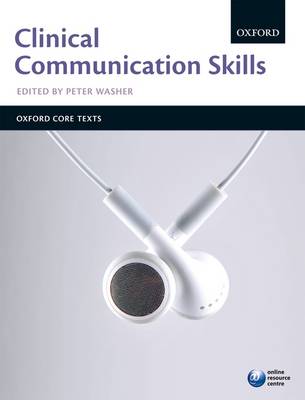
Clinical communication has been formally taught to medical students in the first few years of their course for several years, but it is only in relatively recent times that clinical communication has become routinely assessed. Increasingly, students recognise the fact that their 'general' communication skills do not automatically translate into effective clinical communication.
This textbook reflects the shifts described above and presents the medical student with a compelling resource in a field which has come of age. Clinical Communication Skills is designed to be the first textbook of choice for lecturers and students alike, for early use in the medical degree. The book recognises that this subject is often taught in parallel with Clinical Skills, and makes appropriate links.
The book is unapologetically practical in its remit - it aims to equip students to deal with all kinds of clinical encounters, and to optimise the ways in which they communicate with patients and colleagues. Coverage features written communication, and also includes presenting patients to colleagues. Importantly, the book draws on patient and service-user involvement as well as a range of professional views. Readers can listen to these original interviews which are available as podcasts on
the book's Online Resource Centre. Extracts from these interviews are woven into the text of the book, and are designed in a second colour for ease of reference. Similarly, sample conversational script is printed in colour so that students can easily scan for examples of positive communication.
However, a pragmatic approach is taken; coverage of what to do when things go wrong is also provided.
Clinical Communication Skills assumes no prior knowledge, but the communication challenges which the book addresses do advance throughout the chapters. The book starts with the basics of why clinical communication is taught, the process of the medical interview, and taking a medical history. The middle section of the book covers how to talk with other professionals, to a diverse range of patients, to children and young people, and to people with mental health problems. The final
section of the book covers information-giving skills which have become more prominent across medicine, including managing uncertainty, explaining risk, patient safety, dealing with complaints and breaking bad news. The material is written to apply to a range of settings, not limiting itself to general practice.
The advice provided in the book is informed by, and acknowledges key theories and frameworks. Indeed, the Editor completed a thorough literature review to underpin the writing of the book, and links to much of this research are provided on the book's online resource centre. In terms of comprehensiveness, this text spans the undergraduate clinical communication curriculum and is benchmarked against several international statements on doctor-patient communication, including the UK consensus
statement on the content of communication curricula in undergraduate medical communication (von Fragstein et al, 2008).
Online Resource Centre: www.oxfordtextbooks.co.uk/orc/washer/
* 11 podcasts of interviews relaying experiences of clinical communication, supported by full transcripts of the interviews. Each podcast is designed to be c. 5 minutes long, for ease of teaching and learning. All interviewees are real people (not simulated patients or actors). Interviewees include a variety of patients, including children, and an experienced General Practitioner. The audio content is reprised in the book, in the form of selected extracts which illustrate points within
individual chapters. Full transcripts of each interview are also hosted on line to facilitate closer study of the material.
* Podcast introduction to the book from the Editor.
Contents:
INTRODUCTION; CHAPTER 1: WHY LEARN COMMUNICATION SKILLS?; CHAPTER 2 - THE STRUCTURE AND PROCESS OF THE MEDICAL INTERVIEW; CHAPTER 3 - HOW TO TAKE A MEDICAL HISTORY; CHAPTER 4 - WRITING ABOUT PATIENTS; CHAPTER 5 - GIVING PRESENTATIONS; CHAPTER 6: TALKING WITH OTHER HEALTH PROFESSIONALS & PATIENTS' FAMILIES; CHAPTER 7 - TALKING WITH DISABLED PEOPLE; CHAPTER 8: TALKING WITH PEOPLE FROM OTHER CULTURES; CHAPTER 9 - TALKING ABOUT SEX AND SEXUALITY; CHAPTER 10 - TALKING WITH CHILDREN AND YOUNG PEOPLE; CHAPTER 11 - TALKING WITH PEOPLE WITH MENTAL HEALTH PROBLEMS; CHAPTER 12 - GIVING INFORMATION AND MANAGING UNCERTAINTY; CHAPTER 13: TALKING ABOUT MISTAKES AND DEALING WITH COMPLAINTS; CHAPTER 14 - SHARED DECISION-MAKING AND COMMUNICATING RISK; CHAPTER 15 - BREAKING BAD NEWS; APPENDIX - HOW TO DO WELL IN COMMUNICATION SKILLS OSCES
PRODUCT DETAILS
Publisher: Oxford University Press
Publication date: April, 2009
Pages: 176
Dimensions: 189.00 x 245.00 x 10.00
Weight: 360g
Availability: Available
Subcategories: Diseases and Disorders, Ethics
From the same series