
(To see other currencies, click on price)
MORE ABOUT THIS BOOK
Main description:
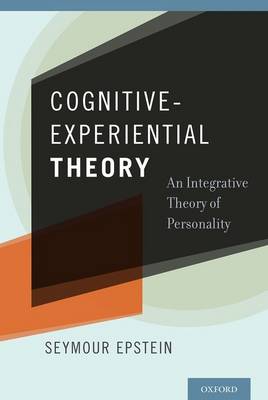
In this volume, Epstein presents a new theory of personality, referred to as cognitive-experiential theory, that is integrative of all other major personality theories. This integration is accomplished by expanding upon current basic assumptions, including the assumption that all higher-order animals automatically construct an implicit theory of reality that is necessary for adapting to their environments and that is, therefore, inherently reinforcing.
Contents:
Acknowledgments
Introduction
Part I. The Theory
Chapter 1. The Basic Theory: Two Systems
Chapter 2. Evidence in Real Life of Two Modes of Information Processing
Chapter 3. The Content and Organization of the Experiential System: With an Emphasis on Basic Needs and Beliefs
Chapter 4. Motivation Further Considered and Emotions
Chapter 5. Interactions Between and Within the Two Systems: Conflict, Compromises, Synergy, Repression, and Dissociation
Part 2. Development and Adjustment
Chapter 6. Development
Chapter 7. Coping and Defense Mechanisms
Chapter 8. The Maladaptive Behavior of Everyday Life
Chapter 9. Neurosis, Post-traumatic Stress Disorder, Psychosis, and Autism
Chapter 10. Depression
Part 3. Clinical Applications
Chapter 11. Psychotherapy 1: Constructive Thinking, Cognitive Therapy, Behavior Therapy, Cognitive-Behavioral Therapy
Chapter 12. Psychotherapy 2: Psychodynamic Therapy, Client-centered Therapy, Gestalt Therapy, Psychosynthesis, Cognitive-experiential Therapy, Relapse
Chapter 13. Psychotherapy 3: Communicating with the Experiential System Communicating with the Experiential System Through the Use of Fantasy
Part 4. Broader Implications
Chapter 14. Implications
PRODUCT DETAILS
Publisher: Oxford University Press (Oxford University Press Inc)
Publication date: January, 2016
Pages: 368
Dimensions: 156.00 x 233.00 x 21.00
Weight: 522g
Availability: Available
Subcategories: Psychology, Psychotherapy