
(To see other currencies, click on price)
MORE ABOUT THIS BOOK
Main description:
The disciplines of cognitive neuroscience, development, and psychopathology are complementary in the study of human perception and attention, even though each discipline emerges from a decidedly different and sometimes incompatible worldview. The meeting of researchers across these disciplines results in a fruitful cross-fertilization that ultimately leads to better science within each discipline and a joint scientific endeavor that is greater than the sum of its
parts.
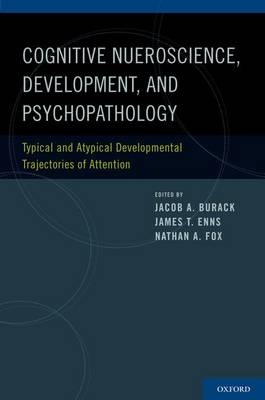
Cognitive Science, Development, and Psychopathology: Typical and Atypical Developmental Trajectories of Attention unites scholars sharing common interests in the development of attention and related areas of functioning with different perspectives and methodologies. The volume does not impose a single framework for discussing the relevant issues, but rather the authors highlight the importance of their own approaches to the study of the typical and atypical development of attention.
Drs. Burack, Enns, and Fox have organized the chapters into three sections: Atypical Environments, Threat, and the Development of Individual Differences in Attention; The Organization of the Development of Attention in Typical and Atypical Processing; and The Case of Orienting Attention in Developing an
Integrated Science. Discussion topics include cognitive bias modification, attention and the development of anxiety disorders, deficient anchoring, reflexive and abnormal social orienting in autism, and social attention. This volume is a unique and critical resource for researchers in communication disorders, developmental and cognitive psychology, human development, neuroscience, and educational and counseling psychology.
Contents:
Contents ; Contributors ; Introduction ; Chapter 1. Cognitive science, development, and psychopathology: Typical and atypical trajectories of attention ; James T. Enns and Jacob A. Burack ; Section I. Atypical Environments, Threat, and the Development of Individual Differences in Attention ; Chapter 2. Linking early adversity, brain, and developmental psychopathology: A review of findings from survivors of extremely low birth weight and child maltreatment ; Vladimir Miskovic and Louis A. Schmidt ; Chapter 3. Cognitive bias modification: The effects of training paradigms ; Jenna N. Goldstein Suway and Nathan A. Fox ; Chapter 4. Attention and the development of anxiety disorders: The importance of disentangling reactive versus regulatory components of attention ; Patricia L. Jordan and J. Bruce Morton ; Section II. The Organization of the Development of Attention in Typical and Atypical Processing ; Chapter 5 Ontogenesis and microgenesis of visual perceptual organization ; Ruth Kimch ; Chapter 6 Deficient anchoring - a potential link between perceptual and cognitive difficulties among individuals with dyslexia ; Karen Banai and Merav Ahissar ; Chapter 7 Autism: Beyond Weak Central Coherence ; Elizabeth Pellicano ; Section III. The Case of Orienting Attention in Developing an Integrated Science ; Chapter 8 Core components of flexibly attending: Summary and synthesis of reflexive orienting in autism ; Jed T. Ellison and J. Steven Reznick ; Chapter 9 Orienting attention to social cues typical and atypical development ; Adrienne Rombough, Jennifer N. Barrie, and Grace Iarocci ; Chapter 10 Investigating social attention: A case for increasing stimulus complexity in the laboratory ; Elina Birmingham, Jelena Ristic, and Alan Kingstone ; Chapter 11 Neurodevelopmental mechanisms in childhood psychopathology: The example of abnormal social orienting in autism ; Noah J. Sasson, Lauren Turner Brown, and Joseph Piven
PRODUCT DETAILS
Publisher: Oxford University Press (Oxford University Press Inc)
Publication date: September, 2012
Pages: 336
Dimensions: 169.00 x 236.00 x 28.00
Weight: 574g
Availability: Available
Subcategories: Neuroscience