
(To see other currencies, click on price)
MORE ABOUT THIS BOOK
Main description:
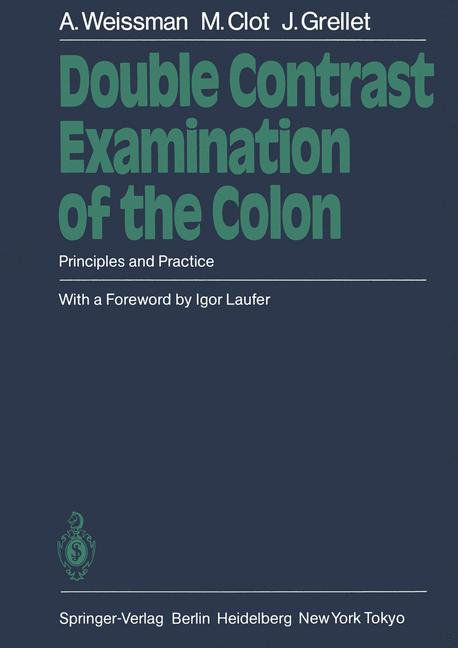
It is a great pleasure for me to introduce and to recommend this much needed text on double contrast examination of the colon. It is aimed both at clinicians who request X-ray examinations of the colon and at radiologists who must per form and interpret these studies. Over the past decade there has been renewed interest in X-ray examination of the colon despite the tremendous advances in endoscopy and imaging tech nology. This renewed interest is evidenced by the proliferation of new books on radiology of the colon. However, previous discussions of double contrast ex amination have concentrated primarily on the technique with too little attention to the understanding and interpretation of the radiologic images. This volume is unique in its emphasis on the basics of image formation and interpretation. It emphasizes the importance of the anteroposterior relation ships of the colon in determining the distribution of barium and air. It also rec ognizes the influence oflocation on the radiologic appearance of the lesion. The authors demonstrate a profound understanding of the principles of double contrast diagnosis as applied to the colon. They also have a good grasp of the gross pathologic changes underlying the radiologic images. The material is presented in a logical and analytical method which should be particularly useful to the beginner in this field. There are many helpful diagrams and the ra diographic illustrations are of excellent quality.
Contents:
1 Double Contrast Enema: Technical Aspects.- 1.1 Preparation of the Patient.- 1.1.1 Objectives.- 1.1.2 Procedure.- 1.2 Barium Preparation.- 1.3 Material.- 1.4 Radiologic Examination.- 1.4.1 Objectives.- 1.4.2 Preliminary Procedure.- 1.4.3 Procedure.- 1.5 Contraindications.- 1.6 Complications.- 1.7 Conclusion.- References.- 2 Interpretation (General Rules, Normal and False Images).- 2.1 General Rules of Interpretation.- 2.1.1 Different Radiologic Aspects of the Colon and the Formation Mechanism of the Image.- 2.1.2 Importance of the Spatial Configuration of the Colon and the Patient's Position for Air and Barium Distribution.- 2.2 Colonic Morphology and Motor Activity.- 2.2.1 Morphology.- 2.2.2 Motor Activity.- 2.3 Normal Appearance of the Colonic Mucosa (Walls and Margins), Physiologic Variants, False Images.- 2.3.1 Poor Coating Quality in Double Contrast.- 2.3.2 False Images.- 2.3.3 Normal Modifications in the Mucosal Line.- 2.4 Interpreting the Examination.- References.- 3 Radiologic Signs in Tumoral Pathology: Polyps and Polyposis Syndromes.- 3.1 Introduction.- 3.2 Polyps.- 3.2.1 Macroscopic Appearance of Polyps.- 3.2.2 Radiologic Polyp Images.- 3.2.3 Diagnostic Problems.- 3.3 Colonic Polyposis.- 3.3.1 Early-Stage Polyposis.- 3.3.2 Advanced Polyposis.- 3.3.3 Appearances Specific to Certain Polyposis Syndromes.- References.- 4 Primary Colorectal Cancer.- 4.1 Nonspecific Radiologic Appearances of Colorectal Carcinoma.- 4.2 Radiologic Signs Indicating the Malignant Nature of a Polyp.- 4.2.1 Size.- 4.2.2 Basal Indentation.- 4.2.3 Volume Doubling Time.- 4.2.4 Other Signs for Consideration.- 4.3 Classic Appearances of Primary Colorectal Carcinoma.- 4.3.1 The Strictly Vegetative Form.- 4.3.2 The Vegetative Ulcerative and Infiltrating Form.- 4.3.3 Strict Infiltrating Forms.- 4.4 Effectiveness of the Double Contrast Enema in Colorectal Carcinoma.- References.- 5 Villomas.- 5.1 Nonspecific Features.- 5.2 Indicative and Specific Features.- 5.3 The Radiologic Diagnosis of Malignancy Remains Problematic.- References.- 6 Ulcerative Colitis.- 6.1 Radiologic Pathology.- 6.2 Radiologic Appearance.- 6.2.1 Motor Activity Changes and Caliber and Haustral Abnormalities.- 6.2.2 Changes in the Colonic Mucosa (Walls and Margins).- 6.3 Differential Diagnosis.- References.- 7 Crohn's Disease of the Colon.- 7.1 Pathology.- 7.1.1 Lesion Distribution.- 7.1.2 Stage of Disease.- 7.2 Correspondence of Radiologic Images to the Lesions.- 7.2.1 Early Stage.- 7.2.2 Advanced Stages.- 7.2.3 Remissions.- 7.2.4 Diagnostic Value of Radiologic Signs.- 7.2.5 Complications.- 7.3 Conclusion.- References.- 8 Colonic Diverticulosis.- 8.1 Physiopathogenic Review.- 8.2 Pathology Review.- 8.2.1 Development and Site of Diverticula.- 8.2.2 Defects of the Colonic Muscular Coat.- 8.2.3 Diverticular Inflammation.- 8.3 Radiologic Aspects of Colonic Diverticulosis.- 8.3.1 Problems of Double Contrast in the Study of Diverticulosis.- 8.3.2 Radiologic Features of Noncomplicated Diverticulosis.- 8.4 Diverticulosis and Diverticulitis.- 8.5 Diverticulosis and Associated Lesions.- 8.5.1 The Detection of Associated Polyps Requires.- 8.5.2 Differentiation Between the Colonic Stenosis Caused by Cancer and That Caused by Diverticulosis.- 8.6 Conclusion.- References.- 9 Conclusion.
PRODUCT DETAILS
Publisher: Springer (Springer-Verlag Berlin and Heidelberg GmbH & Co. K)
Publication date: November, 2011
Pages: 182
Weight: 322g
Availability: Available
Subcategories: Gastroenterology, Hepatology, Radiology