(To see other currencies, click on price)
MORE ABOUT THIS BOOK
Main description:
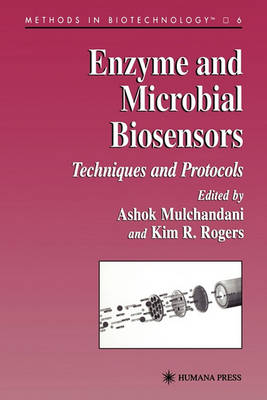
In 1962 Clark and Lyons pioneered the concept of a biosensor. They p- posed immobilizing enzymes at electrochemical detectors to form "enzyme el- trodes" in order to expand the analyte range of ther base sensor. Smce then, the field of blosensors has greatly expanded. Some of the reasons for the expansion include both advances in signal transduction technologies and the incorporation of different biological sensing elements (Table 1). As a consequence, there are now a bewildering array of permutations of the biological sensing element and signal transducers that can be used to c- struct a biosensor. The purpose of the two volumes of Protocols and Te- niques in Biosensors is to provide a basic reference tool and starting point for use by graduate students, postdoctoral and senior researchers, and technicians m academics, industry, and government research establishments, to enable rapid entry into the field of biosensors. There are a variety of approaches that researchers employ to select a combination of bioaffinity elements and signal transducers. One commonly used approach is to identtfy the compound or compounds of interest; identify the biological molecule that yields an appropriate recognitionlselectivtty and dynamic concentration range for the assay; and choose an assay format and signal transduction technology that will meet the analytical requirements for the proposed application, This volume, Enzyme and Microbial Biosensors: Techniques and Protocols, describes a variety of transduction technologies that have been interfaced to enzymes and microorganisms.
Contents:
Part I.Enzyme Biosensors. Principles of Enzyme Biosensors, Ashok Mulchandani. Enzyme Biosensors Based on pH Electrode
Canh Tran-Minh . Enzyme Biosensors Based on Gas Electrodes, Marco Mascini and Gianna Marrazza. Enzyme Biosensors Based on ISFETs, Roland Ulber and Thomas Scheper. Enzyme Biosensors Based on Oxygen Detection, F. W. Scheller, D. Pfeiffer, F. Lisdat, C. Bauer, and N. Gajovic. Enzyme Biosensors Based on the Hydrogen Peroxide Electrode, John Woodward. Enzyme Biosensors Based on Mediator-Modified Carbon Paste Electrode, Prem C. Pandey. Enzyme Biosensors Based on Electron Transfer Between Electrode and Immobilized Peroxidases, Lo Gorton, Elisabeth Csoeregi, Tautgirdas Ruzgas, Irina Gazaryan, and Gyoergy Marko-Varga. Enzyme Biosensors Based on Redox Polymers, Latha Shankar, Michael G. Garguilo, and Adrian C. Michael .
Enzyme Biosensors Based on Metallized Carbon Electrodes, Joseph Wang. Enzyme Biosensors Based on Conducting Polymers,
Wolfgang Schuhmann. Enzyme Sensors Based on Conductimetric Measurement, Norman F. Sheppard, Jr. and Anthony Guiseppi-Elie. Enzyme Biosensors Based on Thermal Transducer/Thermistor, Kumaran Ramanathan, Masoud Khayyami,
and Bengt Danielsson. Enzyme Biosensors Based on Fluorometric Detection, Ashutosh Sharma. Part II. Microbial Biosensors. Microbial Biosensors Based on Oxygen Electrodes,Klaus Riedel . Microbial Biosensors Based on Respiratory Inhibition, Yoshiko Arikawa, Kazunori Ikebukuro, and Isao Karube. Microbial BiosensorsBased on Potentiometric Detection
Aleksandr L. Simonian, Evgenia I. Rainina, and James R. Wild. Microbial Biosensors Based on Optical Detection, Udayakumar Matrubutham and Gary S. Sayler. Index .
PRODUCT DETAILS
Publisher: Springer (Humana Press Inc.)
Publication date: November, 2010
Pages: 284
Weight: 415g
Availability: Available
Subcategories: Biochemistry
From the same series