
(To see other currencies, click on price)
MORE ABOUT THIS BOOK
Main description:
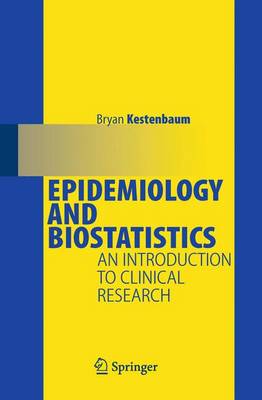
This textbook was born from a disparate collection of written materials that were created to teach Epidemiology and Biostatistics to second year medical students at the University of Washington. These materials included handouts, practice problems, guides to reading research articles, quizzes, notes from student help sessions, and student emails. The primary goal of these written materials, and now this book, is to recreate the perspective of learning Epidemiology and Biostatistics for the first time. With critical editing assistance from Epidemiology faculty, graduate students in Epidemiology and Biostatistics, and the students themselves, I have tried to preserve the innate logic and connectedness of clinical research methods and to demonstrate their application. The textbook is designed to provide students with the tools necessary to form their own informed conclusions from the clinical research literature. More than ever, a clear understanding of the fundamental aspects of Epidemiology and Biostatistics is needed to successfully navigate the increasingly complex methods utilized by modern clinical research studies. This book could not have been created without the dedicated help of the e- tors, the teaching assistants, and the students, who asked the important questions. I would especially like to thank my family who patiently allowed me so much time to write.
Feature:
Concise, intensive introduction to clinical research design for students and clinical research professionals with no previous background in epidemiology or statistics
Provides students and other health professionals with the knowledge necessary to interpret clinical research articles, design clinical studies, and learn essential epidemiological concepts in an expedient manner
Back cover:
This text provides students and other health professionals with the knowledge necessary to interpret clinical research articles, design clinical studies, and learn essential epidemiological concepts in an expedient and concise manner. Fundamental concepts are presented in a highly succinct format suitable for students with no previous background in epidemiology or statistics.
Drawing on teaching experience and student feedback, the author has created a text that attempts to recreate the perspective of learning epidemiology and biostatistics for the first time. The text serves as a rapid, intensive course in clinical research methods that can be used by students taking the required epidemiology course, residency and fellowship programs for physicians entering the clinical research portion of their training, and clinical research programs in fields such as nursing and nutrition that need an intensive course in clinical research design.
Contents:
EPIDEMIOLOGY.- Measures of Disease Frequency.- General Considerations in Clinical Research Design.- Case Reports and Case Series.- Cross-sectional Studies.- Cohort Studies.- Case-control Studies.- Randomized Trials.- Misclassification.- Confounding.- Control of Confounding.- Effect Modification.- Screening.- Diagnostic Testing.- BIOSTATISTICS.- Summary Measures in Clinical Research.- Introduction to Statistical Inference.- Hypothesis Tests.- Intepreting Hypothesis Testing.- Linear Regression.- Non-linear Regression Models.- Survival Analysis.
PRODUCT DETAILS
Publisher: Springer (Springer New York)
Publication date: September, 2009
Pages: 258
Weight: 810g
Availability: Not available (reason unspecified)
Subcategories: Epidemiology, General Practice, Public Health
CUSTOMER REVIEWS
From the reviews:
"In this introductory textbook, examples are carefully chosen to help readers understand important concepts in epidemiology and biostatistics, as well as their application to the field of clinical research. … the book will be useful to any healthcare practitioner interested in having a better understanding of clinical research. … This book has the important quality of providing students with an introductory overview that not only helps them understand the methods, but also guides those interested in learning more in the right direction." (Daniela Claudia Moga, Doody’s Review Service, November, 2009)
“This concise introductory textbook was ‘born from a disparate collection of written materials that were created to teach epidemiology and biostatistics to second-year medical students.’ … to provide medical students with a basic instruction to clinical epidemiology and biostatistics … . suitable for … students with no previous background in clinical epidemiology or biostatistics and for practitioners who want concise introduction to facilitate interpretation of the medical literature. … serve as the course text for a medical student introduction to clinical research methods.” (Douglas J. Lanska, Journal of the American Medical Association, Vol. 303 (18), 2010)