
(To see other currencies, click on price)
MORE ABOUT THIS BOOK
Main description:
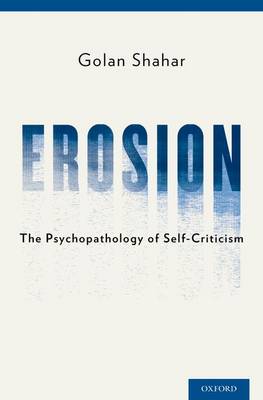
Self-criticism is a personality trait that has been implicated in a wide range of psychopathologies and developmental arrests. Defined as the tendency to set unrealistically high standards for one's self and to adopt a punitive stance towards the self once these standards are not met, self-criticism is both active and cyclical. Self-critics actively create the social-interpersonal conditions that generate their distress, and their distress itself exacerbates
self-criticism.
Erosion offers a comprehensive treatment of self-criticism based in philosophy, developmental science, personality and clinical psychology, social theories, and cognitive-affective neuroscience. Professor Golan Shahar expertly summarizes the most recent research on the topic and synthesizes theory, empirical research, and clinical practice guidelines for assessment, prevention, and treatment. The book rests upon three elements that, as Shahar argues, are central to the maintenance of
self-critical vulnerability: the importance of a concept of an authentic self or the need to "feel real"; the importance of intentionality and goal-directedness; and the power of interpersonal relationships and cultural context. Shahar argues that exploring these elements requires an integrated clinical
approach that incorporates multidimensional assessment and interventions which reconcile science, practice, and policy. The result is a broad and scholarly volume that is useful to practitioners, researchers, and theorists interested in self-criticism.
Contents:
Foreword by Larry Davidson ; Preface ; Acknowledgments ; Part I: In Effect ; Chapter 1 The culprit and its modus operandi ; Chapter 2 Eliminating the other suspects ; Part II: In Theory ; Chapter 3 Theories of self-criticism and their discontents ; Chapter 4 Authenticity and Self-Knowledge (ASK) ; Chapter 5 Development, families, and cultures: The Axis of Criticism (ACRIM) ; Part III: In Practice ; Chapter 6 Credo: A philosophy of treatment ; Chapter 7 Specific interventions and guidelines ; Chapter 8 Postscript ; Notes ; Glossary ; References ; About the Author ; Index
PRODUCT DETAILS
Publisher: Oxford University Press (Oxford University Press Inc)
Publication date: September, 2015
Pages: 240
Dimensions: 156.00 x 238.00 x 22.00
Weight: 448g
Availability: Available
Subcategories: Psychology, Psychotherapy