(To see other currencies, click on price)
MORE ABOUT THIS BOOK
Main description:
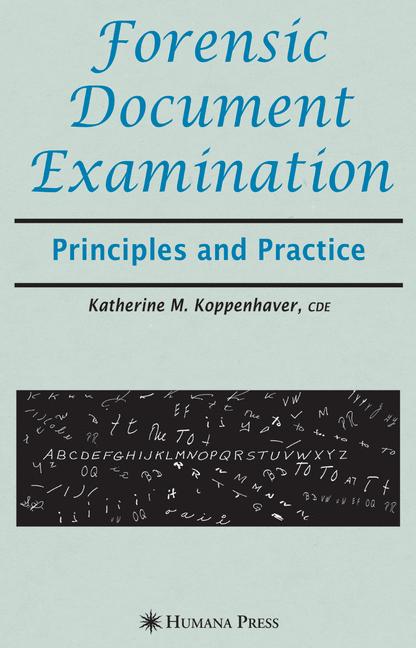
Forensic Document Examination: Principles and Practice is the first textbook written specifically for the study of questioned document analysis. The text comprehensively reviews document examination, with specific attention to handwriting identification and forgery detection. Fundamental principles and techniques of document examination are presented throughout in a concise, straightforward manner. Specific concepts attended to include the factors that affect handwriting; the characteristics of handwriting; the guidelines for determining the authenticity or spuriousness of handwriting; and the proper methods for examining a case from start to finish. For the first time, criminal justice students and others requiring an introduction to document analysis will have a resource to consult that outlines the proper method for analyzing handwriting and a detailed procedure for preparing a document case.
In addition to its utility as a textbook for document analysis, Forensic Document Examination: Principles and Practice will be an invaluable resource for professionals in fields where interaction with document examiners is commonplace. Police officers, private investigators, and attorneys will all benefit from a basic understanding of document examination and what is required for a document examiner to complete an assignment.
Feature:
Evolution of the written word and history of document examination
Principles of handwriting and handwriting identification
Detection of forged and counterfeit documents
Equipping a document laboratory and preparing reports
Identifying check and credit card fraud
Examining seals, stamps, paper fasteners, writing instruments
Contents:
Contents: Dedication Foreword Preface Acknowledgments Chapter 1: Evolution of the Written Word Chapter 2: Principles of Handwriting Chapter 3: Factors that Cause Changes in Handwriting Chapter 4: Handprinting and Numerals Chapter 5: History of Document Examination Chapter 6: Forgery Chapter 7: Other Types of Fraud Chapter 8: Equipping a Laboratory Chapter 9: Care and Handling of Documents Chapter 10: Standards of Comparison Chapter 11: Systematic Examination of Handwriting Chapter 12: Master Pattern Chapter 13: Detecting Fraudulent Documents Chapter 14: Weighing the Evidence Chapter 15: Preparing Reports Chapter 16: Alteration of Documents Chapter 17: Disguised Writing Chapter 18: Disguise Versus Simulation Chapter 19: Check and Credit Card Fraud Chapter 20: Paper Chapter 21: Writing Instruments Chapter 22: Seals, Stamps, and Paper Chapter 23: Typewriters and Printers Chapter 24: Duplicating Methods Chapter 25: Desktop Publishing Chapter 26: The Discovery Process Chapter 27: The Litigation Process Chapter 28: Demonstrative Evidence Chapter 29: Court Cases Appendices Glossaries Work Cited Index
PRODUCT DETAILS
Publisher: Springer (Humana Press)
Publication date: April, 2007
Pages: 315
Weight: 660g
Availability: Not available (reason unspecified)
Subcategories: Forensics
Publisher recommends