
(To see other currencies, click on price)
MORE ABOUT THIS BOOK
Main description:
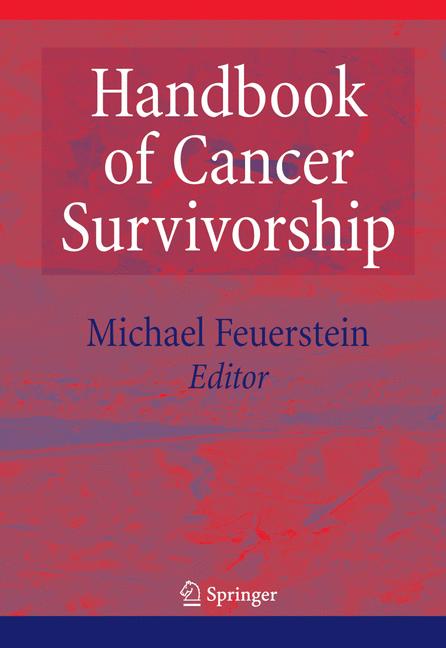
Not long ago, a cancer diagnosis was regarded as an automatic death sentence; today there are ten million survivors. Equally impressive is the growing number of clinicians and researchers dedicated to improving the quality of survivors’ lives and care. Yet despite this encouraging picture, there has never been a reliable central source for relevant clinical information – till now.
The Handbook on Cancer Survivorship responds to the diverse needs of survivors and their support communities by comprehensively addressing the major issues in the field, from the burden of survivorship to secondary prevention. Editor Michael Feuerstein, himself a cancer survivor, and sixty other top scientist-practitioners analyze in depth how survivors meet and manage the challenges of life after cancer, and what clinicians, researchers, and public health systems can do to ease the transition.
The Handbook’s 27 comprehensive chapters include the latest research and practice related to: Survivors’ quality of life, and how it can be assessed; Managing everyday and chronic stress; Depression, anxiety, pain disorders, and cognitive changes
Coping, adaptation, and resilience; Behavior change strategies – exercise, weight control, smoking cessation; Cancer survivorship centers and other models for follow-up care; Survivor, clinician, and international perspectives; New frontiers in practice, research, and policy.
Such wide-ranging coverage benefits everyone involved in cancer survival: primary care providers, oncologists; behavioral health specialists; physical and occupational therapists; nutritionists; epidemiologists; health systems professionals and policymakers; and, of course, survivors themselves and their families.
Back cover:
Not long ago, a cancer diagnosis was regarded as an automatic death sentence; today there are ten million survivors. Equally impressive is the growing number of clinicians and researchers dedicated to improving the quality of survivors’ lives and care. Yet despite this encouraging picture, there has never been a reliable central source for relevant clinical information—until now
The Handbook on Cancer Survivorship responds to the diverse needs of survivors and their support communities by comprehensively addressing the major issues in the field, from the burden of survivorship to secondary prevention. Editor Michael Feuerstein, himself a cancer survivor, and sixty other top scientist-practitioners analyze in depth how survivors meet and manage the challenges of life after cancer, and what clinicians, researchers, and public health systems can do to ease the transition.
The Handbook’s 27 comprehensive chapters include the latest research and practice related to:
-Survivors’ quality of life, and how it can be assessed
-Managing everyday and chronic stress
-Depression, anxiety, pain disorders, and cognitive changes
-Coping, adaptation, and resilience
-Behavior change strategies—exercise, weight control, smoking cessation
-Cancer survivorship centers and other models for follow-up care
-Survivor, clinician, and international perspectives
-New frontiers in practice, research, and policy
Such wide-ranging coverage benefits everyone involved in cancer survival: primary care providers, oncologists; behavioral health specialists; physical and occupational therapists; nutritionists; epidemiologists; health systems professionals and policymakers; and, of course, survivors themselves and their families.
Contents:
Burden.- Cancer Survivorship.- The Burden of Cancer Survivorship.- Quality of Care.- Quality of Life in Long-Term Cancer Survivors.- Health Care Disparities.- Measuring Quality of Life in Cancer Survivors.- Common Problems.- Exercise Motivation and Behavior Change.- Fatigue.- Pain.- Depression.- Interpersonal Relationships.- Adaptation in the Face of Advanced Cancer.- Secondary Prevention.- Restoring Emotional Well-Being.- Physical Activity for Cancer Survivors.- Nutrition and Weight Management in Cancer Survivors.- Management of Chemotherapy-Related Cognitive Dysfunction.- Smoking Cessation and Cancer Survivors.- Psychological Distress, Depression, and Anxiety.- Managing Daily and Long-Term Stress.- Pain and Function.- Work.- Comprehensive Long-Term Follow-up.- Survivor and Provider Perspectives.- Survivor Perspectives on Quality Care.- Living with Advanced Cancer.- International Perspective.- Global Considerations.- Future Directions.- Cancer Survivorship.
PRODUCT DETAILS
Publisher: Springer (Springer US)
Publication date: December, 2006
Pages: 524
Weight: 2690g
Availability: Not available (reason unspecified)
Subcategories: Epidemiology, Oncology, Public Health, Rehabilitation
Publisher recommends
CUSTOMER REVIEWS
From the reviews:
"To my knowledge, this is the first book that targets health care professionals who work with survivors of adult cancer. … For investigators interested in prevention-focused interventions, this is must-read material. For clinicians involved in developing or enhancing multidisciplinary clinical programs for cancer survivors, this section also includes many excellent and well-founded strategies that could be easily integrated into current practice. … It will serve as an excellent starting point for future books on survivorship ... ." (Kevin C. Oeffinger, The New England Journal of Medicine, Vol. 356 (24), 2007)
"In summary, the Handbook of Cancer Survivorship is a ‘must have’ reference for researchers and clinicians who work in the area of cancer care. The bibliographical resources provided alone make it worth the price. More importantly, this book reflects that fact that cancer research has now moved beyond issues of how best to treat and cure to issues of how we will care for those we have treated and who have survived. The editor, contributors, and those whose research is referenced are to be applauded for moving us in that direction." (Gary T. Deimling, Psycho-Oncology, Vol. 16: 871-872, 2007)
"If the idea is to obtain more details on general issues applied to all types of cancers, I would recommend Handbook of Cancer Survivorship." (Daniela Dornelles Rosa, Journal of the American Medical Association, Vol. 298: 1700-1701, 2007)
"This book provides up-to-date information from 60 scientist-practitioners and the editor, a cancer survivor. … The purpose is to compile the work of professionals from multiple disciplines in a comprehensive resource for cancer care clinicians and researchers. … The book should be useful to cancer survivors, persons living with advanced cancer, family, friends, healthcare providers, and researchers. … This scholarly well written book would be useful to the broad range oncology care professionals who guide cancer patients and families … ." (Melody L. McKinney, Doody's Book Review, October, 2007)