
(To see other currencies, click on price)
MORE ABOUT THIS BOOK
Main description:
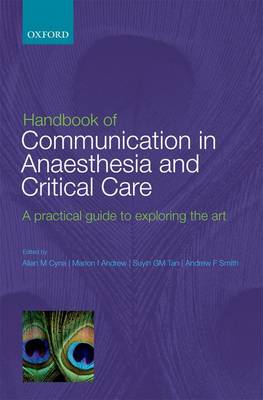
This book provides anaesthetists, intensivists and other critical care staff with a comprehensive resource that offers ways of improving communication in everyday clinical practice, and provides practical communication tools that can be used in difficult or unfamiliar circumstances. It demonstrates how communication can be structured to improve patient care and safety with numerous practical examples and vignettes illustrating how the concepts discussed can be
integrated into clinical practice, and presents ideas in a way that enhances clinical interactions with patients and colleagues and facilitate the teaching of trainees.
Edited by practising anaesthetists with particular expertise in teaching communication, and with contributions from expert clinicians based in North America, Europe and Australasia, this book will stimulate and complement the development of comprehensive resources for communication skills teaching in anaesthesia and other related professional groups.
Contents:
SECTION I PRINCIPLES OF COMMUNICATION ; 1. To begin... ; 2. Structures ; 3. How words hurt ; 4. Language and the subconscious ; 5. Narrative and Metaphor ; SECTION II ROUTINE CLINICAL APPLICATIONS ; 6. The pre-anaesthetic visit ; 7. Consent ; 8. Perioperative care ; SECTION III SPECIFIC CLINICAL CONTEXTS ; 9. The obstetric patient ; 10. The paediatric patient ; 11. Critical care ; 12. When bad things happen ; 13. Patients with special needs ; 14. Needle phobia ; 15. Intra-operative awareness ; SECTION IV COMMUNICATION WITH COLLEAGUES ; 16. Safety-critical communication ; 17. The theatre team ; 18. Teaching and research ; 19. Administrators ; SECTION V ADVANCED COMMUNICATION TECHNIQUES ; 20. Hypnotic techniques
PRODUCT DETAILS
Publisher: Oxford University Press
Publication date: November, 2010
Pages: 288
Dimensions: 157.00 x 234.00 x 17.00
Weight: 438g
Availability: Available
Subcategories: Anaesthetics and Pain, Ethics, General Practice