
(To see other currencies, click on price)
MORE ABOUT THIS BOOK
Main description:
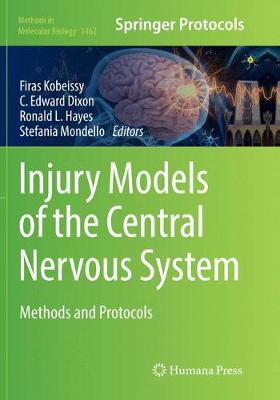
This volume discusses experimental brain injury models that
contain valuable information carefully chosen to widen the researchers' horizon
about neurotrauma. Injury Models of Central Nervous System: Methods and Protocols contains relevant experimental design approaches that have been
adapted and made ready for application in laboratory settings. For easier
navigation, the chapters are categorized into 6 parts: Introduction, General
Consideration in Using Animal Laboratory in CNS Injury Research, Classical TBI
Models and Their Link with Pathophysiological Features of CBS Injury - Models,
Special Topics in CNS Trauma: Comorbid Conditions in CNS Injury, Outcome
Measures in Brain Injury Models, and Future Directions. Written in the highly successful Methods in
Molecular Biology series format, chapters include introductions to their
respective topics, lists of the necessary materials and reagents, step-by-step,
readily reproducible laboratory protocols, and tips on troubleshooting and
avoiding known pitfalls.
Practical and thorough, Injury Models of Central Nervous Systems: Methods and Protocols, is a very useful reference towards the
progress of this discipline.
Contents:
Part I Introduction
1. The History and Evolution of
Experimental Traumatic Brain Injury Models
John Povlishock
Part II. General
Consideration in Using Animal Laboratory in CNS Injury Research
2. Clinical Traumatic Brain Injury in
the Preclinical Setting
Justin Berkner, Rebekah Mannix, and Jianhua Qiu
3. Rodent
Models of Traumatic Brain Injury: Methods and Challenges
Niklas Marklund
4. Traumatic
Brain Injury Models in Animals
Elham Rostami
5. Systematic
Review of Traumatic Brain Injury Animal Models
Helen W.
Phipps
6. Methods
of Drug Delivery in Neurotrauma
Ying Deng-Bryant, Ryan Readnower,
Lai Yee Leung, Frank Tortella, and Deborah Shear
7. Bridging
the Gap of Standardized Animals Models for Blast Neurotrauma: Methodology for Appropriate Experimental Testing
Pamela J. VandeVord, Alessandra Dal
Cengio Leonardi, and David Ritzel
8. Cellular
Mechanisms and Behavioral Outcomes in Blast-Induced Neurotrauma: Comparing
Experimental Set-Ups
Zachary S. Bailey, William Brad
Hubbard, and Pamela J. VandeVord
9. Application
of Systems Biology to Neuroproteomics: The Path to Enhanced Theranostics for
Traumatic Brain Injury
Zaynab Jaber, Patrick Aouad,
Mohamad Al Medawar, Hisham Bahmad, Hussein Abou Abbass, and Firas Kobeissy
10. Role of Systems Biology in Brain
Injury Biomarker Discovery: A Neuroproteomic Application
Zaynab Jaber, Patrick Aouad,
Mohamad Al Medawar, Hisham Bahmad, Hussein Abou Abbass, Hiba Ghandour, Stefania
Mondello, and Firas Kobeissy
Part III Classical TBI Models and Their Link with
Pathophysiological Features of CNS Injury - Models
11.
The
Controlled Cortical Impact Model of Experimental Brain Trauma: Overview,
Research Applications, and Protocol
Nicole Osier and C. Edward Dixon
12.
Weight
Drop Models in Traumatic Brain Injury
Brian T. Kalish and Michael J.
Whalen
13.
Midline
(Central) Fluid Percussion Model of Traumatic Brain Injury
Rachel K. Rowe, Daniel R.
Griffiths, and Jonathan Lifshitz
14.
Lateral
(Parasagittal) Fluid Percussion Model of Brain Injury
Ken C. Van and Bruce G. Lyeth
15.
Impact
Acceleration Model of Diffuse Traumatic Brain Injury
Sarah C. Hellewell, Jenna M.
Ziebell, Jonathan Lifshitz, and M. Cristina Morganti-Kossmann
16.
Experimental
Models for Neurotrauma Research
Johan
Davidsson and Marten Risling
<17.
A Porcine Model
of Traumatic Brain Injury via Head Rotational Acceleration
D. Kacy Cullen, James P. Harris,
Kevin D. Browne, John A. Wolf, John E. Duda, David F. Meaney, Susan S.
Margulies, and Douglas H. Smith
18.
Pediatric
Rodent Models of Traumatic
Brain Injury
Bridgette D. Semple, Jaclyn
Carlson, and Linda J. Noble-Haeusslein
19.
Modeling
Pediatric Brain Trauma: Piglet Model of Controlled Cortical Impact
Jennifer C. Munoz Paraja, Kristen
Keeley, Ann-Christine Duhaime, and Carter P. Dodge
20.
Thromboembolic
Model of Cerebral Ischemia and Reperfusion in Mice
Ali Alawieh, Wenxue Wang, Aarti
Narang, and Stephen Tomlinson
21.
Animal
Stroke Model: Ischemia/Reperfusion and Intracerebral Hemorrhage
Changhong Ren, Christopher Sy,
Jinhuan Gao, Yuchuan Ding, and Xunming Ji
iv ="" special="" topics="" in="" cns="" trauma:="" comorbid="" conditions="" injury
22.
Combined
Neurotrauma Models: Experimental Models Combining Traumatic Brain Injury and Secondary
Insults
Dennis W. Simon, Vincent M. Vagni,
Patrick M. Kochanek, and Robert S. B. Clark
23. Microdialysis as Clinical
Evaluation of Therapeutic Hypothermia in Rat Subdural Hematoma Model
Shoji Yokobori, Markus S. Spurlock,
Stephanie W. Lee, Shyam Gajavelli, and Ross M. Bullock
24. Repetitive Transcranial Magnetic
Stimulation as a Novel Therapy in Animal Models of Traumatic Brain Injury
Thangavelu Soundara Rajan,
Salvatore Cuzzocrea, Daniele Bruschetta, and Angelo Quartarone
25.
Experimental
Models Combining TBI, Hemorrhagic Shock, and Hypoxemia
Lai Yee Leung, Ying Deng-Bryant,
Deborah Shear, and Frank Tortella
26.
Experimental
Models Combining Traumatic Brain Injury and Hypoxia
Eric P. Thelin
27.
Animal
Models of Post-Traumatic Seizures and Epilepsy
Alexander V. Glushakov, Olena Y.
Glushakova, Sylvain Dore, Paul R. Carney, and Ronald L. Hayes
28.
Closed-Head
TBI Model of Multiple-Morbidity
Floyd J. Thompson, Jiamei Hou, and
Prodip K. Bose
Part V Outcome Measures in Brain Injury Models
29.
Cognitive
Evaluation Using Morris Water Maze in Neurotrauma
Ying Deng-Bryant, Lai Yee Leung,
Krista Caudle, Frank Tortella, and Deborah Shear
30.
Assessment
of Cognitive Function in the Water Maze Task: Maximizing Data Collection and Analysis
in Animal Models of Brain Injury
Mark D. Whiting and Olga N.
Kokiko-Cochran
31.
Detecting
Behavioral Deficits Post Traumatic Brain Injury in RatsHibah O. Awwad
32.
Advanced
and High Throughput Method for Mitochondrial Bioenergetics Evaluation in
Neurotrauma
Jignesh D. Pandya, Patrick G.
Sullivan, Lai Yee Leung, Frank C. Tortella, Deborah A. Shear, and Ying
Deng-Bryant
33.
Determination
of Vascular Reactivity of Middle Cerebral Arteries from Stroke and Spinal Cord
Injury Animal Models Using Pressure Myography
Mohammad
A. Anwar and Ali H. Eid
34. Assessment of Basilar Artery Reactivity
in Stroke and Subarachnoid Hemorrhage Using Wire Myograph
Crystal M. Ghantous, Zeina Azrak,
Farah Abdel Rahman, Hana A. Itani, and Asad Zeidan
35. Magnetic Resonance Imaging in Experimental
Traumatic Brain Injury
Qiang Shen, Lora Tally Watts, Wei
Li, and Timothy Q. Duong
36. A Simplified Workflow for Protein
Quantitation of Rat Brain Tissues Using Label-Free Proteomics and Spectral
Counting
Angela M. Boutte, Shonnette F.
Grant, and Jitendra R. Dave
37. Phenotypic Screening of Small-Molecule
Inhibitors: Implications for Therapeutic Discovery and Drug Target Development
in Traumatic Brain Injury
Hassan Al-Ali, Vance P. Lemmon, and
John L. Bixby
38. Postnatal Neural Stem Cells in
Treating Traumatic Brain Injury
Hussein Gazalah, Sarah Mantash,
Naify Ramadan, Sawsan Al Lafi, Sally El Sitt, Hala Darwish, Hassan Azari, Lama
Fawaz, Noel Ghanem, Kazem Zibara,
Rose-Mary Boustany, Firas Kobeissy, and Jihane Soueid
39. A Novel Biopsy Method for Isolating
Neural Stem Cells from the Subventricular Zone of the Adult Rat Brain for Autologous
Transplantation in CNS Injuries
Hadi Aligholi, Gholamreza
Hassanzadeh, Ali Gorji, and Hassan Azari
Part
VI Future Directions
40. Challenging the Paradigms of Experimental
TBI Models: From Preclinical to Clinical Practice
Frank Tortella
PRODUCT DETAILS
Publisher: Springer (Humana Press Inc.)
Publication date: June, 2018
Pages: 743
Weight: 652g
Availability: Available
Subcategories: Neuroscience