
(To see other currencies, click on price)
MORE ABOUT THIS BOOK
Main description:
Scientific progress has been rapid in lysosomal biology during the last six decades. Its application to human disease is nothing less than spectacular. In no other group of disorders has knowledge and clinical utility progressed so speedily. Recall that the organelle was described in just 1955. Since then, the biochemical alterations and storage materials were described, the enzyme deficiencies discovered, the gene coding of these glycoproteins cloned and thousands of mutations defined. These advances have resulted in highly improved diagnosis for more than 50 diseases. For five diseases, including the most common lysosomal storage disorder, molecular therapy is a reality, extremely effective and very safe. This higher plateau of medical approaches to human disease is something to which all translational scientists aspire and only a few actually witness. The relief of pain and suffering is a tribute to the ideas and work of many dedicated investigators. Much of that work is presented in this text. Despite our ability to treat some of these diseases through enzyme replacement therapy (ERT) and, accurately define different diseases that look alike, there is much to be learned about lysosomal disease. With each step up the barrier to knowledge, a new point of view is attained, a fresh perspective. Much is seen more clearly and many “allegories of the cave” are dispelled forever. Yet, our new view demands a new vision drawing us to find better definitions of what we see. This is how it has been with lysosomal diseases.
Feature:
Describes the nature of the lysosomal dysfunction and diseases as well as potential future treatments and therapies
Provides the historical evolution of the field
Organized as a textbook with disease-specific chapters
Invaluable resource for researchers in biochemical and molecular genetics, enzyme therapy, and gene transfer
Back cover:
Lysosomal Biology and Storage Disorders
John A. Barranger and Mario A. Cabrera-Salazar
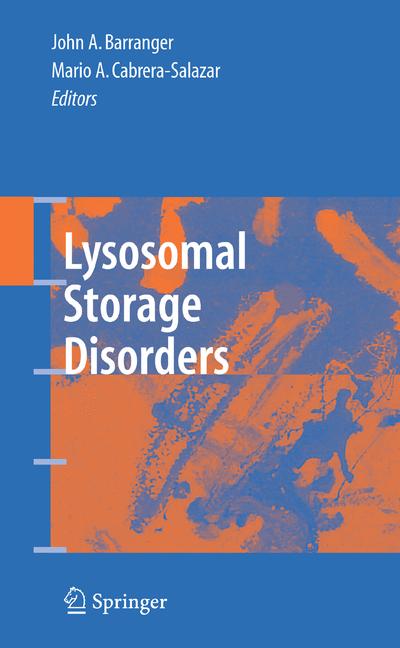
The knowledge of lysosomal biology and the consequences of its dysfunction have increased dramatically in the past 60 years. Research of these disorders has moved from diseases with unknown etiology to disorders with clear and defined pathophysiology and some of them have benefited from the development of disease specific therapeutics. Lysosomal Biology and Storage Disorders describes the nature of the diseases, the historical evolution of the field and future perspectives for the treatment of these clinical entities.
Organized as a textbook, Lysosomal Biology and Storage Disorders describes the nature of lysosomal dysfunction, the synthesis and targeting of lysosomal enzymes and the implications of the targeting mechanisms for the development of new therapies. Disease specific chapters provide thorough reviews of the clinical features of lysosomal storage disorders, their molecular basis and the commercial or experimental therapeutic approaches sought in this area.
Lysosomal Biology and Storage Disorders will be attract to all researchers in biochemical and molecular genetics, enzyme therapy, gene transfer, and others concerned with the models of genetic disease.
This book is dedicated to patients affected by Lysosomal Storage Disorders, and especially to the National Gaucher Foundation (USA) and the Colombian Association of Patients with Lysosomal Storage Diseases (ACOPEL for its Spanish Acronym). Both organizations will share in the sales of this book.
About the Editors:
John A. Barranger, M.D., Ph.D. is a Professor in the departments of human genetics, molecular genetics and biochemistry, and pediatrics at the University of Pittsburgh School of Medicine.
He has also served as director of the Human Gene Therapy Applications Laboratory, the Center for the Study and Treatment of Jewish Genetic Diseases, and the Comprehensive Gaucher Disease Treatment Center in this institution
Mario A. Cabrera-Salazar, MD is a Staff Scientist at Genzyme Corporation in Framingham, MA. He is involved in the development of enzymatic and gene therapies for lysosomal storage disorders and for neurodegenerative diseases in the department of Genetic Disease Science.
Contents:
From Lysosomes to Storage Diseases and Back: A Personal Reminiscence.- Lysosomal Biogenesis and Disease.- The Concept of Treatment in Lysosomal Storage Diseases.- Complex Lipid Catabolism.- Retroviral Vectors for Gene Therapy.- Adenovirus in Gene Therapy.- Setting Back the Clock: Adenoviral-Mediated Gene Therapy for Lysosomal Storage Disorders.- Adeno-Associated Viral-Mediated Gene Therapy of Lysosomal Storage Disorders.- Herpes Simplex Virus Vectors for Gene Therapy of Lysomal Storage Disorders.- Gene Therapy of Lysosomal Storage Disorders by Lentiviral Vectors.- Substrate Reduction Therapy.- Newborn Screening for Lysosomal Storage Disorders.- Genetic Counseling for Lysosomal Storage Diseases.- Neural Stem Cell Therapy in Lysosomal Storage Disorders.- The GM1 Gangliosidoses.- The GM2 Gangliosidoses.- Acid Sphingomyelinase-Deficient Niemann-Pick Disease.- Krabbe Disease (Globoid Cell Leukodystrophy).- Metachromatic Leukodystrophy.- Fabry Disease.- Gaucher Disease: Review and Perspectives on Treatment.- Therapeutic Goals in the Treatment of Gaucher Disease.- The Neuronal Ceroid Lipofuscinoses: Clinical Features and Molecular Basis of Disease.- Mucopolysaccharidosis I.- Mucopolysaccharidosis II.- Sanfilippo Syndrome: Clinical Genetic Diagnosis and Therapies.- Mucopolysaccharidosis IV (Morquio Syndrome; MPS IV).- Mucopolysaccharidosis Type VI (MPS VI, Maroteaux-Lamy Syndrome).- Mucopolysaccharidosis Type VII (Sly Disease): Clinical, Genetic Diagnosis and Therapies.- Pompe Disease-Glycogenosis Type II: Acid Maltase Deficiency.- Lysosomal Free Sialic Acid Storage Disorders: Salla Disease and ISSD.- Cystinosis.- I-Cell Disease.
PRODUCT DETAILS
Publisher: Springer (Springer US)
Publication date: October, 2007
Pages: 564
Weight: 1034g
Availability: Not available (reason unspecified)
Subcategories: Biochemistry, Epidemiology, Genetics
Publisher recommends
CUSTOMER REVIEWS
From the reviews:
"The authors have brought together an excellent group of contributors to provide an introduction to lysosomal storage disorders (LSDs). … It is oriented to serve individuals working in the field of LSDs, but it also would provide a good base of knowledge for graduate students, medical residents, or clinical genetics physicians who wish to update their understanding of the lysosome pathology and function. … With this unique book, the authors have provided a well thought out source of information on lysosomal disorders." (Luis F. Escobar, Doody’s Review Service, July, 2009)