
(To see other currencies, click on price)
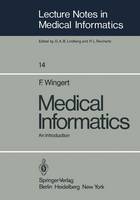
MORE ABOUT THIS BOOK
Main description:
With the exception of some additions in Section 3.1 and minor changes, the English edition of the "Medizinische Informatik" is a translation of the German edition. Because there is frequently no one-to-one correspondence between the Ger man and the English terminology, misinterpretations are possible. I have tried to avoid this situation as far as possible. The main problem re mains within the academic setting. In recent years, the term 1~for.atics has become popular in Europe, but is widely unknown in the United States. The field covers mostly what is understood as computer science and in formation science. The corresponding term medical inforaatics, now used in the name of international societies such as the "International Medical Informatics Association", covers "medical computer science", "medical information science", as well as "biomedical engineering" and has no de finite boundary to "biomathematics". The book has not been translated on a professional basis in order to keep my own style, although there has been assistance by Dr. S. Raymond, for which I am very grateful. Dipl.-Phys. N. Osada has been of great help both by proof-reading and by excellent support during preparation of the camera-ready manuscript. Further valuable advice has been given by: A.W. Pratt, M.D.; M. Ebstein, Ph.D.; M. Pacak, Ph.D.; G.S. Dunham; L.D. Nadel, Ph.D.; P.O. Miller.
Contents:
1. Information Processing in Medicine.- 1.1 Introduction.- 1.2 Overlap With Other Disciplines.- 2. Informatics.- 2.1 Structure.- 2.2 Fundamental Concepts.- 2.2.1 Message and Information.- 2.2.1.1 Events, Probability.- 2.2.1.2 SHANNON'S Information Theory.- 2.2.2 Languages.- 2.2.3 Discretization.- 2.2.3.1 Scanning.- 2.2.3.2 Quantization.- 2.2.4 Message Processing and Information Processing.- 2.2.5 Algorithms.- 2.2.6 Formal Languages.- 2.2.6.1 Programming Languages.- 2.2.7 Architecture of Digital Computers.- 2.2.8 Operating Modes of Digital Computers.- 2.2.9 Computer-Supported Problem Solving.- 3. Classification.- 3.1 Observation Units, Attributes.- 3.1.1 Attribute Structures.- 3.1.2 Binary Attributes.- 3.1.3 Trustworthiness of Data Observation.- 3.1.4 Models.- 3.2 Basic Formulation of the Classification Problem.- 3.3 Mathematical Classification.- 3.3.1 Known Probability Distributions.- 3.3.1.1 Dependency Analyses.- 3.3.1.1.1 Dependency Measures.- 3.3.1.1.2 Dependence of Dependent Variates on Independent Variates.- 3.3.1.1.3 Correlations Between Components of a Random Vector.- 3.3.1.1.4 Contingency-Table Analysis.- 3.3.1.2 Assignment to a Population Type I-Classification Problem.- 3.3.1.2.1 Statistical Decision Models.- 3.3.1.2.2 Predicate Logic Decision Model.- 3.3.2 Classification of an Observation Unit Type 11-Classification Problem.- 3.3.2.1 Configuration-Frequency Analysis.- 3.3.2.2 Cluster Analysis.- 3.3.2.2.1 Distance/Similarity.- 3.3.2.2.1.1 Qualitative Attributes.- 3.3.2.2.1.2 Quantitative Attributes.- 3.3.2.2.1.3 Classes.- 3.3.2.2.2 Algorithms.- 3.4 Classification of Concepts.- 3.4.1 Nomenclature and Terminology.- 3.4.2 Deep Structure of a Classification.- 3.4.2.1 Semantic Dimensions.- 3.4.2.1.1 Topography.- 3.4.2.1.2 Nosology.- 3.4.2.1.3 Morphology.- 3.4.2.1.4 Etiology.- 3.4.2.1.5 Function/Dysfunction.- 3.4.2.1.6 Modification.- 3.4.2.1.7 Procedures.- 3.4.2.2 Relations.- 3.4.3 Methods.- 3.4.4 Coding Semantic Relations.- 3.4.5 Common Classifications.- 3.4.5.1 International Classification of Diseases (ICD).- 3.4.5.2 Klinischer Diagnosenschlussel (KDS).- 3.4.5.3 Systematized Nomenclature of Pathology (SNOP).- 3.4.5.4 Systematized Nomenclature of Medicine (SNOMED).- 3.4.5.5 TNM-Classification.- 3.5 Sequential Decision Strategies.- 3.5.1 Optimal Solution Using Dynamic Programming.- 3.5.2 Heuristic Solutions.- 3.5.2.1 Known Probability Distributions.- 3.5.2.2 Unknown Probability Distributions.- 4. Medical Linguistics.- 4.1 Medical Language.- 4.2 Morphology.- 4.2.1 Elements of Word Construction.- 4.2.2 Word Models.- 4.2.3 Dictionaries.- 4.2.4 Algorithms.- 4.3 Syntax.- 4.3.1 Lexical Analysis.- 4.3.2 Syntactic Analysis.- 4.4 Semantics.- 4.5 Metalanguages in Medicine.- 5. Subfields of Medical Informatics.- 5.1 Data Models, Data Structures.- 5.1.1 Data Models.- 5.1.1.1 Relational Model.- 5.1.1.2 Hierarchic Model.- 5.1.1.3 Network Model.- 5.1.2 Data Structures.- 5.1.2.1 Primitive Objects.- 5.1.2.2 Compound Objects.- 5.1.2.3 Knowledge Representation.- 5.1.3 Data Structures in Medicine.- 5.1.3.1 Medical Record.- 5.1.3.2 General Face Sheet.- 5.1.3.3 Problem-Oriented Medical Record.- 5.1.3.4 Fundamental Documentation.- 5.1.3.5 Anamnesis.- 5.1.3.6 Epicrisis.- 5.1.3.7 Medical Utterance.- 5.1.3.7.1 Patient Identification.- 5.1.3.7.2 Medical Information.- 5.1.3.7.3 Relations.- 5.2 Data Acquisition and Input.- 5.2.1 Organizational Structures.- 5.2.2 Error Control.- 5.2.2.1 Error Detection and Error Supposition.- 5.2.2.1.1 Univariate Methods.- 5.2.2.1.2 Multivariate Methods.- 5.2.2.2 Error Control in the Clinical Laboratory.- 5.2.2.3 Misspellings in Texts.- 5.2.2.4 Disturbance of Analog Messages.- 5.3 Data Storage.- 5.4 Information Extraction.- 5.4.1 Indexing.- 5.4.1.1 Quality Measures.- 5.4.1.2 Methods.- 5.4.1.2.1 Word-Oriented Methods.- 5.4.1.2.2 Phrase-Oriented Methods.- 5.5 Information Retrieval.- 5.5.1 Language Synthesis.- 5.5.1.1 Automated Medical Reporting.- 5.5.1.2 Question-Answering Systems.- 5.6 Data Integrity.- 5.6.1 Data Consistency.- 5.6.2 Data Protection.- 6. Special Applications.- 6.1 Processing of Process Data.- 6.1.1 Biosignal Processing.- 6.1.1.1 Electrocardiography.- 6.1.1.2 Electroencephalography.- 6.1.2 Image Processing.- 6.1.2.1 Algorithms.- 6.1.2.1.1 Contrast Enhancement.- 6.1.2.1.2 Arithmetic Operations.- 6.1.2.1.3 Image Analysis.- 6.1.2.2 Computer-Tomography.- 6.1.3 Laboratory Data Processing.- 6.1.4 Radiology, Nuclear Medicine.- 6.1.5 Intensive-Care Medicine.- 6.2 Economic Applications.- 6.2.1 Patient Admission.- 6.2.2 Inventory Systems.- 6.2.2.1 Blood Bank.- 6.2.2.2 Pharmacy.- 6.3 Information Systems.- 6.3.1 Communication Systems.- 6.3.2 Hospital Information Systems (HIS).- 6.3.2.1 Objectives of a Hospital Information System..- 6.3.2.2 Functions of a Hospital Information System.- 6.3.2.3 Drug-Control Systems.- 6.3.2.4 Peculiarities in a Hospital Information System.- 6.4 Disease Registers.- 6.5 Bibliographies.- 7. References.- 8. Index of Tables.- 9. Index of Figures.- 10. Glossary.- 11. Symbols and Denotations.- 12. Subject Index.
PRODUCT DETAILS
Publisher: Springer (Springer-Verlag Berlin and Heidelberg GmbH & Co. K)
Publication date: April, 2012
Pages: 250
Weight: 462g
Availability: Available
Subcategories: General Issues