
(To see other currencies, click on price)
MORE ABOUT THIS BOOK
Main description:
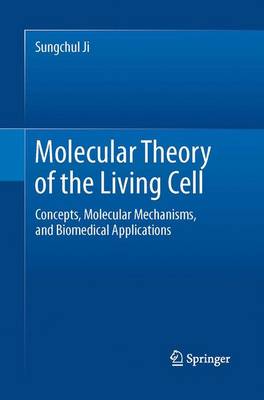
The book presents the first comprehensive molecular theory of the living cell ever published since the cell doctrine was formulated in 1838-1839. It introduces into cell biology over thirty key concepts, principles and laws imported from physics, chemistry, computer science, linguistics, semiotics and philosophy. The author formulates physically, chemically and enzymologically realistic molecular mechanisms to account for basic living processes such as ligand-receptor interactions, enzymic catalysis, force-generating mechanisms in molecular motors, chromatin remodelling, and signal transduction. Possible solutions to basic and practical problems facing contemporary biology and biomedical sciences have been suggested, including pharmacotherapeutics and personalized medicine.
Contents:
Preface.- 1. Introduction.- Part I. Principles, Laws, and Concepts.- 2. Physics.- 2.1. Thermodynamics of Living Systems.- 2.2. The Franck-Condon Principle (FCP).- 2.3. Complementarity.- 2.4. Renormalizable Bionetworks and SOWAWN Machines.- 2.5. The Theory of Finite Classes.- 2.6. Synchronic vs. Diachronic Causes.- 3. Chemistry.- 3.1. Principle of Self-Organization and Dissipative Structures.- 3.2. Conformations vs. Configurations: Noncovalent vs. Covalent Interactions (or Bonds).- 3.3.The Principle of Microscopic Reversibility.- 4. Biology.- 4.1. The Simpson Thesis.- 4.2. Molecular Machines, Motors, and Rotors.- 4.3. What Is Information?.- 4.4. The Chemistry and Thermodynamics of Information.- 4.5. Synchronic vs. Diachronic Information.- 4.6. Quantum Information and Enzymic Catalysis.- 4.7. The Information-Entropy Relation.- 4.8. The Minimum Energy Requirement for Information Transmission.- 4.9. Info-Statistical Mechanics and the Gnergy Space.- 4.10. Free Energy-Information Orthogonality as the 'Bohr-Delbruck Paradox'.- 4.11. What Is Gnergy?.- 4.12. Two Categories of Information in Quantum Mechanics.- 4.13. The Information-Energy Complementarity as the Principle of Organization.- 4.14. Quantization as a Prelude to Organization.- 4.15. Simple Enzymes are to Enzyme Complexes What Atoms are to Quantum Dots.- 4.16. "It from Bit" and the Triadic Theory of Reality.- 5. Engineering.- 5.1. Microelectronics.- 5.2. Computer Science.- 5.3. Cybernetics.- 6. Linguistics, Semiotics, and Philosophy.- 6.1. Linguistics.- 6.2. Semiotics.- 6.3.Philosophy.- Part II. Theories, Molecular Mechanisms, and Models.- 7. Molecular Mechanisms of Enzymic Catalysis.- 7.1. Molecular Mechanisms of Ligand-Protein Interactions.- 7.2. Enzymic Catalysis.- 8. The Conformon.- 8.1. The Definition and Historical Background.- 8.2. Generalized Franck-Condon Principle-Based Mechanism of Conformon Generation.- 8.3. Experimental Evidence for Conformons.- 8.4. Conformons as Force Generators of Molecular Machines.- 8.5. A Bionetwork Representation of the Mechanism of the Ca++ Ion Pump.- 8.6. Ion Pumps as Coincidence Detectors.- 8.7. The Conformon Hypothesis of Energy-Coupled Processes in the Cell.- 8.8. The von Neumann Questions and the Conformon Theory.- 9. Intracellular Dissipative Structures (IDSs).- 9.1. Experimental Evidence for IDSs (Dssipatons).- 9.2. The p53 Network as an 8-Dimensional Hypernetwork.- 9.3. Interactome, Bionetworks, and IDSs.- 10. The Living Cell.- 10.1.The Bhopalator: a Molecular Model of the Living Cell.- 10.2. The IDS-Cell Function Identity Hypothesis.- 10.3. The Triadic Structure of the Living Cell.- 10.4. A Topological Model of the Cell.- 10.5. The Atom-Cell Isomorphism Postulate.- 10.6. A Historical Analogy between Atomic Physics and Cell Biology.- 10.7. Evolving Models of the Living Cells.- Part III. Applications: From Molecules to Mind and Evolution.- 11.Subcellular Systems.- 11.1. Protein Folding and 'Infostatistical Mechanics'.- 11.2. What is a Gene?.- 11.3. Single-Molecule Enzymology.- 11.4. Conformon Model of Molecular Machines.- 11.5. The Conformon Theory of Oxidative Phosphorylation.- 11.6. Deconstructing the Chemiosmotic Hypothesis.- 12.Whole Cells.- 12.1. DNA Arrays: A Revolution in Cell Biology.- 12.2. DNA Array Technique.- 12.3. Simultaneous Measurements of Transcript Levels (TL) and Transcription Rates (TR).- 12.4. RNA Trajectories as Intracellular Dissipative Structures (IDSs).- 12.5. The IDS-Cell Function Identity Hypothesis: Experimental Evidence.- 12.6. The Transcription-Transcript Conflation.- 12.7. Mechanistic Modules of RNA Metabolism.- 12.8. Visualizing RNA Dissipatons.- 12.9. Structural Genes as Regulators of their own Transcripts.- 12.10. Rule-Governed Creativity in Transcriptomics: Microarray Evidence.- 12.11. Genes are Molecular Machines: Microarray Evidence.- 12.12. Isomorphism between Blackbody Radiation and Whole-Cell Metabolism: The Universal Law of Thermal Excitations (ULTE).- 12.13. The Quantization of the Gibbs Free Energy Levels of Enzymes in Living Cells.- 12.14. Time-Depedent Gibbs Free Energy Landscape (TGFEL): A Model of Whole-Cell Metabolism.- 12.15. The Common Regularities (Isomorphisms) found in Physics, Biology and Linguistics: The Role of Gnergy.- 12.16. Tripartite Signal Transduction Unit (TSTU) as the Atom of Life.- 12.17. Computing with Numbers, Words, and Molecules.- 13.Mechanisms of the Origin of Life.- 13.1. The Anderson Model of the Origin of Biological Information.- 13.2.The Conformons Model of the Origin of Life.- 14. Principles and Mechanisms of Biological Evolution.- 14.1. Darwin's Theory of Evolution.- 14.2.The Cell Theory of Evolution.- 14.3. The Principle of Maximum Complexity.- 14.4. Evolution as a Triadic Relation.- 14.5. The Gnergy Principle and Biological Evolution.- 14.6. The Thermodynamics and Informatics of the Control underlying Evolution and Development.- 14.7. The Zeldovich-Shakhnovich and MTLC (Molecular Theory of the Living Cell) Models of Evolution: From Sequences to Species.- 15. Multicellular Systems.- 15.1.The Morphogenesis of Drosophila melanogaster.- 15.2.The Roles of DNA, RNA and Protein Gradients in Drosophila Embryogenesis.- 15.3. The Triadic Control Principle (TCP).- 15.4. The Synchronic and Diachronic Interactions.- 15.5. The Dissipative Structure Theory of Morphogenesis.- 15.6. The Tree-And-Landscape (TRAL) Model of Evolutionary Developmental (EvoDevo) Biology.- 15.7. Quorum Sensing in Bacteria and Cell-Cell Communication Networks.- 15.8. Morphogenesis as a Form of Quorum Sensing.- 15.9. Carcinogenesis as Quorum Sensing Gone Awry.- 15.10. Symmetry Breakings in Morphogenesis and Cosmogenesis.- 15.11. Allometry.- 15.12. Micro-Macro Coupling in the Human Body.- 16. What Is Life?.- 16.1. The Definition of Life.- 16.2. Life according to Schrodinger.- 16.3. Life according to Bohr.- 16.4. Life according to Prigogine.- 16.5. Life according to Pattee.- 16.6. Life based on the Information-Energy Complementarity.- 16.7. Active vs. Passive Phase Transitions: Is Life a Critical Phenomenon?.- 17. Why Is the Cell So Complex?.- 17.1. The Structural Complexity of the Cell.- 17.2. The Dynamic Complexity of the Cell.- 17.3. The Four-Fold Complexities in Physics and Biology.- 17.4. The Law of Requisite Variety and Biocomplexity.- 17.5. Cybernetics-Thermodynamics Complementarity.- 17.6. The Universal Law of Thermal Excitations and Biocomplexity.- 17.7. The Quality-Quantity Duality and Biocomlexity.- 18. Ribonoscopy and Personalized Medicine.- 19. Ribonoscopy and 'Theragnostics'.- 20. Application of the Knowledge Uncertainty Principle to Biomedical Sciences.- 20.1. The Toxicological Uncertainty Principle (TUP).- 20.2. The Pharmacological Uncertainty Principle (PUP).- 20.3. The Medical Uncertainty Principle (MUP).- 20.4. The U-Category: The Universal Uncertainty Principle as a Category.- 21. Conclusions.- Appendices.- Glossary.- References.- Index.
PRODUCT DETAILS
Publisher: Springer (Springer-Verlag New York Inc.)
Publication date: August, 2016
Pages: 748
Weight: 1559g
Availability: Available
Subcategories: Biochemistry