
(To see other currencies, click on price)
MORE ABOUT THIS BOOK
Main description:
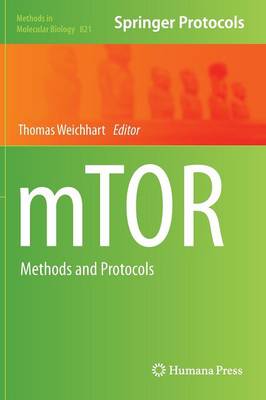
Since its discovery, the mammalian target of rapamycin (mTOR) has been shown to regulate many critical molecular processes in eukaryotes such as metabolism, growth, survival, aging, synaptic plasticity, memory, and immunity. In mTOR: Methods and Protocols expert researchers in the field detail many of the methods which are now commonly used to study mTOR. These include methods and techniques used for the study of the mTOR pathway and potential therapeutic applications of mTOR inhibitors such as, immunosuppressive and anticancer agents. Written in the highly successful Methods in Molecular Biology (TM) series format, chapters include introductions to their respective topics, lists of the necessary materials and reagents, step-by-step, readily reproducible laboratory protocols, and key tips on troubleshooting and avoiding known pitfalls.
Authoritative and practical, mTOR: Methods and Protocols seeks to aid scientists in the further study of this crucially important molecule ranging from the analysis of signal transduction events within a cell to the assessment of complex human diseases such as metabolic disorders or cancer.
Contents:
1. Mammalian Target of Rapamycin: A Signaling Kinase for every Aspect of Cellular Life
Thomas Weichhart
2. Biochemical and Pharmacological Inhibition of mTOR by Rapamycin and an ATP-Competitive mTOR Inhibitor
Ker Yu and Lourdes Toral-Barza
3. Evaluation of the Nutrient-Sensing mTOR Pathway
Sungki Hong, Aristotle M. Mannan and Ken Inoki
4. mTOR Activity Under Hypoxia
Douangsone D. Vadysirisack and Leif W. Ellisen
5. Isolation of the mTOR Complexes by Affinity Purification
Tattym Shaikenov, Olga Bulgakava, Rakhment I. Bersimbaev and Dos D. Sarbassov
6. An in vitro Assay for the Kinase Activity of mTOR Complex 2
Jingxiang Huang
7. Overexpression or Downregulation of mTOR in Mammalian Cells
Mahmoud Khalil and Ivan Gout
8. Dectection of Cytoplasmic and Nuclear Functions of mTOR by Fractionation
Margit Rosner and Markus Hengstschlager
9. Evaluation of Rapamycin-Induced Cell Death
Lorenzo Galluzzi, Eugenia Morselli, Oliver Kepp, Ilio Vitale, Amena Ben Younes, Maria Chiara Maiuri and Guido Kroemer
10. Evaluation of mTOR-Regulated mRNA Translation
Valentina Iadevaia, Xuemin Wang, Zhong Yao, Leonard J. Foster and Christopher G. Proud
11. A Genome-wide RNAi Screen for Polypeptides that Alter rpS6 Phosphorylation
Angela Papageorgiou and Joseph Avruch
12. Immunohistochemical Analysis of mTOR Activity in Tissues
Jinhee Kim, Nancy Otto, Claudio J. Conti, Irma B. Gimenz-Conti and Cheryl L. Walker
13. Assessing Cell Size and Cell Cycle Regulation in Cells with Altered TOR Activity
Megan Cully and Julian Downward
14. Quantitative Visualization of Authophagy Induction by mTOR Inhibitors
Beat Nyfeler, Philip Bergman, Christopher J. Wilson and Leon O. Murphy
15. The in vivo Evaluation of Active-Site TOR Inhibitors (asTORi) in Models of BCR-ABL+Leukemia
Matthew R. Janes and David A. Fruman
16. Inducible raptor and rictor Kncokout Mouse Embryonic Fibroblasts
Nadine Cybulski, Vittoria Zinzalla, and Michael N. Hall
17. Expanding Human T Regulatory Cells with the mTOR- Inbibitor Rapamycin
Manuela Battaglia, Angela Stabilini and Eleonora Tresoldi
18. Rapamycin Induced Enhancement of Vaccine Efficacy in Mice
Chinnaswamy Jagannath and Pearl Bakhru
19. Utilizing a Retroviral RNAi System to Investigate in vivo mTOR Functions in T Cells
Koichi Araki and Bogumila T. Konieczny
20. Exploring Functional in Vivo Consequences of the Selective Genetic Ablation of mTOR Signaling in T Helper Lymphocytes
Greg M. Delgoffe and Jonathan D. Powell
21. Evaluating the Therapeutic Potential of mTOR Inhibitors Using Mouse Genetics
Huawei Li, Jennifer L. Cotton, David A. Guertin
22. Inhibition of PI13K-Akt-mTOR Signaling in Glioblastoma by mTORC1/2 Inhibitors
Qi-Wen Fan and Williams A. Weiss
23. Assessing the Functions of mTOR in Human Embryonic Stem Cells
Jiaxi Zhou, Dong Li, and Fei Wang
24. Video-EEG Monitoring Methods for Characterizing Rodent Models of Tuberous Sclerosis and Epilepsy
Nicholas R. Rensing, Dongjun Guo, and Michael Wong
25. A Genetic Model to Dissect the Role of Tsc-mTORC1 in Neuronal Cultures
Duyu Nie and Mustufa Sahin
26. Tissue-Specific Ablation of Tsc1 in Pancreatic Beta-Cells
Hiroyuki Mori and Kun-Liang Guan
27. A Mouse Model of Diet- Induced Obesity and Insulin REsistance
Chao-Yung Want and James K. Liao
28. Rapamycin as Immunosuppressant in Murine Transplantation Model
Louis-Marie Charbonnier and Alain Le Moine
29. Development of ATP-Competitive mTOR Inhibitors
Qingsong Liu, Seong A. Kang, Carson C. Thoreen, Wooyoung Hur, Jinhua Wang, Jae Won Chang, Andrew Markhard, Jianming Zhang, Taebo Sim, David M. Sabatini and Nathanael S. Gray
PRODUCT DETAILS
Publisher: Springer (Humana Press Inc.)
Publication date: December, 2011
Pages: 477
Weight: 1092g
Availability: Available
Subcategories: Pharmacology, Physiology