
(To see other currencies, click on price)
MORE ABOUT THIS BOOK
Main description:
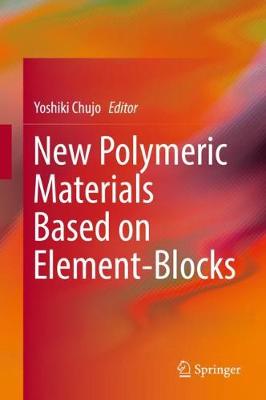
This book introduces the recent progress that has resulted from utilizing the idea of "element-block polymers". A structural unit consisting of various groups of elements is called an "element-block." The design and synthesis of new element-blocks, polymerization of these blocks, and development of methods of forming higher-order structures and achieving hierarchical interface control in order to yield the desired functions are expected to result in manifold advantages. These benefits will encourage the creation of new polymeric materials that share, at a high level, electronic, optical, and magnetic properties not achievable with conventional organic polymeric materials as well as forming properties of molding processability and flexible designability that inorganic materials lack. By pioneering innovative synthetic processes that exploit the reactivity of elements and the preparation techniques employed for inorganic element-blocks, the aim is (1) to create a new series of innovative polymers based on the novel concept of element-block polymers, in which the characteristics of elements are extensively combined and utilized, and (2) to formulate theories related to these polymers. This book demonstrates especially the design strategies and the resulting successful examples offering highly functional materials that utilize element-block polymers as a key unit.
Contents:
Part I: New Materials Based on Novel Concept of Element-Blocks
Chapter 1
Element-Block Materials: New Concept for Development of Advanced Hybrids and Inorganic Polymers
Chapter 2
Si-, Ge-, and Sn-Bridged Biaryls as -Conjugated Element Blocks
Chapter 3
Elements-block -Conjugated Polymers by Post-element-transformation Technique
Chapter 4
Borylated Polystyrenes as Versatile Functional Materials
Chapter 5
Element-block polymeric materials based on cage silsesquioxane frameworks
Chapter 6
Silsesquioxane based hierarchical and hybrid materials
Chapter 7
Nanocomposite materials properties of aminophenylsilsesquioxanes
Chapter 8
Necklace-shaped Dimethylsiloxane Polymers Bearing Polyhedral Oligomeric Silsesquioxane Cages as a New Type of Organic-Inorganic Hybrid
Chapter 9
Alternative Aspects of Polythiophenes
Chapter 10
Polyphosphzenes as an Example of the Element-Blocks Approach to New Materials
Chapter 11
Electronic Structure of Element-Block Material As4S6 with Cage Shape toward "Soft Electride"
Chapter 12
Metalloxane cage compounds as an element-block
Chapter 13
Preparation of Element-Block Materials Using Inorganic Nanostructures and Their Applications
Chapter 14
Design of Element Blocks for Photoresponsive Organosiloxane-based Materials
Chapter 15
How can we control the "element-blocks" in transition metal oxide crystals?
Part II: Applications of Element-Blocks as New Functional Materials
Chapter 16
Organic-inorganic hybrid material with surface modified zirconia nanoparticles as element blocks
Chapter 17
Network formation conditions control water drop adhesion for VK100 and a model Pt-cured silicone
Chapter 18
Block copolymers with element blocks: The metal-bisterpyridine linkage
Chapter 19
Three-dimensional Coordination Polymers composed of luminescent lanthanide element blocks
Chapter 20
Organic Hybrid Thermoelectric Materials Containing Nano-dispersed Poly(nickel 1,1,2,2-ethenetetrathiolata) as an Element Block
Chapter 21
Crystallization kinetics-induced self-assembly of inorganic element blocks and the surface enhanced Raman scattering based on Ag hierarchical structures
Chapter 22
Air-stable opto-electronic devices with metal-oxide cathodes
Chapter 23
Design of multi-functional soft-biomaterials based on the intermediate water concept
Chapter 24
Synthesis of calcium-phosphate-based nanoparticles as biocompatible and biofunctional element blocks
PRODUCT DETAILS
Publisher: Springer (Springer Verlag, Singapore)
Publication date: January, 2019
Pages: 444
Weight: 1046g
Availability: Available
Subcategories: Biomedical Engineering