(To see other currencies, click on price)
MORE ABOUT THIS BOOK
Main description:
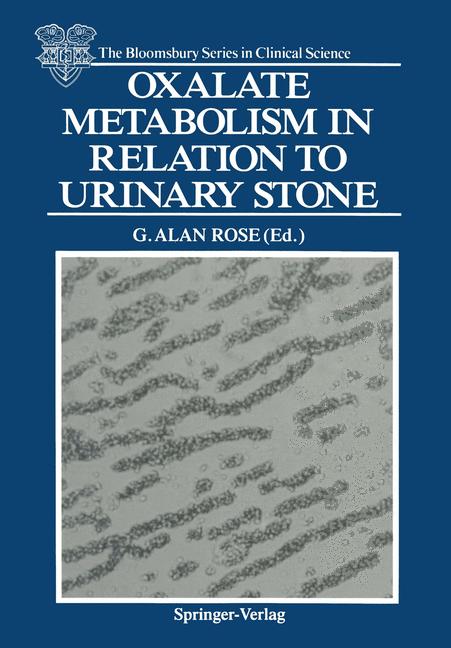
"Oxalate Metabolism in Relation to Urinary Stone" is the third monograph to appear in the "Bloomsbury Series". Edited by Alan Rose, the book describes the current clinical and biochemical features of oxalate metabolism. Its content and direction fulfil the goals of the Series emphasising the strong links between basic science and clinical medicine. London Jack Tinker 30 March 1988 Preface The first oxalate workshop was held in London in 1979 and the proceedings published privately by the Wellcome Foundation. At that time the importance of urinary oxalate as a risk factor more important for calcium oxalate stone formation than urinary calcium had been recognized. Nevertheless measurements of urinary oxalate still left a lot to be desired and in particular the non-enzymatic conversion of ascorbate to oxalate had not been rediscovered so that many measurements must have been wrong. Plasma oxalate was still difficult or impossible to measure by any reasonable, accessible methods and consequently there was still much argument and speculation about the handling of oxalate by the kidneys. A lot of work has been performed in the last eight years on oxalate metabolism and it therefore seemed to the organisers to be a good time to hold a second oxalate workshop.
Contents:
1 Introduction.- Plasma Oxalate/Creatinine Ratio.- Renal Hyperoxaluria?.- 2 Assay of Oxalate and Glycollate in Urine.- Relevant Chemistry of Oxalate and Glycollate Anions.- Assaying of Oxalate in Urine.- Methods for the Preliminary Separation of Oxalate from Other Urinary Constituents.- Analytical Approaches for Determining Urinary Oxalate.- Ascorbate - a Major Problem in the Assaying of Oxalate in Urine.- Normal Range for Urinary Oxalate.- Assaying for Urinary Glycollate.- Chemical Techniques.- Physical Techniques.- Enzymatic Techniques.- Usefulness of Urinary Glycollate in Determining the Origin of Hyperoxaluria.- Summary.- 3 Experiences with an External Quality Assessment Scheme for Urinary Oxalate.- Urinary Oxalate Assay - the Need for External Quahty Assessment.- Organisation of the Quality Assessment Scheme.- Details of Participants.- Preparation and Distribution of Material.- Results.- Selection of Data.- Between-Laboratory Imprecision.- Accuracy.- Ascorbate Interference and its Removal.- Other Observations on Selected Methods.- Discussion.- Conclusion.- 4 Assaying of Oxalate in Plasma.- Plasma-Oxalate Determination.- Separation of Oxalate from Plasma prior to its Measurement.- In vitro Assays for Plasma Oxalate.- In vivo Radioisotopic Assays.- Assaying of Plasma Oxalate at St Peter's Hospitals (London).- Plasma Oxalate Levels in Normal and some Pathological States. Clinical Usefulness of Plasma Oxalate.- Normal Subjects.- Patients with Renal Failure with or without Primary Hyperoxaluria.- Circadian Variation of Plasma Oxalate. Implications for zxOxalate Clearance.- Conclusions and Summary.- 5 Primary Hyperoxaluria.- Clinical Aspects.- Biochemistry.- General.- The Metabolic Lesion in Type I Primary Hyperoxaluria.- The Metabohc Lesion in Type II Primary Hyperoxaluria.- Primary Hyperoxaluria Type III.- Investigation and Evaluation of Patients with Primary Hyperoxaluria.- Treatment.- 6 Primary Hyperoxaluria in Children.- Clinical Features.- Age and Sex.- Presentation.- Infantile Oxalosis.- Older Children.- Biochemical Features.- Urine Oxalate in Normal Children.- Hyperoxaluria.- Glycollate.- Diagnosis in Renal Failure.- Progress.- Renal Function.- Systemic Oxalosis.- Treatment.- Simple Measures.- Pyridoxine.- Surgery and Lithotripsy.- Dialysis and Transplantation.- The Future.- Antenatal Diagnosis.- Liver Transplantation.- 7 Enteric and Other Secondary Hyperoxalurias.- Oxalate Metabolism and Secondary Hyperoxaluria.- Pathogenesis of Enteric Hyperoxaluria.- Glyoxylate Theory.- Origin of Excess Urinary Oxalate.- Reasons for Hyperabsorption of Dietary Oxalate.- Clinical Importance of Enteric Hyperoxaluria.- Renal Complications.- Screening for Steatorrhoea with the Oxalate Loading Test.- Treatment of Enteric Hyperoxaluria.- Dietary Measures.- Drug Therapy.- Surgical Treatment.- Summary.- 8 Mild Metabolic Hyperoxaluria. A New Syndrome.- Historical.- Clinical Details of Patients.- Link with Other Conditions.- Response to Pyridoxine.- Aetiology.- Have Others Seen MMH?.- Effect of Pyridoxine on Stone Formation.- 9 Oxalate Crystalluria.- Crystal Types Seen by Light Microscopy at 37 DegreesC.- Calcium Oxalate.- Calcium Phosphate.- Investigating Crystalluria.- Inducing Crystallisation.- Generating Crystals by Evaporation.- Quantitative Crystal Measurements.- Determining Relative Amounts of Calcium Oxalate Crystals.- Absolute Quantities of Calcium Oxalate Crystals.- Chemical Analysis of Urinary Crystals.- Recent Studies of Crystalluria.- Crystal Sizes.- "Eroded" Envelope Oxalate Crystals.- The Importance of Urinary Oxalate in Calcium Oxalate Crystalluria.- Microscopy of Urinary Oxalate Crystals.- Aggregation of Envelope Oxalate Crystals.- Role of Urinary Calcium Concentration in Oxalate Crystalluria.- Urine Osmolality and Calcium Oxalate Crystalluria.- Osmolality and Calcium Phosphate Crystalluria.- pH Effects on Crystalluria.- Microscopy Findings.- Effect on Crystalluria of Urinary pH.- Inhibitors of Calcium Oxalate Crystallisation.- Summary.- 10 Renal Failure and Transplantation in Primary Hyperoxaluria.- Clinical Aspects.- Medical Care.- Surgical Care.- Systemic Oxalosis.- Peritoneal Dialysis and Haemodialysis.- Renal Transplantation.- Combined Hepatic and Renal Transplantation.- Conclusion.- 11 Vitamin B6 Metabolism in Relation to Metabolic Hyperoxaluria.- Structure and Function of Vitamin B6.- Vitamin B6 and Hyperoxaluria.- Methods for Studying Pyridoxine Metabolism.- Analytical Problems.- Present Methods Available.- A Simple HPLC Method for Studying Vitamin B6 Metabolism.- Apotryptophanase Assay.- Urinary Pyridoxic Acid Assay.- Evaluation of Plasma Vitamin B6 Methods.- Separation of Vitamin B6 Standards.- Calibration of HPLC System.- Chemical Recovery of B6 Vitamers from Plasma.- Precision of HPLC Assay for Vitamin B6.- Correlation between HPLC and Enzymatic Method for Plasma PLP.- Correlation between Two Methods for Pyridoxic Acid.- Physiology of Pyridoxine.- Diurnal Rhythm of Plasma PLP in Normal Subjects.- Effect of a Single Dose of 200 mg Pyridoxine.- Reference Plasma PLP Values.- Plasma B6 Profile from a Normal Subject.- Plasma B6 Profiles from Individuals on Pyridoxine Supplements.- Half-Life of Plasma Pyridoxine.- Effect of Dose of Pyridoxine on Plasma Levels of Vitamers.- Plasma Levels of Vitamin B6 in Metabolic Hyperoxalurias.- Urinary Excretion of Pyridoxic Acid after Load of Pyridoxine.
PRODUCT DETAILS
Publisher: Springer (Springer London Ltd)
Publication date: January, 2012
Pages: 197
Weight: 382g
Availability: Available
Subcategories: Biochemistry, Nephrology, Pharmacology, Urology
From the same series