
(To see other currencies, click on price)
MORE ABOUT THIS BOOK
Main description:
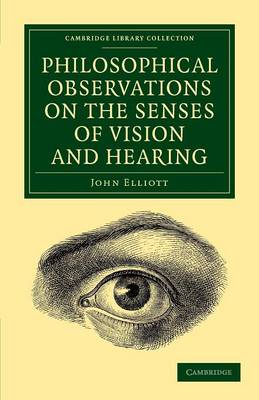
Although first to suggest the possibility of light frequencies beyond the visible spectrum, the natural philosopher John Elliott (1747-87) was better known at his death for his failed suicide in front of the woman he loved. Tried for attempting to shoot her, he was acquitted but died in prison awaiting trial on the lesser charge of assault. First published in 1780, this work was his most important. Contemporary science held that vibrations of the air were directly communicated to the optic and auditory nerves and passed on to the sensorium, while Elliot proposed, through experimentation upon himself, the existence of sensory receptors, each tuned to only a limited part of the spectrum of physical frequencies. This insight led him to postulate the existence of what we now know to be ultraviolet and infrared radiation, thus paving the way for further discoveries in human sensory perception.
Contents:
Preface; Part I. Observations on the Senses: 1. Of vision; 2. Of taste, smell and feeling; 3. Of hearing; 4. Other phenomena of hearing; 5. An appendix to the foregoing essay; Part II. A Treatise on Harmonic Sounds: Introduction; The theory of harmonic sounds; Part III. An Inquiry into Combustion: 1. The principal phenomena of incombustible bodies; 2. The phenomena of combustible bodies; 3. Of the principle on which combustion depends; 4. Of the phlogiston; 5. Of the heat and light attending combustion; 6. Of the continuance of combustion; 7. A speculation; 8. Of the origin of heat in combustion; 9. Of the light and colours which arise on the ignition, and combustion of bodies; 10. Of respiration, and animal heat; 11. Of the vital and other motions of the body; 12. Of the action of the fibres, or muscular motion; Appendix.
PRODUCT DETAILS
Publisher: Cambridge University Press
Publication date: July, 2013
Pages: 236
Dimensions: 140.00 x 216.00 x 14.00
Weight: 310g
Availability: Available
Subcategories: Physiology