
(To see other currencies, click on price)
MORE ABOUT THIS BOOK
Main description:
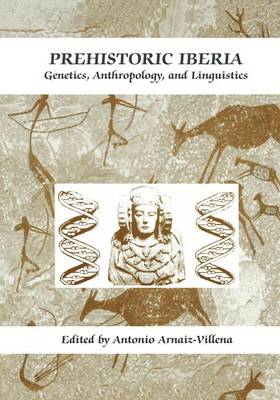
The symposium "Prehistoric Iberia: genetics, anthropology and linguistics" was held in the Circulo de Bellas Artes, Madrid on 16th -17th November 1998. The idea was bringing together specialists who could address not clearly resolved historic and prehistoric issues regarding ancient Iberian and Mediterranean populations, following a multidisciplinary approach. This was necessary in the light of the new bulk of genetic, archeological and linguistic data obtained with the new DNA technology and the recent discoverings in the other fields. Genes may now be easily studied in populations, particularly HLA genes and markers of the mitochondrial DNA and the Y chromosome. Basques, Iberians, North Africans, Berbers (Imazighen) and Mediterraneans have presently been widely studied. The genetic emerging picture is that Mediterraneans are closely related from West (Basque, Iberians, Berbers) to East (Jews, Lebanese, Cretans); however, Greeks are outliers in all the analyses done by using HLA genes. Anthropologists and archeologists showed how there was no people substitution during the revolutionary Mesolithic-Neolithic transition; in addition, cultural relationships were found between Iberia and predinastic Egypt (EI Badari culture). Basque language translation into Spanish has been the key for relating most Mediterranean extinct languages. The Usko-Mediterranean languages were once spoken in a wide African and European area, which also included parts of Asia. This was the "old language" that was slowly substituted by Eurasian languages starting approximately after the Bronze Age (or 2,000 years BC).
Contents:
Preface. Part I. Genetics: 1. Genetic and historical relationships among Mediterraneans; J. Martinez-Laso, et al. 2. Genetic affinities among human populations inhabiting the sub-Saharan area, Northwest Africa, and the Iberian Peninsula; C. Flores, et al. 3. The history of Iberian and Moroccan populations: evidence from genetic data (DNA studies and classical polymorphisms); P. Moral, et al. 4. The Berbers of North Africa: genetic relationships according to HLA and other polymorphisms, A. Sanchez-Mazas; Part II. Anthropology: 5. Berber ethnogenesis: the origin of the first Berber-speaking social formations; J. Onrubia Pintado. 6. Applications of evolutive archeology: migrations from Africa to Iberia in the recent prehistory; J. L. Escacena Carrasco. Part III. Linguistics: 7. Deciphering the Iberian-Tartesian language; J. Alonso-Garcia et al. 8. The Basque language is included in the Dene-Caucasian language family; M. Ruhlen. 9. The Usko-Mediterranean languages; A. Arnaiz-Villena, J.Alonso-Garcia. Index.
PRODUCT DETAILS
Publisher: Springer (Springer-Verlag New York Inc.)
Publication date: October, 2012
Pages: 252
Weight: 515g
Availability: Available
Subcategories: Genetics