
(To see other currencies, click on price)
MORE ABOUT THIS BOOK
Main description:
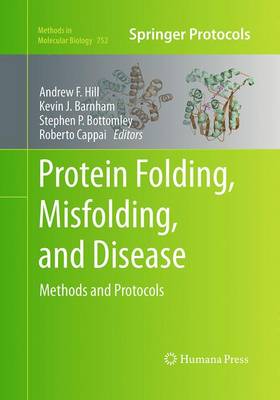
Protein misfolding is a key feature of many disorders in humans, given that over twenty proteins are known to misfold and cause disease. In Protein Folding, Misfolding, and Disease: Methods and Protocols, experts in the field present a collection of current methods for studying the analysis of protein folding and misfolding, featuring strategies for expressing and refolding recombinant proteins which can then be utilized in subsequent experiments. This detailed volume also covers methods for analyzing the formation of amyloid, protocols for determining the size and structure of native and misfolded proteins, as well as specific examples of where misfolded proteins can be examined using state-of -the-art technologies. Written in the highly successful Methods in Molecular Biology (TM) series format, chapters contain introductions to their respective topics, lists of the necessary materials and reagents, step-by-step, readily reproducible laboratory protocols, and key tips on troubleshooting and avoiding known pitfalls.
Up to date and authoritative, Protein Folding, Misfolding, and Disease: Methods and Protocols offers researchers the tools necessary to move ahead in this vital field.
Contents:
1. Strategies for Boosting the Accumulation of Correctly Folded Recombinant Proteins Expressed in Escherichia coli
Ario de Marco
2. An Escherichia coli Cell-Free System for Recombinant Protein Synthesis on a Milligram Scale
Luke A. Miles, Gabriela A.N. Crespi, Han Sen, Andrew F. Hill, and Michael W. Parker
3. Synthesis of Peptide Sequences Derived from Fibril-Forming Proteins
Denis B. Scanlon and John A. Karas
4. Refolding Your Protein with a Little Help from REFOLD
Jennifer Phan, Nasrin Yamout, Jason Schmidberger, Stephen P. Bottomley, and Ashley M. Buckle
5. Circular Dichroism and Its Use in Protein Folding Studies
David T. Clarke
6. Distance Measurements by Continuous Wave EPR Spectroscopy to Monitor Protein Folding
James A. Cooke and Louise J. Brown
7. Solution-State Nuclear Magnetic Resonance Spectroscopy and Protein Folding
Lisa D. Cabrita, Christopher A. Waudby, Christopher M. Dobson, and John Christodoulou
8. Diagnostics for Amyloid Fibril Formation: Where to Begin
Danny M. Hatters and Michael D. Griffin
9. Probing Protein Aggregation with Quartz Crystal Microbalances
Tuomas P.J. Knowles, Glyn L. Devlin, Christopher M. Dobson, and Mark E. Welland
10. Dried and Hydrated X-Ray Scattering Analysis of Amyloid Fibrils
Sally L. Gras and Adam M. Squires
11. Solid-State NMR of Amyloid Membrane Interactions
John D. Gehman and Frances Separovic
12. Sedimentation Velocity Analysis of Amyloid Fibrils
Chi Le Lan Pham, Yee-Foong Mok, and Geoffrey J. Howlett
13. Transmission Electron Microscopy of Amyloid Fibrils
Sally L. Gras, Lynne J. Waddington, and Kenneth N. Goldie
14. Surface Plasmon Resonance Spectroscopy: A New Lead in Studying the Membrane Binding of Amyloidogenic Transthyretin
Xu Hou, David H. Small, and Marie-Isabel Aguilar
15. Elucidating the Role of Metals in Alzheimer's Disease through the Use of Surface Enhanced Laser Desorption / Ionisation Time-of-Flight Mass Spectrometry
Andrew D. Watt, Keyla A. Perez, and Lin Wai Hung
PRODUCT DETAILS
Publisher: Springer (Humana Press Inc.)
Publication date: August, 2016
Pages: 249
Weight: 500g
Availability: Available
Subcategories: Pathology