(To see other currencies, click on price)
MORE ABOUT THIS BOOK
Main description:
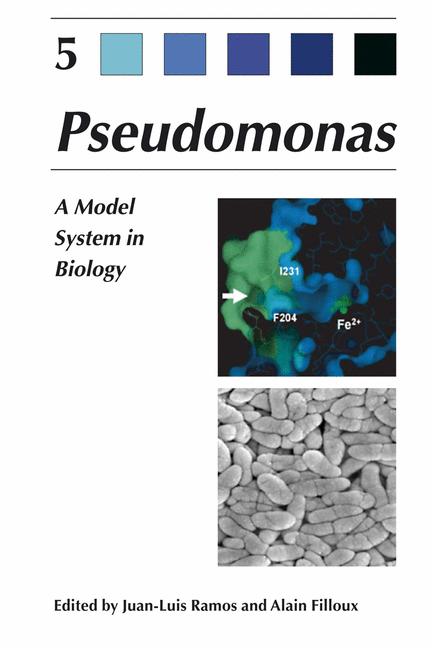
The first four volumes of Pseudomonas series covered the biology of pseudomonads in a wide context, including the niches they inhabit, the taxonomic relations among members of this group, the molecular biology of gene expression in different niches and under different environmental conditions, the analysis of virulence traits in plants, animals and human pathogens as well as the determinants that make some strains useful for biotechnological applications and promotion of plant growth.
Pseudomonas volume 5 is intended to collect new information on the genomics of saprophytic soil Pseudomonas, as well as functions related to genomic islands. Pseudomonas are ubiquitous inhabitants and this volume explores life styles in different settings and sheds further insights on the wide metabolic potential of this microbe for the removal of pollutants and production of added-value products. This volume also explores how Pseudomonas responds and reacts to environmental signals, including detection of cell density.
This fifth volume covers the following topics:
- Genomics
- Physiology and metabolism
- Databases
- Gene regulation
- Pathogenesis
- Catabolism and biotransformations.
Pseudomonas volume 5 will be of use to researchers working on these bacteria, particularly those studying virulence, genomics, physiology, biotechnology, biotransformations, etc. Advanced students in biology, medicine and agronomy will also find this volume a valuable reference during their studies.
Feature:
Most recent addition and updates in the field of Pseudomonas
Novel concepts and technologies in bacterial genomics and pathogenesis
International expertise from top experts in the field
In depth review of specific areas of research for Pseudomonas
Contents:
GENOMICS 1. Genomics of Pseudomonas fluorescens Pf-5
Dmitri V. Mavrodi, Ian T. Paulsen, Qinghu Ren and Joyce E. Loper 2. Glycosilation Islands of Pseudomonas species
Amrisha Verma and Reuben Ramphal PHYSIOLOGY AND METABOLISM 3. Styrene, an unpalatable substrate with complex regulatory networks
Livia Leoni, Giordano Rampioni and Elisabetta Zennaro 4. Degradation of o-xylene by Pseudomonas stutzeri OX1 (Pseudomonas sp. OX1)
Paola Barbieri, Dafne Solera, Enrica Galli, Faustino Vidal-Aroca and Giovanni Bertoni 5. Carbazole metabolism by Pseudomonas
Hideaki Nojiri and Toshio Ohmori 6. The catabolism of phenylacetic acid and other related molecules in Pseudomonas putida U.
José María Luengo, Sagrario Arias, Mario Arcos and Elías R. Olivera 7. Role of membrane structure during stress signalling and adaptation in Pseudomonas
Christine Baysse and Fergal O’Gara DATABASES 8. Towards a genome-wide mutant library of Pseudomonas putida strain KT2440 Estrella Duque, Antonio J. Molina-Henares, Jesús de la Torre, María Antonia Molina-Henares, Teresa del Castillo, Jennifer Lam, and Juan L. Ramos GENE REGULATION 9. The use of microcalorimetry to study regulatory mechanisms in Pseudomonas
Tino Krell, Andreas Busch, María-Eugenia Guazzaroni, Jesús Lacal, María-Trinidad Gallegos and Wilson Terán 10. Cell-cell communication: Quorum sensing and regulatory circuits in Pseudomonas aeruginosa
Andrée M. Lazdunski, Isabelle Ventre, and Sophie Bleves 11. Modulation of bacteria lifestyles via two-component regulatory networks
Isabelle Ventre, Andrew L. Goodman, Alain Filloux, and Stephen Lory PATHOGENESIS 12. Pseudomonas aeruginosainternalization by non-phagocytic cells
Joanne Engel CATABOLISM AND BIOTRANSFORMATIONS 13. Histidine catabolism and catabolite regulation
Yoshifumi Itoh, Takayuki Nishijyo, and Yuyi Nakada 14. Synthesis and degradation of polyhydroxyalkanoates
Auxiliadora Prieto, Laura I. de Eugenio, Beatriz Galán, José M. Luengo, and Bernard Witholt
15. Quorum quenching acylases in Pseudomonas aeruginosa
Joanna Krzeslak, Mariana Wahjudi and Wim J. Quax
PRODUCT DETAILS
Publisher: Springer (Springer Netherlands)
Publication date: July, 2007
Pages: 463
Availability: Not available (reason unspecified)
Subcategories: Microbiology
Publisher recommends