
(To see other currencies, click on price)
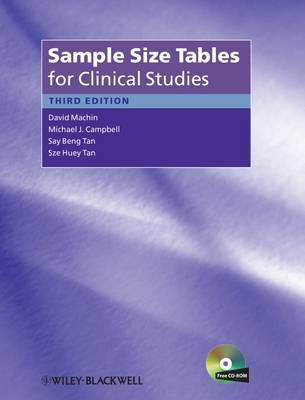
MORE ABOUT THIS BOOK
Main description:
This book provides statisticians and researchers with the statistical tools – equations, formulae and numerical tables – to design and plan clinical studies and carry out accurate, reliable and reproducible analysis of the data so obtained. There is no way around this as incorrect procedure in clinical studies means that the researcher′s paper will not be accepted by a peer–reviewed journal. Planning and analysing clinical studies is a very complicated business and this book provides indispensible factual information.
Back cover:
This book provides statisticians and researchers with the statistical tools – equations, formulae and numerical tables – to design and plan clinical studies and carry out accurate, reliable and reproducible analysis of the data so obtained. There is no way around this as incorrect procedure in clinical studies means that the researcher′s paper will not be accepted by a peer–reviewed journal. Planning and analysing clinical studies is a very complicated business and this book provides indispensible factual information.
Contents:
Preface, viii.
1 Basic design considerations, 1
2 Distributions and confidence intervals, 14
Table 2.1 The Normal distribution functionaprobability that aNormally distributed variable is less than z, 27
Table 2.2 Percentage points of the Normal distribution for a and1 – ß, 28
Table 2.3 Values of ?(a, ß) = (z1–a/2 + z1–ß)2, 28
Table 2.4 The t–distribution, 29
3 Comparing two independent groups for binary data,30
Table 3.1 Sample size for the comparison of two proportions,38
Table 3.2 Sample size for the comparison of two proportionsusing the odds ratio (OR), 40
4 Comparing two independent groups for ordered categoricaldata, 42
5 Comparing two independent groups for continuous data,47
Table 5.1 Sample sizes for the two sample t–test with two–sideda = 0.05, 54
Table 5.2 Sample sizes for the two sample t–test with unequalvariances, 55
Table 5.3 Sample sizes for the one sample t–test with two–sideda = 0.05, 57
6 Cluster designs, repeated measures data and more than twogroups, 58
Table 6.1 Multiplying factor for repeated measures designs,66
7 Comparing paired groups for binary, ordered categorical andcontinuous outcomes, 67
Table 7.1 Sample sizes for paired binary data, 80
Table 7.2 Sample sizes for paired continuous data with two–sideda = 0.05, 81
8 Comparing survival curves, 82
Table 8.1 Number of critical events for comparison of survivalrates (Logrank test), 95
Table 8.2 Number of subjects for comparison of survival rates(Logrank test), 97
Table 8.3 Number of critical events for comparison of twoexponential survival distributions with two–sided a = 0.05, 99
9 Equivalence, 100
Table 9.1 Sample sizes for bioequivalence studiesadifferencebetween two means or ratio of two means, 115
Table 9.2 Sample sizes for testing the equivalence of two means,116
Table 9.3 Sample sizes for testing the equivalence of twoproportions, 118
10 Confidence intervals, 120
Table 10.1 Sample sizes required to observe a given confidenceinterval width for a given proportion in a sample from a largepopulation, 134
Table 10.2 Sample sizes required to observe a given confidenceinterval width for the difference between twoproportionsaindependent groups, 135
Table 10.3 Sample sizes required to observe a proportionateconfidence interval width for the difference between two groupsexpressed via the odds ratio (OR), 136
Table 10.4 Sample sizes required to observe a given confidenceinterval width for the difference between two proportions frompaired or matched groups, 137
Table 10.5 Sample sizes required to observe a given confidenceinterval width to estimate a single mean or the difference betweentwo means for independent or matched groups, 139
11 Post–marketing surveillance, 140
Table 11.1 Sample sizes required to observe a total of a adversereactions with a given probability 1 – ß and anticipatedincidence ?, 147
Table 11.2 Sample sizes required for detection of a specificadverse reaction with background incidence, ?0, known, 148
Table 11.3 Sample sizes required for detection of a specificadverse reaction with background incidence unknown, 149
Table 11.4 Number of cases to be observed in a case–controlstudy, 150
12 The correlation coefficient, 151
Table 12.1 Sample sizes for detecting a statisticallysignificant correlation coefficient, 155
13 Reference intervals and receiver operating curves,156
Table 13.1 Sample sizes in order to obtain a required referenceintervalaNormal distribution, 167
Table 13.2 Sample sizes in order to obtain a required referenceintervalanon–Normal distribution, 168
Table 13.3 Sample sizes required to observe a given sensitivityand specificity in diagnostic accuracy studiesasingle sample,169
Table 13.4 Sample sizes required to observe a given sensitivityand specificity in diagnostic accuracy studiesatwo sample unpaireddesign, 171
Table 13.5 Sample sizes required to observe a given sensitivityand specificity in diagnostic accuracy studiesatwo sample matchedpaired design, 173
Table 13.6 Sample sizes required to observe a given confidenceinterval width for receiver operating curves (ROC), 175
14 Observer agreement studies, 177
Table 14.1 Sample sizes required to observe a given confidenceinterval to estimate the proportion of disagreements between twoobservers, 187
Table 14.2 Sample sizes required to observe a given confidenceinterval to estimate the within observer variation, 188
Table 14.3 Sample sizes required to observe a given confidenceinterval to minimise the number of subjects required to achieve thedesired precision in the probability of their disagreement, TDis,189
Table 14.4 Sample sizes required to observe a given confidenceinterval width for inter–observer agreement using Cohen′s Kappa?,190
Table 14.5 Sample sizes required to observe a given intra–classcorrelation using confidence interval approach, 191
Table 14.6 Sample sizes required to observe a given intra–classcorrelation using hypothesis testing approach with two–sided a =0.05, 192
15 Dose finding studies, 193
16 Phase II trials, 205
Table 16.1 Fleming A Hern single–stage Phase IIdesign, 223
Table 16.2 Gehan two–stage Phase II designaStage 1, 224
Table 16.3 Gehan two–stage Phase II designaStage 2, 225
Table 16.4 Simon Optimal and Minimax designs, 226
Table 16.5 Bayesian single threshold design (STD), 227
Table 16.6 Bayesian dual threshold design (DTD), 228
Table 16.7 Case and Morgan design (EDA) with a = 0.05, 229
Table 16.8 Case and Morgan design (ETSL) with a = 0.05, 230
Table 16.9 Simon, Wittes and Ellenberg design, 231
Table 16.10 Bryant and Day design, 233
17 Sample size software , 235
Cumulative references, 237
Index, 247
PRODUCT DETAILS
Publisher: John Wiley & Sons Ltd (Wiley–Blackwell)
Publication date: November, 2008
Pages: 264
Dimensions: 195.00 x 254.00 x 20.14
Weight: 666g
Availability: Not available (reason unspecified)
Subcategories: Diseases and Disorders, General Issues, General Practice