(To see other currencies, click on price)
MORE ABOUT THIS BOOK
Main description:
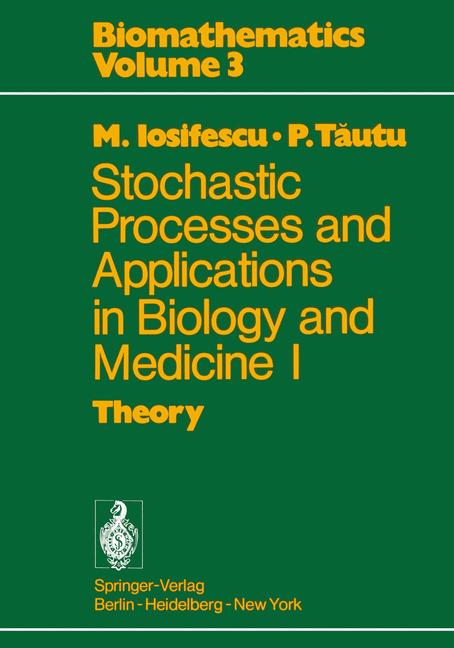
This volume is a revised and enlarged version of Chapters 1 and 2 of a book with the same title, published in Romanian in 1968. The revision resulted in a new book which has been divided into two parts because of the large amount of new material. The present part is intended to introduce mathematicians and biologists with a strong mathematical and probabilistic background to the study of stochastic processes. We hope some readers will be able to discover by themselves the new features of our treatment such as the inclusion of some unusual topics, the special attention paid to some usual topics, and the grouping of the material. We draw the reader's attention to the numbering, because there are structural differences between the two parts. In Part I there are Chapters, Sections, Subsections, Paragraphs and Subparagraphs. Thus the numbering a. b. c. d. e refers to Subparagraph e of Paragraph d of Subsection c of Section b of Chapter a. Definitions, theorems lemmas and propositions are numbered a. b. n, n = 1,2, . . . , where a indicates the chapter and b the section. In Part II there are Sections, Subsections, Paragraphs, and SUbparagraphs. Thus the numbering a. b. c. d refers to Subparagraph d of Paragraph c of Subsection b of Section a. Theorems and lemmas are numbered a. n, n = 1, 2, . . . , where a indicates the section.
Contents:
1 Discrete parameter stochastic processes.- 1.1. Denumerable Markov chains.- 1.1.1. Preliminaries.- 1.1.1.1. Definition of a Markov chain.- 1.1.1.2. The existence theorem.- 1.1.1.3. The n-step transition probabilities.- 1.1.1.4. Strong Markov property.- 1.1.2. Classification of states.- 1.1.2.1. Return states and recurrent states.- 1.1.2.2. Regenerative phenomena.- 1.1.2.3. Positive states and limit theorems.- 1.1.2.4. Geometric ergodicity.- 1.1.2.5. Essential states and classes of states.- 1.1.2.6. Conditional motion.- 1.1.3. Taboo and stationarity.- 1.1.3.1. Taboo transition probabilities.- 1.1.3.2. Ratio limit theorems.- 1.1.3.3. Stationary distributions.- 1.1.3.4. Stationary measures.- 1.1.3.5. Integral representations.- 1.1.4. Finite state Markov chains.- 1.1.4.1. Specific properties.- 1.1.4.2. The matrix method.- 1.1.4.3. The Ehrenfest model.- 1.2. Noteworthy classes of denumerable Markov chains.- 1.2.1. Random walk.- 1.2.1.1. Homogeneous random walk.- 1.2.1.2. Some important special cases.- 1.2.1.3. Barriers.- 1.2.1.4. Generalizations.- 1.2.1.5. Integral representations for certain nonhomogeneous random walks.- 1.2.2. Galton-Watson chains.- 1.2.2.1. Basic properties.- 1.2.2.2. Extinction probability.- 1.2.2.3. Time to extinction.- 1.2.2.4. Stationary distributions and stationary measures.- 1.2.2.5. Spectral theory of Galton-Watson chains.- 1.2.2.6. Asymptotic properties.- 1.2.2.7. Multitype Galton-Watson chains.- 1.2.3. Markov chains occurring in queueing theory.- 1.2.3.1. Preliminaries.- 1.2.3.2. Queueing systems.- 1.2.3.3. An imbedded Markov chain in the M/G/1 queue.- 1.2.3.4. An imbedded Markov chain in the GI/M/1 queue.- 1.3. Markov chains with arbitrary state space.- 1.3.1. Preliminaries.- 1.3.1.1. Definition and existence theorem.- 1.3.1.2. Generalized n-step transition functions.- 1.3.2. Uniform ergodicity.- 1.3.2.1. Uniform strong ergodicity.- 1.3.2.2. Uniform weak ergodicity.- 1.3.3. The coefficient of ergodicity.- 1.3.3.1. Definition and properties.- 1.3.3.2. Application to uniform ergodicity.- 1.3.3.3. Some limit theorems.- 1.3.4. Compact Markov chains.- 1.3.4.1. Definition and properties.- 1.3.4.2. Random systems with complete connections.- References.- 2 Continuous parameter stochastic processes.- 2.1. Some general problems.- 2.1.1. Preliminaries.- 2.1.1.1. Definition of a stochastic process.- 2.1.1.2. Finite dimensional distributions.- 2.1.2. Basic concepts.- 2.1.2.1. Separability.- 2.1.2.2. Stochastic continuity and measurability.- 2.1.3. Trajectories.- 2.1.3.1. Generalities.- 2.1.3.2. Continuous trajectories.- 2.1.3.3. Trajectories without discontinuities of the second kind.- 2.1.4. Convergence of stochastic processes.- 2.1.4.1. Weak convergence of processes.- 2.1.4.2. The Prohorov theorem.- 2.2. Processes with independent increments.- 2.2.1. Preliminaries.- 2.2.1.1. Definition and existence theorem.- 2.2.1.2. Stochastic continuity.- 2.2.2. Basic processes with independent increments.- 2.2.2.1. The Poisson process.- 2.2.2.2. The Wiener process.- 2.2.2.3. Brownian motion.- 2.2.3. General properties.- 2.2.3.1. Integral decomposition.- 2.2.3.2. The three parts decomposition.- 2.3. Markov processes.- 2.3.1. Preliminaries.- 2.3.1.1. Transition functions.- 2.3.1.2. Definition and existence theorem.- 2.3.1.3. The strong Markov property.- 2.3.1.4. The semi-group approach to homogeneous Markov processes.- 2.3.2. Markov jump processes. I. General theory.- 2.3.2.1. Transition intensity functions.- 2.3.2.2. The Kolmogorov-Feller equations.- 2.3.2.3. Determining a transition function from its intensity.- 2.3.2.4. The minimal process.- 2.3.3. Markov jump processes. II. Discrete state space.- 2.3.3.1. The case of a finite state space.- 2.3.3.2. The case of a denumerable state space.- 2.3.3.3. Poisson processes as Markov jump processes.- 2.3.3.4. Markov branching processes.- 2.3.4. Homogeneous Markov jump processes with discrete state space.- 2.3.4.1. Preliminaries.- 2.3.4.2. Continuity and differentiability properties.- 2.3.4.3. The Kolmogorov differential equations.- 2.3.4.4. Continuous parameter regenerative phenomena.- 2.3.4.5. Properties of trajectories.- 2.3.4.6. Discrete skeletons and classification of states.- 2.3.4.7. Birth-and-death processes.- 2.3.5. Markov diffusion processes.- 2.3.5.1. Classical diffusion processes.- 2.3.5.2. The Kolmogorov equations.- 2.3.5.3. Approximations.- 2.3.5.4. Boundaries.- 2.3.5.5. Brownian motion as diffusion process.- 2.3.6. Extensions of Markov processes.- 2.3.6.1. Semi-Markov processes.- 2.3.6.2. Renewal processes.- References.- Notation index.- Author index.
PRODUCT DETAILS
Publisher: Springer (Springer-Verlag Berlin and Heidelberg GmbH & Co. K)
Publication date: January, 2012
Pages: 332
Weight: 505g
Availability: Available
Subcategories: General Issues, General Practice
From the same series