
(To see other currencies, click on price)
MORE ABOUT THIS BOOK
Main description:
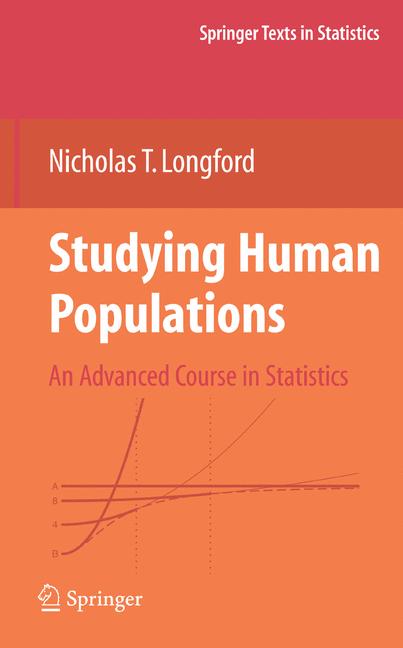
Studying Human Populations is a textbook for graduate students and research workers in social statistics and related subject areas. It follows a novel curriculum developed around the basic statistical activities of sampling, measurement and inference. Statistics is defined broadly as making decisions in the presence of uncertainty that arises as a consequence of limited resources available for collecting information. A connecting link of the presented methods is the perspective of missing information, catering for a diverse class of problems that include nonresponse, imperfect measurement and causal inference. In principle, any problem too complex for our limited analytical toolkit could be converted to a tractable problem if some additional information were available. Ingenuity is called for in declaring such (missing) information constructively, but the universe of problems that we can address is wide open, not limited by a discrete set of procedures.
The monograph aims to prepare the reader for the career of an independent social statistician and to serve as a reference for methods, ideas for and ways of studying human populations: formulation of the inferential goals, design of studies, search for the sources of relevant information, analysis and presentation of results. Elementary linear algebra and calculus are prerequisites, although the exposition is quite forgiving, especially in the first few chapters. Familiarity with statistical software at the outset is an advantage, but it can be developed concurrently with studying the text.
Feature:
Text for competent practitioners of statistics, not future statisticians
Suitable as reference
Back cover:
Studying Human Populations is a textbook for graduate students and research workers in social statistics and related subject areas. It follows a novel curriculum developed around the basic statistical activities of sampling, measurement and inference. Statistics is defined broadly as making decisions in the presence of uncertainty that arises as a consequence of limited resources available for collecting information. A connecting link of the presented methods is the perspective of missing information, catering for a diverse class of problems that include nonresponse, imperfect measurement and causal inference. In principle, any problem too complex for our limited analytical toolkit could be converted to a tractable problem if some additional information were available. Ingenuity is called for in declaring such (missing) information constructively, but the universe of problems that we can address is wide open, not limited by a discrete set of procedures.
The monograph aims to prepare the reader for the career of an independent social statistician and to serve as a reference for methods, ideas for and ways of studying human populations: formulation of the inferential goals, design of studies, search for the sources of relevant information, analysis and presentation of results. Elementary linear algebra and calculus are prerequisites, although the exposition is quite forgiving, especially in the first few chapters. Familiarity with statistical software at the outset is an advantage, but it can be developed concurrently with studying the text.
Nicholas T. Longford directs the statistical research and consulting company SNTL in Reading, England. He had held senior research posts at the Educational Testing Service, Princeton, NJ, and De Montfort University, Leicester, England. He was awarded the first Campion Fellowship by the Royal Statistical Society (2000-2002). He is a member of the editorial boards of the British Journal of Mathematical and Statistical PsychologyB and of Survey Research Methods, and a former Associate Editor of the Journal of Educational and Behavioral Statistics, Journal of Multivariate Analysis and Journals of the Royal Statistical Society Series A and D. He is the author of three other monographs, the latest entitled Missing Data and Small-Area Estimation (Springer, 2005).
Contents:
ANOVA and Ordinary Regression.- Maximum Likelihood Estimation.- Sampling Methods.- The Bayesian Paradigm.- Incomplete Data.- Imperfect Measurement.- Experiments and Observational Studies.- Clinical Trials.- Random Coefficients.- Generalised Linear Models.- Longitudinal and Time-Series Analysis.- Meta-Analysis and Estimating Many Quantities.
PRODUCT DETAILS
Publisher: Springer (Springer New York)
Publication date: December, 2007
Pages: 474
Weight: 902g
Availability: Not available (reason unspecified)
Subcategories: Epidemiology
Publisher recommends
From the same series
CUSTOMER REVIEWS
From the reviews:
"The book provides a useful collection of material at postgraduate-level and beyond under broad themes. … For the wider readership, it can generally serve as a useful, consolidated reference on an extensive variety of topics."(Stephan Haslett, International Statistical Reviews, Vol. 76 (2), 2008)