
(To see other currencies, click on price)
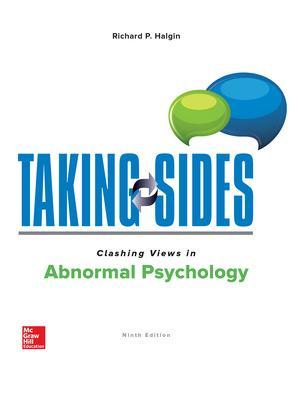
MORE ABOUT THIS BOOK
Main description:
The Taking Sides Collection on McGraw-Hill Create (R) includes current controversial issues in a debate-style forma designed to stimulate student interest and develop critical thinking skills. This Collection contains a multitude of current and classic issues to enhance and customize your course. You can browse the entire Taking Sides Collection on Create or you can search by topic, author, or keywords. Each Taking Sides issue is thoughtfully framed with Learning Outcomes, an Issue Summary, an Introduction, and an "Exploring the Issue" section featuring Critical Thinking and Reflection, Is There Common Ground?, Additional Resources, and Internet References. Go to the Taking Sides Collection on McGraw-Hill Create (R) at www.mcgrawhillcreate.com/takingsides and click on "Explore this Collection" to browse the entire Collection. Select individual Taking Sides issues to enhance your course, or access and select the entire Halgin: Taking Sides: Clashing Views in Abnormal Psychology, 9/e book here http://create.mheducation.com/createonline/index.html#qlink=search%2Ftext%3Disbn:1259903907 for an easy, pre-built teaching resource. Visit http://create.mheducation.com for more information on other McGraw-Hill titles and special collections.
Contents:
Unit 1: Psychological Conditions and Treatments
Issue: Is the Addiction Model Appropriate for Treating Compulsive Sexual Behaviors?
YES: Isaac Abel, from "Was I Actually 'Addicted' to Internet Pornography?" The Atlantic (2013)
NO: Marty Klein, from "Why 'Sexual Addiction' Is Not a Useful Diagnosis-And Why It Matters," martyklein.com (2016)
Isaac Abel, a journalist who writes (under a pen name) about sexuality and gender, shares his story of compulsive sexual behaviors while arguing that the sex addiction model, while not perfect, gave support to his struggle. Marty Klein, an author and Certified Sex Therapist, argues that the sex addiction model is harmful to clients, treating normal sexual behaviors as pathologies and gives undue authority to moralizing, sex-negative "experts."
Issue: Is Attention-Deficit/Hyperactivity Disorder (ADHD) a Real Disorder?
YES: National Institute of Mental Health (NIMH), from "Attention Deficit Hyperactivity Disorder (ADHD)," National Institute of Mental Health (2014)
NO: Tim O'Shea, D.C., from "ADD: A Designer Disease," The Doctor Within (2014)
The National Institute of Mental Health concurs with DSM-5 in viewing ADHD as a valid disorder that warrants thoughtful diagnosis and effective intervention. Tim O'Shea, Doctor of Chiropractic, views the diagnosis of ADD/ADHD as representing an invidious assault on American children that is promoted by parents, teachers, psychiatrists, school personnel, lobbyists, and the pharmaceutical industry.
Issue: Should Asperger's Syndrome Be a Diagnosis Distinct from Autism Spectrum Disorder?
YES: Dania Jekel and Nomi Kaim, from "Asperger's: Too Valuable to Lose," Original Work (2017)
NO: Francesca Happe and Jon Sutton, from "A Creative, Interpersonal, Social Scientist," The Psychologist (2014)
Dania Jekel, Executive Director of the Asperger/Autism Network, and Nomi Kaim, an adult living with Asperger's, stand against the exclusion of Asperger's from the DSM-5 as a distinct diagnosis, and they call for its reintroduction in the next edition. They consider Asperger's to be a unique profile on the autism spectrum, and that recognition of Asperger's as a valid diagnosis has had a positive impact on the lives of those with this condition. They seek to depathologize Asperger's, and they are striving to have society view this condition as an example of neurodiversity. Professor Francesca Happe defends the revisions to the neurodevelopment disorders section of the DSM-5 that eliminated Asperger's as a distinct diagnosable disorder. She considers Asperger's to be a "descriptive" term, rather than a diagnostic category, as it has no clear distinction that separates it from what is already captured by dimensional autism spectrum. She views the autism spectrum in a "multidimensional space," and asserts that individual categorical diagnoses fail to capture the heterogeneity of autism spectrum disorders.
Issue: Is Alcoholics Anonymous (A.A) an Ineffective Treatment Based on Pseudoscience?
YES: Gabrielle Glaser, from "The Irrationality of Alcoholics Anonymous," The Atlantic (2015)
NO: Sarah A. Benton, from "Critique of Gabrielle Glaser's Atlantic Article 'Irrationality of AA'," Original Work (2015)
Gabrielle Glaser asserts that A.A. is based on a "debunked" framework and contends that several alternative treatments are much more effective. She labels A.A. as "the medical treatment least grounded in modern science," and criticizes the lack of qualified addiction counselors who run A.A. groups. She criticizes A.A. for its inflated success rates, inability to help with comorbid mental health conditions, and its overall "one size fits all" approach. She views A.A. as obsolete faith-based and abstinence-based treatment that should and will be replaced by evidence-based treat
ments, which teach alcoholic individuals how to appropriately moderate their alcohol consumption. Mental health clinician Sarah A. Benton provides a rebuttal to several of Glaser's assertions. She refutes the claim of A.A. as unscientific, and criticizes Glaser's subscription to the notion of moderated drinking as evidence that Glaser does not have a grasp of how alcoholism works. Benton advocates that A.A. to be used in tandem with other treatment modalities. She considers the spiritual element of A.A. to be an invaluable part of the recovery process, and states that spirituality's positive effects are empirically supported. She praises A.A.'s tenet of abstaining from alcohol as scientifically sound and the practical route to recovery.
Issue: Is "Social Transitioning" a Beneficial Treatment for Transgender Children?
YES: Kristina Olson and Lily Durwood, from "Are Parents Rushing to Turn Their Boys Into Girls?" Slate (2016)
NO: Alice Dreger, from "The Big Problem with Outlawing Gender Conversion Therapies," Wired (2015)
Kristina Olson, Associate Professor of Psychology and founder of the TransYouth Project at the University of Washington, and Lily Durwood, Project Coordinator at the TransYouth Project, argue that researchers have misrepresented findings to suggest that many young people who identify as transgender will ultimately identify as cisgender, and that calls to limit the option of social transitioning can be harmful to transgender youth. Alice Dreger, author and Professor of Clinical Medical Humanities and Bioethics at Northwestern University, argues that controversial "gender conversion therapy" can help prevent unnecessary treatments on gender non-conforming young people.
Issue: Should Psychiatric Asylums Be Reestablished as a Treatment Option for Long-term, Inpatient Care?
YES: H. Richard Lamb and Linda E. Weinberger, from "Rediscovering the Concept of Asylum for Persons with Serious Mental Illness," The Journal of the American Academy of Psychiatry and the Law (2016)
NO: Julian C. Hughes, from "Objections and Merits: A Commentary on 'Improving Long-term Psychiatric Care: Bring Back the Asylum' by Sisti, Segal, and Emanuel," Journal of Ethics in Mental Health (2015)
Psychiatrist H. Richard Lamb and Psychologist Linda E. Weinberger argue that negative connotations surrounding asylums due to their dark history should not end the discussion of revisiting institutionalization as a solution for long-term mental health care moving forward. They criticize deinstitutionalization and note that the movement has displaced the severely mentally ill from treatment facilities and into prisons, or trans-institutionalization. By expanding and improving the concept of asylum, they contend that those with low-functioning serious mental illness (SMI) such as severe schizophrenia can be given life structure and a road to recovery rather than an underserved punishment. They conclude that such "re-institutionalization" measures provide the optimal route to rehabilitation for individuals with SMIs, a remedy neither prisons nor community-based services can adequately provide. Julian C. Hughes contests a highly controversial article in the Journal of the American Medical Association (JAMA), which advocates for the return of institutionalization as a long-term psychiatric care model. He argues such institutions "breed abusive and infantilizing attitudes" and "represent a return to the bad old days of prejudice amongst the public and paternalism amongst the professionals." He cites the importance of patient autonomy in the recovery process, something stripped away by such institutions. Although not against long-term inpatient care altogether, he urges such measures should not resemble the structure of the prototypical asylum, and believes a return to institutionalization is an oversimplified "bandage" solution to complex flaws throughout the mental health care system. He advocates for the improvement of community-based services to reduce stigma surrounding mental health.
Unit 2: The Trend toward Biological Interventions
Issue: Do We Still Need Psychiatrists?
YES: Steven Moffic, from "Why We Still Need Psychiatrists!" Mad in America (2012)
NO: Steven Balt, from "Yes, We Still Need Psychiatrists, but for What?" The Carlat Psychiatry Report (2012)
Psychiatrist Steven Moffic states that psychiatrists play critically important roles in the field of mental health care because they are extensively trained and well-versed in understanding the functioning of the human body and the treatment of mental disorders. He urges psychiatrists to accept constructive criticism and to take steps to move forward in developing innovative intervention models such as collaborating on-site with primary care physicians in offering integrated care. Psychiatrist Steven Balt believes that psychiatrists have overstepped the boundaries of their position, and doing so has often led to mislabeling and mistreating countless people. He contends that much of what psychiatrists do is pseudoscience, but that most people nevertheless buy into the psychiatric model. He argues that psychiatrists, with their years of scientific education, can use their influence to change the current state of affairs in the field of mental health.
Issue: Is Addiction a Brain Diseas
e?
YES: National Institute on Drug Abuse, from "Drugs, Brain, and Behavior: The Science of Addiction," National Institute on Drug Abuse (2014)
NO: Sally Satel and Scott O. Lilienfeld, from "Addiction and the Brain-Disease Fallacy," Frontiers in Psychiatry (2014)
In the NIDA publication, the argument is made that addiction is indeed a disease, and that scientific information is available about the nature, prevention, and treatment of this disease. Psychiatrist Sally Satel and Clinical Psychologist Scott O. Lilienfeld oppose the Brain-Disease Model of Addiction, asserting that is over-emphasizes the brain's role in addiction while not considering the role of choice and operant conditioning in addiction formation and persistence. They insist that addicts can choose recovery and are not "helpless victims of their own hijacked brains." They emphasize personality responsibility rather than searching for a "magic bullet" cure. They consider the medicalization of addiction as a failed attempt by advocates to destigmatize addicts when, in fact, it has worked to enable their problem behaviors.
Issue: Should Memory-Dampening Drugs Be Used to Prevent and Treat Trauma in Combat Soldiers?
YES: Elise Donovan, from "Propranolol Use in the Prevention and Treatment of Posttraumatic Stress Disorder in Military Veterans: Forgetting Therapy Revisited," Perspectives in Biology and Medicine (2010)
NO: The President's Council on Bioethics, from "Beyond Therapy: Biotechnology and the Pursuit of Happiness," President's Council on Bioethics (2003)
Research scientist Elise Donovan states that an alarming and rising number of soldiers are returning from combat suffering from PTSD, and that medications such as the beta-blocker propranolol can alleviate their symptoms. Propranolol, she argues, will help soldiers with PTSD who have essentially lost "their sense of self" reintegrate into society. Because the drug causes memory dampening, rather than memory loss, it will create an opportunity for veterans to better cope with everyday life upon returning from combat. She believes that symptoms and consequential behaviors associated with PTSD (i.e., suicide, domestic abuse, and alcohol or drug abuse) will be greatly reduced in PTSD patients who take propranolol. Dr. Donovan also states that use of propranolol will foster an experience of posttraumatic growth. The President's Council on Bioethics, chaired by Dr. Leon Kass, criticizes the use of memory-dampening drugs to treat the symptoms of trauma by asking, "What kind of society are we likely to have when the powers to control memory, mood, and mental life through drugs reach their full maturity?" The Council asserts that identities are formed by what people do and what they undergo or suffer. Escaping painful memories would necessarily result in a change in the identity of who the person is, as well as the person's perception and understanding of significant life events.
Issue: Should Brain Stimulation Therapies Be Used in Efforts to Rehabilitate Psychopathic Criminals?
YES: Sergio Canavero, from "Criminal Minds: Neuromodulation of the Psychopathic Brain," Frontiers in Human Neuroscience (2014)
NO: Dietmar Hubner and Lucie White, from "Neurosurgery for Psychopaths? An Ethical Analysis," AJOB Neuroscience (2016)
Neurosurgeon Sergio Canavero advocates for the experimental implementation of neuromodulating interventions, specifically cortical stimulation (CS), for criminal and/or psychopathic individuals. He considers CS a "risk-free" procedure for treating people with criminal psychopathy. He asserts that CS has the potential to increase behavioral inhibition, boost neuroplasticity, and rewire moral circuitry in the psychopathic brain. He believes that the benefits of these brain stimulating procedures outweigh legal and ethical concerns. Bioethicists Dietmar Hubner and Lucie White contend that neuromodulation of criminal psychopaths, specifically the implementation of deep brain stimulation (DBS), violate the ethical code of medical research. They question the medical benefit of DBS for psychopathy on several grounds. First, they argue that the "disease" model of psychopathy is debatable, thus making medical intervention inappropriate. Second, they contend that psychopaths do not experience subjective suffering and that medical intervention is only justified in cases in which individuals are relieved of such suffering. They argue that psychopaths experience their condition as an "objective" reality and that the "wish to alter them cannot override their lacking the wish to change." Due to objections on the part of psychopathic individuals, they conclude that such interventions would violate the ethical standard of voluntary informed consent. They also assert that similar e
thical concerns could arise in the application of other brain-stimulating procedures.
Issue: Is Marijuana a Viable Treatment Option for Psychiatric Disorders?
YES: Will Hall, from "Marijuana for Mental Health Conditions?" Everything Matters: Beyond Meds (2015)
NO: Bernard Woodward, from "Marijuana and the Psychiatric Patient," Psychiatric Times (2017)
Counselor Will Hall supports the exploration of marijuana as a potential treatment for psychiatric conditions due to the ineffectiveness of psychotropic medications and the stagnancy of psychopharmacological developments. He asserts that many are already using cannabis to treat their mental health conditions on their own volition. He advises medical professionals to challenge the notion of "reefer madness" perpetuated by the "War on Drugs" and believes it is unethical to withhold this holist
PRODUCT DETAILS
Publisher: McGraw-Hill (McGraw-Hill Education)
Publication date: November, 2017
Pages: 384
Weight: 780g
Availability: Available
Subcategories: Psychology