
(To see other currencies, click on price)
MORE ABOUT THIS BOOK
Main description:
Tensor algebra and tensor analysis were developed by Riemann, Christo?el, Ricci, Levi-Civita and others in the nineteenth century. The special theory of relativity, as propounded by Einstein in 1905, was elegantly expressed by Minkowski in terms of tensor ?elds in a ?at space-time. In 1915, Einstein formulated the general theory of relativity, in which the space-time manifold is curved. The theory is aesthetically and intellectually satisfying. The general theory of relativity involves tensor analysis in a pseudo- Riemannian manifold from the outset. Later, it was realized that even the pre-relativistic particle mechanics and continuum mechanics can be elegantly formulated in terms of tensor analysis in the three-dimensional Euclidean space. In recent decades, relativistic quantum ?eld theories, gauge ?eld theories, and various uni?ed ?eld theories have all used tensor algebra analysis exhaustively. This book develops from abstract tensor algebra to tensor analysis in va- ous di?erentiable manifolds in a mathematically rigorous and logically coherent manner. The material is intended mainly for students at the fourth-year and ?fth-year university levels and is appropriate for students majoring in either mathematical physics or applied mathematics.
Feature:
Many known concepts which are scattered in various books are brought together in a rigorous, logical way
Chapter 7 contains discussion on extrinsic curvature which is more extensive than in any other book available
Tensor analysis is further explained in the book, touching on general differential manifolds, manifolds with connections and manifolds with metrics and connections. Competing books have only Riemannian and Pseudo-Riemannian manifolds discussed
Each section of each chapter contains questions and exercises to further enhance understanding of the topics discussed
Back cover:
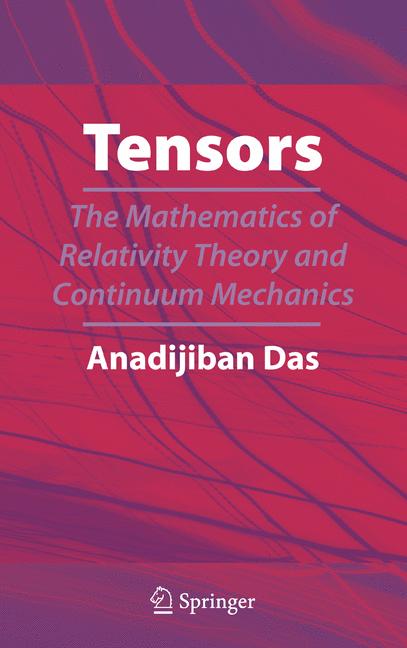
Tensors: The Mathematics of Relativity Theory and Continuum Mechanics, by Anadijiban Das, emerged from courses taught over the years at the University College of Dublin, Carnegie-Mellon University and Simon Fraser University.
This book will serve readers well as a modern introduction to the theories of tensor algebra and tensor analysis. Throughout Tensors, examples and worked-out problems are furnished from the theory of relativity and continuum mechanics.
Topics covered in this book include, but are not limited to:
-tensor algebra
-differential manifold
-tensor analysis
-differential forms
-connection forms
-curvature tensors
-Riemannian and pseudo-Riemannian manifolds
The extensive presentation of the mathematical tools, examples and problems make the book a unique text for the pursuit of both the mathematical relativity theory and continuum mechanics.
Contents:
Finite-Dimensional Vector Spaces and Linear Mappings.- Tensor Algebra.- Tensor Analysis on a Differentiable Manifold.- Differentiable Manifolds with Connections.- Riemannian and Pseudo-Riemannian Manifolds.- Special Riemannian and Pseudo-Riemannian Manifolds.- Hypersurfaces, Submanifolds, and Extrinsic Curvature.
PRODUCT DETAILS
Publisher: Springer (Springer New York)
Publication date: September, 2007
Pages: 292
Weight: 1330g
Availability: Not available (reason unspecified)
Subcategories: Physiology
Publisher recommends
CUSTOMER REVIEWS
From the reviews:
"This book is a very nice introduction to the theory of tensor analysis on differentiable manifolds. It is intended mainly for students, but it can also be useful to everyone interested in the tensor analysis on differentiable manifolds and its application to the relativity theory and continuum mechanics." (Cezar Dumitru Oniciuc, Zentralblatt MATH, Vol. 1138 (16), 2008)