
(To see other currencies, click on price)
MORE ABOUT THIS BOOK
Main description:
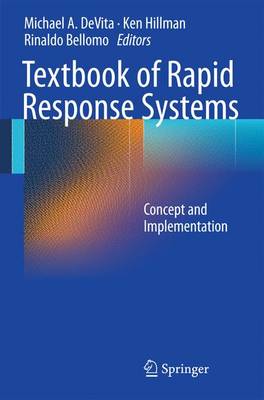
Successor to the editors' groundbreaking book on medical emergency teams, Textbook of Rapid Response Systems addresses the problem of patient safety and quality of care; the logistics of creating an RRS (resource allocation, process design, workflow, and training); the implementation of an RRS (organizational issues, challenges); and the evaluation of program results. Based on successful RRS models that have resulted in reduced in-hospital cardiac arrest and overall hospital death rates, this book is a practical guide for physicians, hospital administrators, and other healthcare professionals who wish to initiate an RRS program within their own institutions.
Feature:
Successor to the groundbreaking book, DeVita, Hillman, and Bellomo, eds., MEDICAL EMERGENCY TEAMS (Springer, 2006)
Written by the world's leading innovators in the development of Rapid Response Systems
Provides advice, tips, and process guidelines from successful Rapid Response Systems
Up-to-the-minute, comprehensive, and essential content, including coverage of pediatric response systems, sepsis response teams, and much more.
Back cover:
Textbook of Rapid Response Systems is designed to assist the medical practitioner or administrator to implement and improve a Rapid Response System, from the logistics of creating a Rapid Response System (including resource allocation, process design, workflow, and training), to the problem of patient safety and quality of care, the evaluation of program results, and engagement in systems research. Written by the world’s leading innovators in the development of Rapid Response Systems, this brand new book takes the place of its groundbreaking predecessor, DeVita, Hillman, and Bellomo, eds., Medical Emergency Teams (Springer, 2006) and includes coverage of pediatric response systems and sepsis response teams, as well as advice, tips, and process guidelines from successful Rapid Response Systems. Textbook of Rapid Response Systems is an invaluable resource for healthcare professionals seeking to improve quality of care in the emergency setting.
Contents:
Section I: RRS’s and Patient Safety.- Rapid Response Systems History and Terminology.- RRS’s General Principles.- Measuring and Improving Safety.- Integrating a Rapid Response System into a Patient Safety Program.- Acute Hospitalist Medicine and the Rapid Response System.- Medical Trainees and Patient Safety.- Rapid Response Systems: A Review of the Evidence.- Health Care Systems and Their (Lack of) Integration.- Creating Process and Policy Change in Health Care.- The Challenge of Predicting in Hospital Cardiac Arrests and Deaths.- The Meaning of Vital Signs.- Matching Illness Severity with Level of Care.- Causes of Failure to Rescue.- Section II. Creating a RRS.- Impact of Hospital Size and Location on Feasibility of RRS.- Barriers to the Implementation of RRS.- An Overview of the Afferent Limb.- The Impact of Delayed RRS Activation.- The Case for Family Activation of the RRS.- RRT: Nurse-led RRS’s.- MET: Physician-led RRS’s.- Pediatric RRS’s.- Sepsis Response Team.- Other Efferent Limb Teams: (BAT, DAT, M, H, and trauma).- Other Efferent Limb Teams: Crisis Response for Obstetric Patients.- Personnel Resources for Responding Teams.- Equipment, Medications, and Supplies for a RRS.- The Administrative Limb.- The Secondary Victim.- Section III. Monitoring of Efficacy and New Challenges.- RRS’s in Teaching Hospitals.- The Nurse’s View of RRS’s.- Resident Training and RRS’s.- Optimizing RRS’s Through Simulation.- Evaluating Effectiveness of Complex System Interventions.- RRS Education for Ward Staff.- Standardized Process and Outcome Assessment Tool.- The Impact of RRS’s on Choosing “Not For Resuscitation” Status.- The Costs and the Savings.
PRODUCT DETAILS
Publisher: Springer (Springer New York)
Publication date: December, 2010
Pages: 458
Weight: 1410g
Availability: Not available (reason unspecified)
Subcategories: Accident & Emergency Medicine, Anaesthetics and Pain, Cardiovascular Medicine, Critical Care Medicine
CUSTOMER REVIEWS
From the reviews:
“This is an overview work describing the evolution and current practice of physician and nurse led rapid response programs. … Hospitalists, critical care trainees, and other hospital-based practitioners responsible for response to acute changes in patient condition are an appropriate audience for this book … . This book provides historical perspective, state-of-the-art reviews, and a summary of challenges facing practitioners using this tool to improve outcomes.” (David J. Dries, Doody’s Review Service, May, 2011)