
(To see other currencies, click on price)
MORE ABOUT THIS BOOK
Main description:
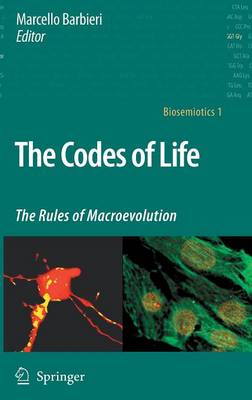
Building on a range of disciplines – from biology and anthropology to philosophy and linguistics – this book draws on the expertise of leading names in the study of organic, mental and cultural codes brought together by the emerging discipline of biosemiotics.
The book’s 18 chapters present a range of experimental evidence which suggests that the genetic code was only the first in a long series of organic codes, and that it has been the appearance of new codes – organic, mental and cultural – that paved the way for the major transitions in the history of life.
While the existence of many organic codes has been proposed since the 1980s, this volume represents the first multi-authored attempt to deal with the range of codes relevant to life, and to reveal the ubiquitous role of coding mechanisms in both organic and mental evolution. This creates the conditions for a synthesis of biology and linguistics that finally overcomes the old divide between nature and culture.
The book will appeal to all those interested in the origins and evolution of life, including biologists (from molecular and cellular biologists to evolutionary and developmental biologists), ecologists, anthropologists, psychologists, philosophers of science, linguists, and researchers interested in the history of science, the origins of life, artificial life and intelligence, and information theory and communication technology.
Feature:
First multi-authored book on organic codes
Genetic code was only first of a long series of organic codes
Finally the rules of macroevolution looked for by generations of biologists
Organic codes are the key to understanding the major transitions of life history
Evolution took place by natural selection, conventions
Mental, cultural codes came after a three-billion-year history of organic codes
Back cover:
Building on a range of disciplines – from biology and anthropology to philosophy and linguistics – this book draws on the expertise of leading names in the study of organic, mental and cultural codes brought together by the emerging discipline of biosemiotics.
The book’s 18 chapters present a range of experimental evidence which suggests that the genetic code was only the first in a long series of organic codes, and that it has been the appearance of new codes – organic, mental and cultural – that paved the way for the major transitions in the history of life.
While the existence of many organic codes has been proposed since the 1980s, this volume represents the first multi-authored attempt to deal with the range of codes relevant to life, and to reveal the ubiquitous role of coding mechanisms in both organic and mental evolution. This creates the conditions for a synthesis of biology and linguistics that finally overcomes the old divide between nature and culture.
The book will appeal to all those interested in the origins and evolution of life, including biologists (from molecular and cellular biologists to evolutionary and developmental biologists), ecologists, anthropologists, psychologists, philosophers of science, linguists, and researchers interested in the history of science, the origins of life, artificial life and intelligence, and information theory and communication technology.
Marcello Barbieri is Professor of Embryology at the University of Ferrara, Italy, president of the Italian Association for Theoretical Biology, Editor-in-Chief of the Journal of Biosemiotics, and Co-Editor of the Springer book series in Biosemiotics.
Contents:
Editorial: The new frontier of biology; M. Barbieri.- Part 1: Codes and Evolution. 1. Codes of biosequences; E.N. Trifonov.- 2. The mechanisms of evolution: natural selection and natural conventions; M. Barbieri.- Part 2: The Genetic Code. 3. Catalytic propensity of amino acids and the origins of the genetic code and proteins; Á. Kun et al.- 4. Why the genetic code originated: implications for the origin of protein synthesis; M. Di Giulio.- 5. Self-referential formation of the genetic system; R.C. Guimarães et al.- 6. The mathematical structure of the genetic code; D. Gonzalez.- 7. The arithmetical origin of the genetic code; V. shCherbak.- Part 3: Protein, Lipid and Sugar Codes. 8. Protein linguistics and the modular code of the cytoskeleton; M. Gimona.- 9. A lipid-based code in nuclear signalling; N.M. Maraldi.- 10. Biological information transfer beyond the genetic code: the sugar code; H.-J. Gabius.- 11. The immune self code: from correspondence to complexity; Y. Neuman.-12. Signal transduction codes and cell fate; M. Faria.- Part 4: Neural, Mental, and Cultural Codes. 13. Towards an understanding of language origins; E. Szathmáry.- 14. The codes of language: turtles all the way up?; S.J. Cowley.- 15. Code and context in gene expression, cognition, and consciousness; S. Ó Nualláin.- 16. Neural coding in the neuroheuristic perspective; A.E.P. Villa.- 17. Error detection and correction codes; D.L. Gonzalez.- 18. The musical codebetween nature and nurture: ecosemiotic and neurobiological claims; M. Reybrouck.-
PRODUCT DETAILS
Publisher: Springer (Springer Netherlands)
Publication date: November, 2007
Pages: 440
Weight: 847g
Availability: Not available (reason unspecified)
Subcategories: Biochemistry
Publisher recommends
From the same series
CUSTOMER REVIEWS
From the reviews:
"Biosemiotics purports to be a new synthesis of existing theories and compilations of theories addressing evolutionary bases. Barbieri … has asked a group of researchers to present their ideas on a wide-ranging set of notions about change and stability. … This work offers an impressive array of facts and speculations, extremely stimulating in origin and execution. … the articles are generally well done with good bibliographies, and they will be useful to many researchers. … Summing Up: Recommended. Graduate students and researchers/faculty." (F. W. Yow, CHOICE, Vol. 45 (10), June, 2008)