
(To see other currencies, click on price)
MORE ABOUT THIS BOOK
Main description:
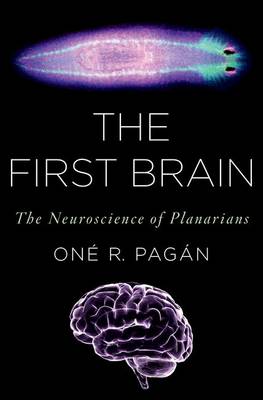
Planarians, a class of flatworm, are extraordinary: they possess the remarkable ability to regenerate lost body parts, including complete regeneration of the nervous system. If cut into pieces, each piece of the planarian can regenerate into a complete organism. They are also unique among invertebrates in that they display addiction-like behaviors to many drugs abused by humans. Because of these distinct neurological traits, the planarian is often used as an animal
model in neurological research, being used most recently for developments in neuropharmacology.
The First Brain is a discussion of how planarians have been used in neuropharmacology, and what role they have played in scientific developments that have a high impact on our culture. Planarians have been the animal models for research in drug addiction, antidepressant development, and various other topics in biology, neurobiology, and even zoology. Pagan uses these flatworms as a framework to explore the history of biological research. The book provides accessible background
information on how biomedical research is impacted by evolution, and defines neurobiology and neuropharmacology in ways that are easy to understand. At the same time, Pagan provides enough detail for the book to useful for scientists working in various subsections of biology.
The planarian has played a key role in the history biological, neuropharmacological, and zoological research, and has even made appearances in a few unexpected places in popular culture. One Pagan explores all these roles, and shows us why the planarian truly is one of the most extraordinary and influential organisms in scientific research today.
Contents:
TABLE OF CONTENTS ; INTRODUCTION ; PART I - FUNDAMENTALS ; Chapter 1. Science ; Science does not exist ; Reductionism, its advantages and limits ; On theories and Theories ; Evolution and Life ; Chapter 2. Biomedical Research ; Biochemistry and cell biology lite ; How we classify life ; Animal models and biomedical research ; Basic or fundamental research? ; PART II - THE SCIENCE OF THE BRAIN ; Chapter 3. An introduction to neuroscience ; Neuroscience or neurobiology? ; Neurons ; The Spaniard and the Italian ; Excitable cells and electrophysiology ; Synapses and chemical neurotransmission ; Is a nervous system absolutely necessary for survival? ; Plant Neurobiology ; Chapter 4. The human brain ; What exactly is a brain? ; The human brain and nervous system ; A brief history of what people thought of their brains ; The complexity of the human brain / On really BIG numbers ; Chapter 5. Some brief thoughts on pharmacology ; What is pharmacology? ; Psychopharmacology, plant style ; Animal models in pharmacology ; PART III - PLANARIANS ; Chapter 6. Planarians ; What is a flatworm? ; Flatworm evolution and fossil records ; What is a planarian? ; Early works on planarians (1700-1800s) ; Planariologists: Three <"personal>" connections ; Chapter 7. Planarians in modern biology ; Genetics ; First they liked planarians then they didn't ; Sages of regeneration ; Of planarians and genomes ; Chapter 8. Planarians in the popular culture: The arts, science fiction, fantasy and humor ; Planarians in the popular culture ; Planaria: Poem by Dr. Lance Larsen ; Planarian man ; Planaria and the new Battlestar Galactica ; Fringe ; Twilight ; The Big Bang Theory ; Dr. Who ; Planarian humor ; PART IV - THE FIRST BRAIN ; Chapter 9. The first brain ; Early, really early nervous systems ; The first hunters ; The first brain ; Why are planarians an excellent animal model in neuroscience? ; Very brief comments on protopsychology ; Chapter 10. From corals and plants to planarians and rats ; Planarians in pharmacology: nicotine and cocaine ; The beginnings of systematic planarian pharmacology research ; The Temple University team ; The joy of discovery ; From corals and plants to planarians and rats ; Planarian research translated to vertebrates: What does it mean, and what it doesn't ; What can the planarian brain teach us about our own? ; EPILOGUE ; REFERENCES - BOOKS ; REFERENCES - ARTICLES
PRODUCT DETAILS
Publisher: Oxford University Press (Oxford University Press Inc)
Publication date: May, 2014
Pages: 280
Dimensions: 156.00 x 242.00 x 25.00
Weight: 634g
Availability: Available
Subcategories: Neuroscience