
(To see other currencies, click on price)
MORE ABOUT THIS BOOK
Main description:
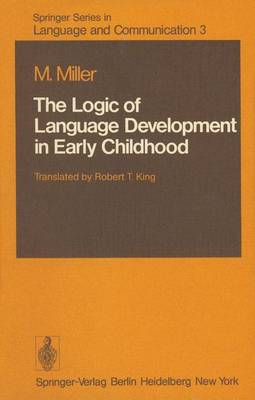
This monograph originated as an interim report on the research project Cog- nitive and Social Determinants on Language Acquisition which I conducted under the auspices of the German Department of the University of Frankfurt from September 1971 until the end of 1976. Since November 1972 this project was financed by the Max-Planck-Institut fur Bildungsforschung in Berlin as part of the research project Elternhaus und Schule conducted by Oevermann, Krappmann, and Kreppner. While the goal of this project on language acquisition is the reconstruc- tion of the language development of three German children: two middle-class children and one lower-class child from the time of the first linguistic utterances up to the fourth birthday, this interim report deals only with early language development, and it is essentially based on a large body of observational data on the language development of the two middle-class chil- dren from their 16th up to their 23rd months of life. In its German version this monograph was completed in March 1975 and pub- lished by Klett Verlag in the series "Konzepte der Humanwissenschaften".
Contents:
1 Introduction.- 2 Description of the Project: Cognitive and Social Determinants of Language Acquisition.- 2.1 General and Long-Term Goals of the Language Acquisition Project.- 2.2 The Children under Observation: Meike, Kerstin, and Simone.- 2.2.1 Social Data.- 2.3 The Method of Gathering Data.- 2.3.1 Tape Recordings.- 2.3.2 Transcriptions.- 3 A Quantitative Analysis of the Early Linguistic Development of Meike and Simone.- 3.1 A Survey of the Individual Corpora of Utterances of Meike and Simone.- 3.2 Quantitative Features of Corpora I to III for Meike and Simone.- 3.2.1 MLU Values.- 4 Problems in the Transformational Analysis of Early Child Language.- 4.1 The Pivot-Grammar Approach.- 4.1.1 Characteristics of the Pivot-Grammar Approach.- 4.1.2 Criticism of the Pivot-Grammar Approach.- a) Distributional Evidence for Pivot Grammar.- b) The Universality of Pivot Grammar.- 4.2 Empirical Arguments for a Transformational Descriptive Model.- 4.2.1 The Descriptive Inadequacy of a Phrase Structure Grammar.- 4.2.2 Constructional Homonyms.- 4.3 The Method of Rich Interpretation.- 4.3.1 Semantic Analyses of Early Child Language.- 4.3.2 Discovery Procedures.- 4.4 Reduction Transformations.- 4.4.1 The Definition and Description of Reduction Transformations.- 4.4.2 Criticism of Reduction Transformations.- 5 Aspects of the Early Linguistic Development of Meike and Simone.- 5.1 A Sketch of a Model for the Description of a Child's Communicative Intentions.- 5.2 Illocutionary Acts and Terminal Intonation Contours.- 5.2.1 Preliminary Considerations.- 5.2.2 A Model for the Description of Terminal Intonation Contours in Adult Language.- 5.2.3 The Ontogenesis of Terminal Intonation Contours.- 5.2.4 Some Contrasting Arguments on the Role of Terminal Intonation Contours at the Stage of One-Word Utterances.- 5.2.5 A Description of the Terminal Intonation Contours of Meike and Simone.- 5.2.6 A Reliability Test of the Description of Terminal Intonation Contours.- 5.2.7 Correspondence between Terminal Intonation Contours and Types of Illocutionary Acts in the Utterances of Meike and Simone.- 5.3 Propositional Acts and Word Order.- 5.3.1 Preliminary Considerations.- 5.3.2 The Semantics of One-Word Utterances.- 5.3.3 Semantic Versus Syntactic Relations.- 5.3.4 The System of Semantic Relations in Early Child Language.- a) The Definition and Formal Representation of Semantic Relations.- b) The Logical Structure of Semantic Relations.- c) The Form of the Realization Rules.- d) A Description of the Semantic Relations of Early Child Language.- e) "Referential Operations".- f) A Description of "Referential Operations" as Predicates and as Forms of Deictic Reference.- 5.3.5 A Tabulated Survey of the Semantic Construction Types (SKT's) used by Meike and Simone.- 5.3.6 Word Order in Meike's and Simone's Utterances.- a) Word Order in Two-Word Utterances.- b) Word Order in Three-Word and Four-Word Utterances.- c) Discussion of the Results Concerning Word Order in the Utterances of Meike and Simone.- 5.3.7 Word Order in Child Language and Adult Language.- 5.4 Context-Referential Acts and Ellipsis.- 5.4.1 Preliminary Considerations.- 5.4.2 The Communicative Egocentrism of the Child.- 5.4.3 Deixis and Communicative Egocentrism.- 5.4.4 Gestural and Symbolical Use of Deixis.- 5.4.5 Place Deixis.- 5.4.6 Time Deixis.- 5.4.7 Person Deixis.- 5.4.8 Implicit Reference by Means of Illocutionary Acts and Interactional Routines.- 5.4.9 Contextual Alternatives and Constructional Problems for the Child.- 6 Conclusion.- 6.1 Summary.- 6.1.1 Semantic Relations and Sensorimotor Intelligence.- 6.1.2 Pragmatic Conventions and Communicative Egocentrism.- 6.2 Final Comments on the Logic of Language Development in Early Childhood.- 7 Appendix.- 7.1 Glossary of the Notations Used in the Transcripts.- 7.2 Context of Items Used in the Intonation Test.- 7.3 Context of Items Used in the Semantic and Pragmatic Analysis.- Meike SKT 1.- Simone SKT 1.- Meike SKT 2.- Simone SKT 2.- Meike SKT 3.- Simone SKT 3.- Mei ke SKT 4-6.- Simone SKT 4-6.- Meike SKT 7.- Simone SKT 7.- Meike SKT 8.- Simone SKT 8.- Meike SKT 9.- Simone SKT 9.- Meike SKT 10.- Simone SKT 10.- Meike SKT 11.- Simone SKT 11.- Meike SKT 12.- Simone SKT 12.- Meike SKT 13.- Simone SKT 13.- References.- Author Index.
PRODUCT DETAILS
Publisher: Springer (Springer-Verlag Berlin and Heidelberg GmbH & Co. K)
Publication date: November, 2011
Pages: None
Weight: 717g
Availability: Available
Subcategories: Paediatrics and Neonatal, Psychology