
(To see other currencies, click on price)
MORE ABOUT THIS BOOK
Main description:
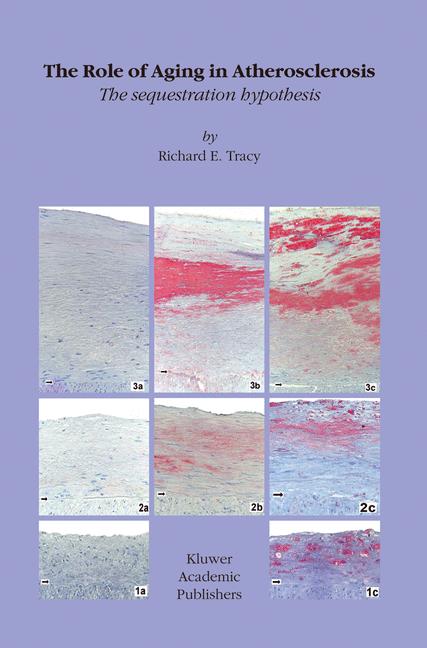
The cover of this book summarizes the central features of the sequestration hypothesis: Commonplace appearances seen in human coronary artery, fat stained in paraffin seetions by a new technique explained in Chapter Eleven, are arranged to suggest pathways of evolution toward atheroma. The hypothesis formulated and defended in the pages ofthis book is this: Fibroplasia progresses upward in column "a" from "la" to "3a" as a characteristic feature of aging. This starts sooner and progresses faster in men than in wornen. Numbers ofSMC's remain essentially constant so that fibroplasia per SMC steadily increases. The rise upward conveys an increasing propensity to sequester atherogenic lipids, causing transition rightward into column "b". Sequestered extracellular lipid then attracts fatty streak elements, especially foam cells and lyrnphocytes, to propel the arterial site rightward into column "c". Frame "lc" corresponds to the AHA Lesions Committee classification type IIb, the progression resistant fatty streak arising directly without prior lipid sequestration; this can progress to atheroma, but slowly after much delay, although extreme provocation can accelerate the process. Such progression is rightward toward atherorna with thin cap, not upward toward fibroplastic thickening. Frame "2c" corresponds to the AHA classification, type Ha, progression prone fatty streaks. These readily evolve into atheroma, again by horizontal progression.
Contents:
One: Introduction to the sequestration hypothesis. Two: The sampling theory of fibrotic arteriosclerosis. Three: Intrusion of atheroma into the most fibrotically thickened intimal sites. Four: Conditions for the intrusion of atheroma in coronary artery. Five: The size of the SMC realm assessed with the help of sampling theory. Six: Biased censoring of low SMC sites by atheroma in coronary artery. Seven: Biased sampling of low SMC sites by atheroma in thoracic aorta. Eight: SMC numbers at varying depths in intima of thoracic aorta. Nine: Histologic appearances of SMC clusters and realms. Ten: Direct imaging of the hypothetical quantity, sequestered lipid. Eleven: Local sequestration of lipid from place to place within an artery. Twelve: Fibroplasia in microscopic renal arteries. Thirteen: Parameters of fibroplasia in renal microvasculature. Fourteen: The course of arterial intimal fibroplasia in aging arteries. Fifteen: The course of fibroplasia per SMC over time in aging arteries. Sixteen: Fibroplasia per SMC in the media of coronary arteries. Seventeen: Influence of arteriolar hyalinization on renovascular fibroplasia. Eighteen: The Hy effect on Ra in widely variable circumstances. Nineteen: Hyalinized renal arterioles and the maleness coronary risk factor. Twenty: Two pathways to atheroma variably linked to renovasculopathies. Twenty One: Age of onset of the sex difference in coronary fibroplasias. Twenty Two: Adrenocortical nodularity in relation to coronary fibroplasia. Twenty Three: Atheroma and intimal fibroplasia in periodontal disease. Twenty Four: Atheroma and intimal fibroplasia in relation to obesity. Twenty Five: Paucity of literature relevant to SMC numbers and the aging risk factor.
PRODUCT DETAILS
Publisher: Springer
Publication date: December, 2010
Pages: 288
Weight: 454g
Availability: Available
Subcategories: Cardiovascular Medicine, Endocrinology