
(To see other currencies, click on price)
MORE ABOUT THIS BOOK
Main description:
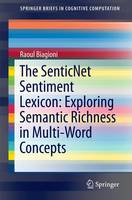
The research and its outcomes presented in this book, is about lexicon-based sentiment analysis. It uses single-, and multi-word concepts from the SenticNet sentiment lexicon as the source of sentiment information for the purpose of sentiment classification.
In 6 chapters the book sheds light on the comparison of sentiment classification accuracy between single-word and multi-word concepts, for which a bespoke sentiment analysis system developed by the author was used.
This book will be of interest to students, educators and researchers in the field of Sentic Computing.
Contents:
1. Introduction
1.1 Sentiment in Opinionated Text
1.2 Background
1.3 Research Problem
2. Sentiment Analysis
2.1 Sentiment Analysis Challenges
2.2 Levels of Analysis
2.3 Supervised vs. Unsupervised Sentiment Analysis
2.4 Linguistics-based Sentiment Analysis
2.5 Lexicon-based Sentiment Analysis
2.6 Conclusion
3. SenticNet
3.1 The Common Sense Nature of SenticNet Knowledge
3.2 A Seminal Approach to Concept-based Sentiment Analysis
3.3 Producing SenticNet
3.4 SenticNet Processes
3.5 SenticNet Knowledge: Encoding
3.6 SenticNet Access Methods
3.7 SenticNet in Numbers
3.7.1 Concept Types: Number of Words
3.7.2 Analysis of Polarity Values: Single-Word vs. Multi-Word Concepts
3.8 Conclusion
4. Unsupervised Sentiment Classification
4.1 Datasets
4.2 Classification Design and Implementation
4.2.1 Overview
4.2.2 Sentiment Classification Process
4.2.3 Polarity Value Thresholds
4.2.4 Implementation
4.3 Conclusion
5. Evaluation
5.1 Classification Performance
5.1.1 Research Question
5.1.2 Qualitative Differences Between the Datasets
5.1.3 SenticNet
5.1.4 Sentiment Analysis System
5.1.5 Sentiment Classification Design
5.2 Limitations
5.3 Conclusions
6. Conclusion
6.1 Future Work
6.2 Final Remarks
Index
PRODUCT DETAILS
Publisher: Springer (Springer International Publishing AG)
Publication date: June, 2016
Pages: 61
Weight: 1241g
Availability: Available
Subcategories: Neuroscience