
(To see other currencies, click on price)
MORE ABOUT THIS BOOK
Main description:
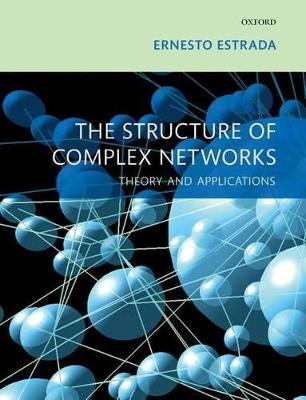
This book deals with the analysis of the structure of complex networks by combining results from graph theory, physics, and pattern recognition. The book is divided into two parts. 11 chapters are dedicated to the development of theoretical tools for the structural analysis of networks, and 7 chapters are illustrating, in a critical way, applications of these tools to real-world scenarios. The first chapters provide detailed coverage of adjacency and metric and
topological properties of networks, followed by chapters devoted to the analysis of individual fragments and fragment-based global invariants in complex networks. Chapters that analyse the concepts of communicability, centrality, bipartivity, expansibility and communities in networks follow. The second
part of this book is devoted to the analysis of genetic, protein residue, protein-protein interaction, intercellular, ecological and socio-economic networks, including important breakthroughs as well as examples of the misuse of structural concepts.
Contents:
1: Introduction
2: Adjacency Relationships in Networks
3: Metric and Topological Structure of Networks
4: Fragments (Subgraphs) in Complex Networks
5: Accounting for all parts (subgraphs)
6: Communicability Functions in Networks
7: Centrality Measures
8: Global Network Invariants
9: Expansion and Network Classes
10: Community Structure in Networks
11: Network Bipartivity
12: Random Models of Networks
13: Genetic Networks
14: Protein Residue Networks
15: Protein-protein Interaction Networks
16: The Structure of Reaction Networks
17: Intercellular Networks
18: Networks in Ecology
19: Socio-Economic Networks
20: Conclusions
PRODUCT DETAILS
Publisher: Oxford University Press
Publication date: June, 2016
Pages: 480
Dimensions: 189.00 x 247.00 x 25.00
Weight: 874g
Availability: Available
Subcategories: Biochemistry