
(To see other currencies, click on price)
MORE ABOUT THIS BOOK
Main description:
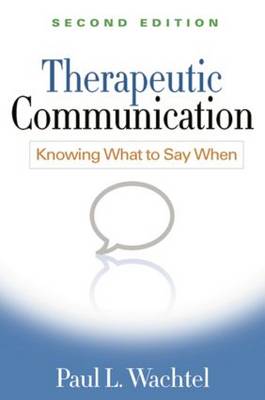
A uniquely practical guide and widely adopted text, this book shows precisely what therapists can say at key moments to enhance the process of healing and change. Paul Wachtel explains why some communications in therapy are particularly effective, while others that address essentially the same content may actually be countertherapeutic. He offers clear and specific guidelines for how to ask questions and make comments in ways that facilitate collaborative exploration and promote change. Illustrated with vivid case examples, the book is grounded in an integrative theory that draws from features of psychodynamic, cognitive-behavioral, systemic, and experiential approaches.
New to This Edition
* Reflects nearly 20 years of advances in the field and refinements of the author's approach.
*Broader audience: in addition to psychodynamic therapists, cognitive-behavioral therapists and others will find specific, user-friendly recommendations.
*Chapter on key developments and convergences across different psychotherapeutic approaches.
*Chapter on the therapeutic implications of attachment theory and research.
See also Wachtel's Relational Theory and the Practice of Psychotherapy, which explores a new direction in psychoanalytic thought that can expand and deepen clinical practice.
Contents:
Introduction
1. Rethinking the Talking Cure: The Therapist Speaks Too
I. Theoretical and Empirical Foundations
2. The Continuing Evolution of Psychotherapy: New and Converging Developments in Psychoanalytic, Cognitive-Behavioral, Systemic, and Experiential Approaches
3. Attending to Attachment: Accelerating Interest in the Therapeutic Implications of Attachment Theory and Research
4. Cyclical Psychodynamics I: Vicious and Virtuous Circles
5. Cyclical Psychodynamics II: Anxiety, Exposure, and Interpretation
6. Cyclical Psychodynamics III: Insight, the Therapeutic Relationship, and the World Outside
II. Clinical Applications and Guidelines
7. Accusatory and Facilitative Comments: Criticism and Permission in the Therapeutic Dialogue
8. Exploration, Not Interrogation
9. Building on the Patient's Strengths
10. Affirmation and Change
11. Attribution and Suggestion
12. Reframing, Relabeling, and Paradox
13. Therapist Self-Disclosure: Prospects and Pitfalls
14. Achieving Resolution of the Patient's Difficulties: Resistance, Working Through, and Following Through
III. Postscript
15. Therapeutic Communication with Couples, Ellen F. Wachtel
PRODUCT DETAILS
Publisher: Taylor & Francis (Guilford Press)
Publication date: December, 2013
Pages: 398
Weight: 588g
Availability: Available
Subcategories: Psychotherapy