
(To see other currencies, click on price)
MORE ABOUT THIS BOOK
Main description:
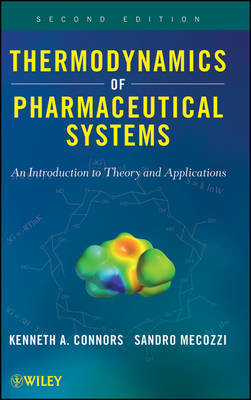
An introductory text that covers the fundementals of thermodynamics as it applies to pharmaceutical science, the new edition explores topics such as drug discovery and drug delivery, supramolecular chemistry, molecular recognition, and nanotecnologies in greater depth. This book introduces students of pharmacy to the profound thermodynamic applications in the laboratory while also serving as a handy resource for practicing researchers.
Contents:
PREFACE. PREFACE TO THE FIRST EDITION. 0. Review of Mathematics. 0.1. Introduction. 0.2. Dimensions and Units. 0.3. Logarithms and Exponents. 0.4. Algebraic and Graphical Analysis. 0.5. Dealing with Change. 0.6. Statistical Treatment of Data. Problems. I BASIC THERMODYNAMICS. 1. Energy and the First Law of Thermodynamics. 1.1. Fundamental Concepts. 1.2. The First Law of Thermodynamics. 1.3. The Enthalpy. Problems. 2. The Entropy Concept. 2.1. The Entropy Defined. 2.2. The Second Law of Thermodynamics. 2.3. Applications of the Entropy Concept. Problems. 3. The Free Energy. 3.1. Properties of the Free Energy. 3.2. The Chemical Potential. Problems. 4. Equilibrium. 4.1. Conditions for Equilibrium. 4.2. Physical Processes. 4.3. Chemical Equilibrium. Problems. II THERMODYNAMICS OF PHYSICAL PROCESSES. 5. Introduction to Physical Processes. 5.1. Scope. 5.2. Concentration Scales. 5.3. Standard States. Problems. 6. Phase Transformations. 6.1. Pure Substances. 6.2. Multicomponent Systems. Problems. 7. Solutions of Nonelectrolytes. 7.1. Ideal Solutions. 7.2. Nonideal Solutions. 7.3. Partitioning Between Liquid Phases. Problems. 8. Solutions of Electrolytes. 8.1. Coulombic Interaction and Ionic Dissociation. 8.2. Mean Ionic Activity and Activity Coefficient. 8.3. The Debye-Huckel Theory. Problems. 9. Colligative Properties. 9.1. Boiling Point Elevation. 9.2. Freezing Point Depression. 9.3. Osmotic Pressure. 9.4. Isotonicity Calculations. Problems. 10. Solubility. 10.1. Solubility as an Equilibrium Constant. 10.2. The Ideal Solubility. 10.3. Temperature Dependence of the Solubility. 10.4. Solubility of Slightly Soluble Salts. 10.5. Solubilities of Nonelectrolytes: Further Issues. Problems. 11. Surfaces and Interfaces. 11.1. Thermodynamic Properties. 11.2. Adsorption. Problems. III THERMODYNAMICS OF CHEMICAL PROCESSES. 12. Acid-Base Equilibria. 12.1. Acid-Base Theory. 12.2. pH Dependence of Acid-Base Equilibria. 12.3. Calculation of Solution pH. 12.4. Acid-Base Titrations. 12.5. Aqueous Solubility of Weak Acids and Bases. 12.6. Nonaqueous Acid-Base Behavior. 12.7. Acid-Base Structure and Strength. Problems. 13. Electrical Work. 13.1. Introduction. 13.2. Oxidation-Reduction Reactions. 13.3. Electrochemical Cells. 13.4. pH Measurement. 13.5. Ion-Selective Membrane Electrodes. Problems. 14. Noncovalent Binding Equilibria. 14.1. Introduction. 14.2. The Noncovalent Interactions. 14.3. Binding Models. 14.4. Measurement of Binding Constants. 14.5. Applications. Problems. APPENDIXES. Appendix A Physical Constants. Appendix B Kinetic Theory of Gases. Appendix C Extrathermodynamic Relationships. ANSWERS TO PROBLEMS. BIBLIOGRAPHY. INDEX.
PRODUCT DETAILS
Publisher: John Wiley & Sons Ltd (John Wiley & Sons Inc)
Publication date: January, 2010
Pages: 364
Dimensions: 165.00 x 234.00 x 22.00
Weight: 636g
Availability: Available
Subcategories: Diseases and Disorders, Pharmacology