
(To see other currencies, click on price)
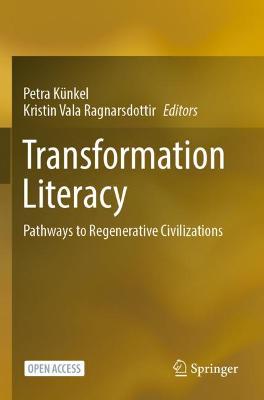
MORE ABOUT THIS BOOK
Main description:
This open access book brings science and practice together and inspires a global movement towards co-creating regenerative civilizations that work for 100% of humanity and the Earth as a whole. With its conceptual foundation of the concept of transformation literacy it enhances the knowledge and capacity of decision-makers, change agents and institutional actors to steward transformations effectively across institutions, societal sectors and nations.
Humanity is at crossroads. Resource depletion and exponential emissions that not only cause climate change, but endanger the health of people and planet, call for a decisive turnaround of human civilization. A new and transformative paradigm is emerging that advocates for regenerative civilizations, in which a narrative of systemic health as much as individual and collective vitality guide the interaction of socio-economic-ecological systems. Truly transformative change must go far beyond technical solutions, and instead envision what can be termed 'a new operating system' that helps humankind to live well within the planetary boundaries and partner with life's evolutionary processes. This requires transformations at three different levels:
* Mindsets that reconnect with a worldview in which human agency acknowledges its co-evolutionary pathways with each other and the Earth.
* Political, social and economic systems that are regenerative and foster the care-taking for Earth life support systems.
* Competencies to design and implement effective large-scale transformative change processes at multiple levels with multiple stakeholders.
This book provides key ingredients for enhancing transformation literacy from various perspectives around the globe. It connects the emerging practice of stewarding transformative change across business, government institutions and civil society actors with the most promising scientific models and concepts that underpin human action to shape the future collectively in accordance with planetary needs.
Contents:
Introduction and conceptual framing - transformation literacy as a future-making skill
Mindsets in service of wellbeing on a healthy planet
Setting the scene: How to connect with a world as an interconnected whole
The same tone, but a new sound - understanding the story of the soul as pathway to regenerative civilizations
Possible futures
Transformative literacy as the ability to look forward from within
Chinese cultural treasures as contributions to a mindset of interconnectedness for global transformations
The systems aliveness approach - from navigating emergency to stewarding wellbeing on a healthy planet
Systems that enable and safeguard wellbeing on a healthy planet
Setting the scene: Viewing the world as interconnected systems
Everything is connected - envisioning how a regenerative world looks like
Managing forestry in a sustainable manner, the importance of systems analysis
Sustainable community transformation process
The role of capacity-building in Sumba, Indonesia
Towards transformation to a wellbeing economy in an African country: A case study from Namibia
A not-for-profit economy for a regenerative sustainable world
Politics, systems thinking and building the wellbeing economy: The example of Wales
Processes for stewarding transformations towards wellbeing and a healthy planet
Setting the scene: How to enhance the knowledge and practice of transformation literacy
Turning mindshifts into transformation leadership
Models of Change: Strategies to make the socio-ecological transformation a success
Red Snow - when the Climate Bleeds: A Nordic art and science project
Collaborative transformations: Circular economy strategies in Europe
Small scale and large scale - why networks are the cornerstone of transformations
Collective stewardship towards economies in service to life
Memories of our collective future
PRODUCT DETAILS
Publisher: Springer (Springer Nature Switzerland AG)
Publication date: March, 2022
Pages: None
Weight: 682g
Availability: Available
Subcategories: General Issues, Public Health