
(To see other currencies, click on price)
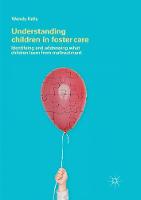
MORE ABOUT THIS BOOK
Main description:
This book introduces the Relational Learning Framework (RLF), an assessment tool which helps foster care practitioners, social workers and foster carers to examine what foster children have learned in their early life about relationships and particularly through maltreatment. Grounded in attachment theory and drawing on cognitive theory this book will help practitioners to understand and respond to the challenging behaviour presented by these children and remove barriers to an empathic response.
Early chapters provide context in a theoretical discourse on the causes and consequences of psychological and attachment difficulties for children in care, including a discussion of maltreatment and foster care. The theoretical basis of the technique will be outlined and subsequent chapters will explain how to undertake RLF including the wide-ranging practice evidence, a worked example, common themes and trouble shooting.
This will be an invaluable source for clinical practitioners, social workers, foster care practitioners and foster parents who want to make sense of the complex information about children in foster care to improve their relationships. It will also provide insight into foster children's mental health and behaviour for academics and postgraduate students in related disciplines.
Contents:
Chapter 1. Introduction.- Chapter 2. The effects of early maltreatment.- Chapter 3. Maltreatment, foster care and mental health.- Chapter 4. Attachment.- Chapter 5. Relational Learning Framework.- Chapter 6. Common themes.- Chapter 7. Workbook for working through an RLF.- Chapter 8. Clinical tools.- Chapter 9. Conclusion.
PRODUCT DETAILS
Publisher: Springer (Springer International Publishing AG)
Publication date: August, 2018
Pages: 232
Weight: 454g
Availability: Available
Subcategories: Psychotherapy