
(To see other currencies, click on price)
MORE ABOUT THIS BOOK
Main description:
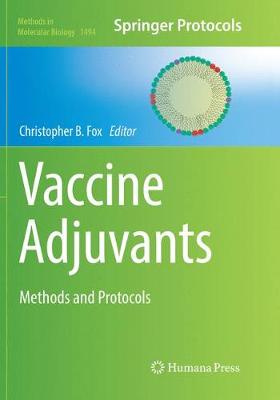
This collection seeks to elucidate the practical methods necessary for successful adjuvant development, with a particular focus on the synthesis, formulation, manufacturing, and characterization aspects involved. Beginning with an overview and a case study, the book then delves into in silico design, chemical synthesis, biosynthesis, and/or purification from natural raw materials of specific adjuvant molecules, adjuvant formulation approaches, the analytical characterization of adjuvant formulations and adjuvant-containing vaccines, as well as the biological characterization of vaccine adjuvant activity, including in vitro and in vivo approaches, to measure innate and adaptive immune responses. Written in the highly successful Methods in Molecular Biology format, chapters include introductions to their respective topics, lists of the necessary materials and reagents, step-by-step, readily reproducible laboratory protocols, and tips on troubleshooting and avoiding known pitfalls.
Practical and authoritative, Vaccine Adjuvants: Methods and Protocols aims to facilitate vaccine adjuvant product development efforts, making them more accessible, manufacturable, and better characterized.
Contents:
1. Overview of Vaccine Adjuvants: Introduction, History, and Current Status
Ruchi R. Shah, Kimberly J. Hassett, and Luis A. Brito
2. Development of the CpG Adjuvant 1018: A Case Study
John D. Campbell
3. Syntheses of Human TLR8-Specific Small-Molecule Agonists
Mallesh Beesu, Hari Prasad Kokatla, and Sunil A. David
4. Semisynthesis of Analogues of the Saponin Immunoadjuvant QS-21
Alberto Fernandez-Tejada, William E. Walkowicz, Derek S. Tan, and David Y. Gin
5. QS-21 Adjuvant: Laboratory-Scale Purification Method and Formulation into Liposomes
Livia Brunner, Christophe Barnier-Quer, and Nicolas Collin
6. Purification of an Immunoadjuvant Saponin Fraction from Quillaja brasiliensis Leaves by Reverse-Phase Silica Gel Chromatography
Anna C.A. Yendo, Fernanda de Costa, Carla Kauffmann, Juliane D. Fleck, Grace Gosmann, and Arthur G. Fett-Neto
7. Biosynthetic Approaches to Squalene Production: The Case of Yeast
Martin Valachovic and Ivan Hapala
8. In Silico Adjuvant Design and Validation
Matthew N. Davies, Helene Pere, Iris Bosschem, Freddy Haesebrouck, Bram Flahou, Eric Tartour, Darren R. Flower, David F. Tough, and Jagadeesh Bayry
9. Yvonne Perrie, Elisabeth Kastner, Swapnil Khadke, Carla B. Roces, and Peter Stone 10. Synthesis of Lymph Node-Targeting Adjuvants Melissa C. Hanson and Darrell J. Irvine 11. Preparing an Adjuvanted Thermoresponsive Gel Formulation for Sublingual Vaccination Manjari Lal, Jessica White, and Changcheng Zhu 12. Manufacture of Oil-in-Water Emulsion Adjuvants Jean Haensler 13. Methods to Prepare Aluminum Salt-Adjuvanted Vaccines Sachin G. Thakkar and Zhengrong Cui 14. Production of Adjuvant-Loaded Biodegradable Particles for Use in Cancer Vaccines Cristina Maria de Barros, Emad Ibrahim Wafa, Khanidtha Chitphet, Kawther Ahmed, Sean M Geary, and Aliasger K. Salem 15. Lyophilization of Adjuvanted Vaccines: Methods for Formulation of a Thermostable Freeze Dried Product Michelle Y. Chan, Timothy S. Dutill, and Ryan M. Kramer 16. Stressed Stability Techniques for Adjuvant Formulations Manvi Hasija, Anthony Sheung, Nausheen Rahman, and Salvador F. Ausar 17. Particle Sizing of Nanoparticle Adjuvant Formulations by Dynamic Light Scattering (DLS) and Nanoparticle Tracking Analysis (NTA) Michelle Y. Chan, Quinton M. Dowling, Sandra J. Sivananthan, and Ryan M. Kramer 18. Quantification of Multiple Components of Complex Aluminum-Based Adjuvant Mixtures by Using Fourier Transform Infrared Spectroscopy and Partial Least Squares Modeling Quinton M. Dowling and Ryan M. Kramer 19. Determination of Protein Content in Alhydrogela-Based Vaccines by O-Phthalaldehyde Assay Kelly M. Rausch and Daming Zhu 20. Staining and Transfer Techniques for SDS-PAGE Gels to Minimize Oil-in-Water Emulsion Adjuvant Interference Alicia M. Schwartz, Michelle Y. Chan, Dawn M. Fedor, Sandra J. Sivananthan, and Ryan M. Kramer 21. Interactions Between Antigens and Nanoemulsion Adjuvants: Separation and Characterization Techniques Michelle Y. Chan, Dawn M. Fedor, Tony Phan, Lucien Barnes V, and Ryan M. Kramer 22. Screening Vaccine Formulations in Fresh Human Whole Blood Jalil Hakimi, Sepideh Aboutorabian, Frederick To, Salvador F. Ausar, Nausheen Rahman, and Roger H. Brookes 23. Analysis of the Innate Response to Adjuvants: Characterization of the Draining Lymph Node by Fluorescence-Activated Cell Sorting Anthony L. Desbien 24. Assessment of Antigen-Specific Cellular Immunogenicity Using Intracellular Cytokine Staining, ELISpot, and Culture Supernatants Elyse A. Beebe and Mark T. Orr 25. Eliciting Epitope-Specific CD8 T Cell Response by Immunization with Microbial Protein Antigens Formulated with -Galactosylceramide: Theory, Practice, and Protocols Pavlo Gilchuk, Frances C. Knight, John T. Wilson, and Sebastian Joyce 26. Molecular Methods and Bioinformatic Tools for Adjuvant Characterization by High-Throughput Sequencing Steven R. Wiley and Vanitha S. Raman
PRODUCT DETAILS
Publisher: Springer (Humana Press Inc.)
Publication date: July, 2018
Pages: 372
Weight: 7192g
Availability: Available
Subcategories: Immunology