
(To see other currencies, click on price)
MORE ABOUT THIS BOOK
Main description:
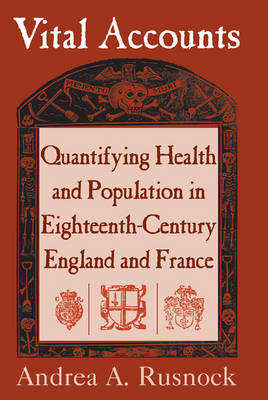
Why did Europeans begin to count births and deaths? How did they collect the numbers and what did they do with them? Through a compelling comparative analysis, Vital Accounts charts the work of the physicians, clergymen and government officials who crafted the sciences of political and medical arithmetic in England and France during the long eighteenth-century, before the emergence of statistics and regular government censuses. Andrea A. Rusnock presents a social history of quantification that highlights the development of numerical tables, influential and enduring scientific instruments designed to evaluate smallpox inoculation, to link weather and disease to compare infant and maternal mortality rates, to identify changes in disease patterns and to challenge prevailing views about the decline of European population. By focusing on the most important eighteenth century controversies over health and population, Rusnock shows how vital accounts - the numbers of births and deaths - became the measure of public health and welfare.
Contents:
Introduction; 1. A new science: political arithmetic; Part I. Smallpox Inoculation and Medical Arithmetic: 2. A measure of safety: English debates over inoculation in the 1720s; 3. The limits of calculation: French debates over inoculation in the 1760s; 4. Charitable calculations: English debates over the inoculation of the urban poor, 1750-1800; Part II. Medical Arithmetic and Environmental Medicine: 5. Medical meteorology: accounting for the weather and disease; 6. Interrogating death: disease, mortality and environment; Part III. Political Arithmetic: 7. Count, measure, compare: the depopulation debates; Conclusion; Bibliography; Index.
PRODUCT DETAILS
Publisher: Cambridge University Press
Publication date: February, 2009
Pages: 272
Dimensions: 152.00 x 229.00 x 15.00
Weight: 400g
Availability: Available
Subcategories: Epidemiology, General Issues