
(To see other currencies, click on price)
MORE ABOUT THIS BOOK
Main description:
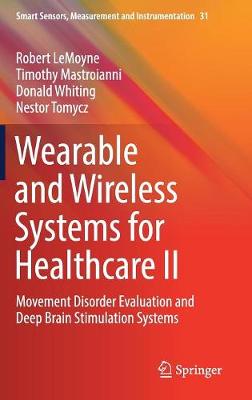
This book provides a far-sighted perspective on the role of wearable and wireless systems for movement disorder evaluation, such as Parkinson's disease and Essential tremor. These observations are brought together in the application of quantified feedback for deep brain stimulation systems using the wireless accelerometer and gyroscope of a smartphone to determine tuning efficacy. The perspective of the book ranges from the pioneering application of these devices, such as the smartphone, for quantifying Parkinson's disease and Essential tremor characteristics, to the current state of the art. Dr. LeMoyne has published multiple first-of-their-kind applications using smartphones to quantify movement disorder, with associated extrapolation to portable media devices.
Contents:
Chapter 1: Wearable and wireless systems for movement disorder evaluation and deep brain stimulation systems
1.1 Introduction
1.2 Perspectives of the chapters
1.2.1 Perspective of Chapter 2:
Movement disorders: Parkinson's disease and Essential tremor, a general perspective
1.2.2 Perspective of Chapter 3:
Traditional ordinal strategies for establishing the severity and status of movement disorders, such as Parkinson's disease and Essential tremor
1.2.3 Perspective of Chapter 4:
Deep brain stimulation for the treatment of movement disorder regarding Parkinson's disease and Essential tremor with device characterization
1.2.4 Perspective of Chapter 5:
Surgical procedure for deep brain stimulation implantation and operative phase with post-operative risks
1.2.5 Perspective of Chapter 6:
Preliminary wearable and locally wireless systems for quantification of Parkinson's disease tremor and Essential tremor characteristics
1.2.6 Perspective of Chapter 7:
Wearable and wireless systems with Internet connectivity for quantification of Parkinson's disease tremor and Essential tremor characteristics
1.2.7 Perspective of Chapter 8:
Role of machine learning for classification of movement disorder and deep brain stimulation status
1.2.8 Perspective of Chapter 9:
Assessment of machine learning classification strategies for the differentiation of deep brain stimulation 'On' and 'Off' status for Parkinson's disease
1.2.9 Perspective of Chapter 10:
New perspectives for Network Centric Therapy for the treatment of Parkinson's disease and Essential tremor
1.3 Conclusion
References
Chapter 2: Movement disorders: Parkinson's disease and Essential tremor, a general perspective
2.1 Introduction
2.2 Parkinson's disease
2.3 Essential tremor
2.4 Traditional strategies for assessing progression and treatment of Parkinson's disease and Essential tremor
2.5 Advanced strategies for assessing progression and treatment of Parkinson's disease and Essential tremor
2.6 Extrapolation to Network Centric Therapy
2.7 Conclusion
References
Chapter 3: Traditional ordinal strategies for establishing the severity and status of movement disorders, such as Parkinson's disease and Essential tremor
3.1 Introduction
3.2 Clinical assessment of Parkinson's disease
3.3 Clinical assessment of Essential tremor
3.4 Wearable and wireless systems for the quantification of movement disorder tremor
3.5 Extrapolation to Network Centric Therapy
3.6 Conclusion
References
Chapter 4: Deep brain stimulation for the treatment of movement disorder regarding Parkinson's disease and Essential tremor with device characterization
4.1 Introduction
4.2 The foundations of deep brain stimulation
4.3 Long term efficacy and the quest to define the mechanisms of deep brain stimulation
4.4 Benefit and risk consideration of deep brain stimulation
4.5 Target selection for deep brain stimulation
4.5.1 Essential tremor
4.5.2 Parkinson's disease
4.6 Deep brain stimulation system device description
4.6.1 Electrode leads and the implantable pulse generator
4.6.2 Battery
4.6.3 Electrical signal
4.7 Deep brain stimulation system programmer
4.8 Attaining the optimal parameter configuration for deep brain stimulation an issue with tuning
4.9 Future perspectives for deep brain stimulation
4.10 Conclusion
References
Chapter 5: Surgical procedure for deep brain stimulation implantation and operative phase with post-operative risks
5.1 Introduction
5.2 General surgical perspective and considerations for the application of deep brain stimulation
5.3 Deep brain stimulation operative risks and complications
5.4 Post-operative risk regarding energy interaction
5.5 Adverse neurological and neuropsychological effects for deep brain stimulation
5.6 Operative technique advocated by Allegheny General Hospital
5.7 Applied deep brain stimulation programming from by Allegheny General Hospital
5.8 Conclusion
References
Chapter 6: Preliminary wearable and locally wireless systems for quantification of Parkinson's disease and Essential tremor characteristics
6.1 Introduction
6.2 Preliminary applications for accelerometers quantifying Parkinson's disease
6.3 Wireless accelerometer feedback for optimal tuning of deep brain stimulation parameter settings, a conceptual perspective
6.4 Preliminary demonstration of wearable and wireless accelerometer systems for quantifying Parkinson's disease tremor
6.5 Evolution of wearable and wireless systems, from local wireless connectivity to Internet connectivity
6.6 Conclusion
References
Chapter 7: Wearable and wireless systems with Internet connectivity for quantification of Parkinson's disease and Essential tremor characteristics
7.1 Introduction
7.2 Smartphone for quantifying Parkinson's disease hand tremor
7.3 Smartphone for quantification of Essential tremor regarding deep brain stimulation in 'On' and 'Off' mode
7.4 Smartwatches, Bluetooth wireless connectivity, and other wearable and wireless systems for the quantification of movement disorder status
7.5 Network Centric Therapy
7.6 Conclusion
References
Chapter 8: Role of machine learning for classification of movement disorder and deep brain stimulation status
8.1 Introduction
8.2 Waikato Environment for Knowledge Analysis (WEKA) for machine learning classification of movement disorder ameliorated through deep brain stimulation using wearable and wireless systems for quantified feedback
8.2.1 J48 decision tree
8.2.2 K-nearest neighbors
8.2.3 Logistic regression
8.2.4 Support vector machine
8.2.5 Multilayer perceptron neural network
8.2.6 Random forest
8.2.7 Attribute-Relation File Format (ARFF)
8.3 The role of machine learning for Network Centric Therapy
8.4 Conclusion
References
Chapter 9: Assessment of machine learning classification strategies for the differentiation of deep brain stimulation 'On' and 'Off' status for Parkinson's disease
9.1 Introduction
9.2 Background
9.3 Method and materials
9.4 Results and discussion
9.5 Network Centric Therapy integrating wearable and wireless systems as quantified feedback for deep brain stimulation using machine learning classification
9.6 Conclusion
References
Chapter 10: New perspectives for Network Centric Therapy for the treatment of Parkinson's disease and Essential tremor
PRODUCT DETAILS
Publisher: Springer (Springer Verlag, Singapore)
Publication date: March, 2019
Pages: 128
Weight: 454g
Availability: Available
Subcategories: Biomedical Engineering, Neurology, Physiology