
(To see other currencies, click on price)
MORE ABOUT THIS BOOK
Main description:
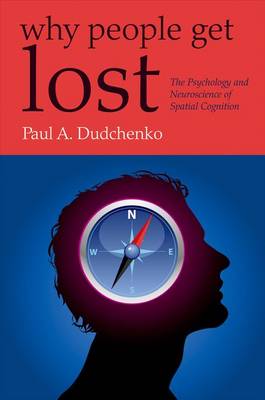
At some point in our lives, most of us have been lost. How does this happen? What are the limits of our ability to find our way? Do we have an innate sense of direction?
'How people get lost' reviews the psychology and neuroscience of navigation. It starts with a history of studies looking at how organisms solve mazes. It then reviews contemporary studies of spatial cognition, and the wayfinding abilities of adults and children. It then considers how specific parts of the brain provide a cognitive map and a neural compass. This book also considers the neurology of spatial disorientation, and the tendency of patients with Alzheimer's disease to lose their
way.
Within the book, the author proposes that we get lost because our brain's compass becomes misoriented.
This book is written for anyone with an interest in navigation and the brain. It assumes no specialised knowledge of neuroscience, but covers recent advances in our understanding of how the brain represents space.
Contents:
Preface ; Acknowledgements ; Dedication ; 1. On being lost ; 2. A history of "maze" psychology ; 3. Contemporary studies of spatial cognition ; 4. Human navigation ; 5. Spatial cognition in children ; 6. The hippocampus as a cognitive map ; 7. Place cells and brain imaging ; 8. The neural basis for a sense of direction: head direction neurons ; 9. Alzheimer's disease, the parietal lobe, and topographical disorientation ; 10. Why we get lost
PRODUCT DETAILS
Publisher: Oxford University Press
Publication date: July, 2010
Pages: 314
Dimensions: 163.00 x 241.00 x 24.00
Weight: 648g
Availability: Available
Subcategories: Neuroscience