
(To see other currencies, click on price)
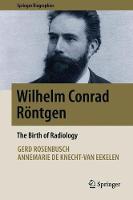
MORE ABOUT THIS BOOK
Main description:
This book, which will appeal to all with an interest in the history of radiology and physics, casts new light on the life and career of Wilhelm Conrad Roentgen, showing how his personality was shaped by his youth in the Netherlands and his teachers in Switzerland. Beyond this, it explores the technical developments relevant to the birth of radiology in the late nineteenth century and examines the impact of the discovery of X-rays on a broad range of scientific research. Roentgen (1845-1923) was born in Lennep, Germany, but emigrated with his family to the Netherlands in 1848. As a 17-year-old he moved to Utrecht, entering the Technical School and living at the home of Dr. Jan Willem Gunning. In this well-educated family he was stimulated to continue his studies at university. In 1868 he received a diploma from the Federal Polytechnic School in Zurich and just a year later completed a PhD in physics. He followed his mentor, August Kundt, to the universities of Wurzburg (1870) and Strasburg (1872) and married Anna Ludwig in 1872. In 1879 Roentgen gained his first professorship at a German University, in Giessen, followed by a chair in Wurzburg in 1888. Here he discovered X-rays in 1895, for which he received the first Nobel Prize in physics in 1901. From 1900 until his retirement in 1921 he occupied the chair of physics at the Munich University.
Contents:
Lennep 1845 Youth in Apeldoorn
Education in the Netherlands
J.W. Gunning, Roentgen's mentor
Study in Switzerland
Personal life
Career in Germany
Developments in Physics
Discovery of the X-rays
Professor in Munchen
X-rays - Vista of another world
PRODUCT DETAILS
Publisher: Springer (Springer International Publishing AG)
Publication date: April, 2019
Pages: 203
Weight: 585g
Availability: Available
Subcategories: General Issues, Radiology