
(To see other currencies, click on price)
MORE ABOUT THIS BOOK
Main description:
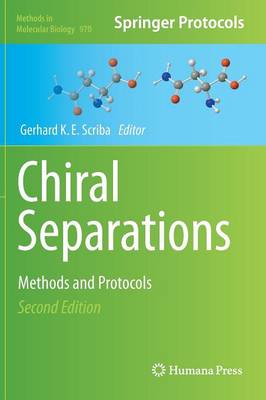
There is a demand for analytical methods that are able to discriminate between enantiomers in order to analyze the enantiomeric purity of compounds from natural or chemical sources not only in pharmaceutical sciences but in any field on bioactive compounds including chemistry, biology, biochemistry, forensic, and environmental sciences and many others. The second edition of Chiral Separations: Methods and Protocols, expands upon the previous edition with current methodology, providing an overview and especially practically oriented applications of the most important analytical techniques in chiral separation sciences. New chapters on analytical separation sciences by chromatographic and electrophoretic techniques have been added as has simulated moving bed chromatography as a preparative method. Written in the highly successful Methods in Molecular Biology™ series format, the chapters include introductions to their respective topics, lists of the necessary materials and reagents, step-by-step, readily reproducible laboratory protocols, and tips on troubleshooting and avoiding known pitfalls.
Authoritative and cutting-edge, Chiral Separations: Methods and Protocols, Second Edition is helpful for analytical chemists working on stereochemical problems in fields or pharmacy, chemistry, biochemistry, food chemistry, molecular biology, forensics, environmental sciences or cosmetics in academia, government or industry.
Feature:
Focuses on analytical seperation sciences by chromatographic and electrophoretic techniques
Provides step-by-step detail essential for reproducible results
Contains key notes and implementation advice from the experts
Back cover:
There is a demand for analytical methods that are able to discriminate between enantiomers in order to analyze the enantiomeric purity of compounds from natural or chemical sources not only in pharmaceutical sciences but in any field on bioactive compounds including chemistry, biology, biochemistry, forensic, and environmental sciences and many others. The second edition of Chiral Separations: Methods and Protocols, expands upon the previous edition with current methodology, providing an overview and especially practically oriented applications of the most important analytical techniques in chiral separation sciences. New chapters on analytical separation sciences by chromatographic and electrophoretic techniques have been added as has simulated moving bed chromatography as a preparative method. Written in the highly successful Methods in Molecular Biology™ series format, the chapters include introductions to their respective topics, lists of the necessary materials and reagents, step-by-step, readily reproducible laboratory protocols, and tips on troubleshooting and avoiding known pitfalls.
Authoritative and cutting-edge, Chiral Separations: Methods and Protocols, Second Edition is helpful for analytical chemists working on stereochemical problems in fields or pharmacy, chemistry, biochemistry, food chemistry, molecular biology, forensics, environmental sciences or cosmetics in academia, government or industry.
Contents:
1. Chiral Recognition in Separation Science – An Overview
Gerhard K. E. Scriba
2. Enantioseparations by Thin-Layer Chromatography
Massimo Del Bubba, Leonardo Checchini, Alessandra Cincinelli and Luciano Lepri
3. Gas Chromatographic Enantioseparation of Unfunctionalized Chiral Hydrocarbons - An Overview
Volker Schurig, Diana Kreidler
4. HPLC-Enantioseparation on Cyclodextrin-based Chiral Stationary Phases
Yong Wang and Siu Choon Ng
5. Enantioseparations by High Performance Liquid Chromatography Using Polysaccharide-Based Chiral Stationary Phases – An Overview
Bezhan Chankvetadze
6. Common Screening Approaches for Efficient Analytical Method Development in LC and SFC on Columns Packed with Immobilized Polysaccharide-derived Chiral Stationary Phases
Pilar Franco and Tong Zhang
7. Chiral Separations by HPLC on Immobilized Polysaccharide Chiral Stationary Phases
Imran Ali, Zeid A. AL-Othman, and Hassan Y. Aboul-Enein
8. Enantioseparations by High-Performance Liquid Chromatography Using Macrocyclic Glycopeptide-Based Chiral Stationary Phases – An Overview
István Ilisz, Anita Aranyi, Zoltán Pataj, Antal Péter
9. Enantioseparations of Primary Amino Compounds by High Performance Liquid Chromatography Using Chiral Crown Ether-Based Chiral Stationary Phase
Myung Ho Hyun
10. Screening of Pirkle-type Chiral Stationary Phases for HPLC Enantioseparations
Gregory K. Webster and Ted J. Szczerba
11. Enantioseparations by High Performance Liquid Chromatography Based on Chiral Ligand Exchange
Benedetto Natalini, Roccaldo Sardella, Federica Ianni
12. Enantioseparations by High Performance Liquid Chromatography Using Molecularly Imprinted Polymers
David A. Spivak
13. Chiral Mobile Phase Additives in HPLC Enantioseparations
Shengjia Wang, Lushan Yu, Su Zeng
14. Chiral Benzofurazan-Derived Derivatization Reagents for Indirect Enantioseparations by HPLC
Toshimasa Toyo'oka
15. Separation of Racemic 1-(9-anthryl)-2,2,2-trifluoroethanol by Sub-/supercritical Fluid Chromatography
Xiqin Yang, Leo Hsu and Gerald Terfloth
16. Chiral Separations by Simulated Moving Bed Method Using Polysaccharide-Based Chiral Stationary Phases
Toshiharu Minoda
17. Enantioseparations by Capillary Electrophoresis Using Cyclodextrins as Chiral Selectors
Gerhard K. E. Scriba and Pavel Jáč
18. Application of Dual Cyclodextrin-Systems in Capillary Electrophoresis Enantioseparations
Anne-Catherine Servais and Marianne Fillet
19. Enantioseparations in Nonaqueous Capillary Electrophoresis Using Charged Cyclodextrins
Anne-Catherine Servais and Marianne Fillet
20. Use of Macrocyclic Antibiotics as the Chiral Selectors in Capillary Electrophoresis
Chengke Li, Jingwu Kang
21. Application of Polymeric Surfactants in Chiral Micellar Electrokinetic Chromatography (CMEKC) and CMEKC Coupled to Mass Spectrometry
Jun He and Shahab A. Shamsi
22. Cyclodextrin-modified Micellar Electrokinetic Chromatography for Enantioseparations
Wan Aini Wan Ibrahim, Dadan Hermawan and Mohd Marsin Sanagi
23. Cyclodextrin-mediated Enantioseparation in Microemulsion Electrokinetic Chromatography
Claudia Borst and Ulrike Holzgrabe
24. Chiral Separations by Capillary Electrophoresis Using Proteins as Chiral Selectors
Jun Haginaka
25. Enantioseparation by Chiral Ligand-Exchange Capillary Electrophoresis
Yi Chen, Lijuan Song
26. Experimental Design Methodologies in the Optimization of Chiral CE or CEC Separations – An Overview
Bieke Dejaegher, Debby Mangelings, and Yvan Vander Heyden
27. Chiral Capillary Electrophoresis-Mass Spectrometry
Elena Domínguez-Vega, Antonio L. Crego, Maria Luisa Marina
28. Application of Chiral Ligand-Exchange Stationary Phases in Capillary Electrochromatography
Martin G. Schmid
29. Polysaccharide-Derived Chiral Stationary Phases in Capillary Electrochromatography Enantioseparations
Zhenbin Zhang, Hanfa Zou and Junjie Ou
30. Open Tubular Molecular Imprinted Phases in Chiral Capillary Electrochromatography
Won Jo Cheong and Song Hee Yang
31. Enantioseparations in Capillary Electrochromatography Using Sulfated Poly b-Cyclodextrin Modified Silica-Based Monolith as Stationary Phase
Ruijuan Yuan and Guosheng Ding
32. Cyclodextrin-Mediated Enantioseparations by Capillary Electrochromatography
Dorothee Wistuba and Volker Schurig
PRODUCT DETAILS
Publisher: Springer (Humana Press)
Publication date: January, 2013
Pages: 480
Weight: 1220g
Availability: Not available (reason unspecified)
Subcategories: Biochemistry
From the same series





CUSTOMER REVIEWS
From the reviews of the second edition:
“The second edition of Chiral Separations: Methods and Protocols discusses almost every kind of chiral separation method, with the emphasis on fundamental research and experimental design. … it is a very useful book for scientists and students involved in the enantioseparation field, and scientists involved in R & D areas such as drug development and environmental monitoring can also benefit from this monograph. It is expected that this book will definitely promote research in chirality-related fields.” (Huwei Liu, Analytical and Bioanalytical Chemistry, Vol. 406, 2014)
“The book provides an overview and practically oriented applications of the most important analytical techniques in chiral separations. … the chapters include introductions, lists of necessary materials and reagents, step-by-step laboratory protocols, and troubleshooting tips. Pharmacists, biochemists, chemists, food chemists, molecular biologists, and forensic and environmental scientists will find this book extremely useful.” (Omer Iqbal, Doody’s Book Reviews, August, 2013)